Foreign influence in the Syrian military, chiefly Turkish and Russian, combined with the continued presence of extremist elements within its ranks, will constrain Damascus’s ability to take steps consistent with US interests. This could include steps to prevent the resurgence of the Islamic State, stopping Hezbollah from receiving weapons through Syrian territory that enable attacks on Israel, and building a cohesive national military that can maintain domestic unity and stability. The Syrian military’s current trajectory complicates each of those objectives.
The Syrian Army appointed Ömer Muhammed Çiftçi, a Turkish citizen and former member of Hayat Tahrir al Sham (HTS), the Islamist coalition that led the final offensive against Bashar al Assad, as commander of its 62nd Division on August 6. The appointment highlights the growing Turkish influence in Syria’s military and the consolidation of former HTS figures, some of whom retain ties to US- and UN-designated groups.
Around the same time, Russia, which maintained a military footprint in Syria during the Assad era at Hmeimim Air Base and Tartus naval base, signed an agreement with the new leadership in Damascus to transform the two facilities into combined Russian-Syrian training centers. Though the former rebels fought against Putin’s forces, many new Syrian military representatives have visited Russia since the fall of the Assad regime. While no major military transactions have been publicly announced, Syrian officials have noted that the country’s military institution remains heavily influenced by Moscow, and the government hopes to avoid damaging future relations.
Russian influence extends not only to doctrine, but to equipment, much of which is of Russian origin. Throughout the Cold War and into the 21st Century, Syria primarily imported arms from Russia, including during the country’s civil war. During that conflict, Russia delivered significant systems, including the high-altitude S-300 air defense platform, T-90S main battle tanks, and MiG-29 fighter aircraft.
Syria has demonstrated some ability to use its reconstituted security forces to advance US interests, but the potential for increased extremism continues to be a concern. Though Damascus hopes to improve relations with Washington, the Syrian government’s ties with Moscow and Ankara may undermine American interests and constrain how far Damascus will go in working with Washington.
To explore these dynamics, it is helpful to examine three trends: Syria’s military rebuilding amid persistent extremist ties, Turkey’s expanding influence over its new armed forces, and Russia’s efforts to preserve its military presence in Syria.
Syria’s military is rebuilding with high hopes
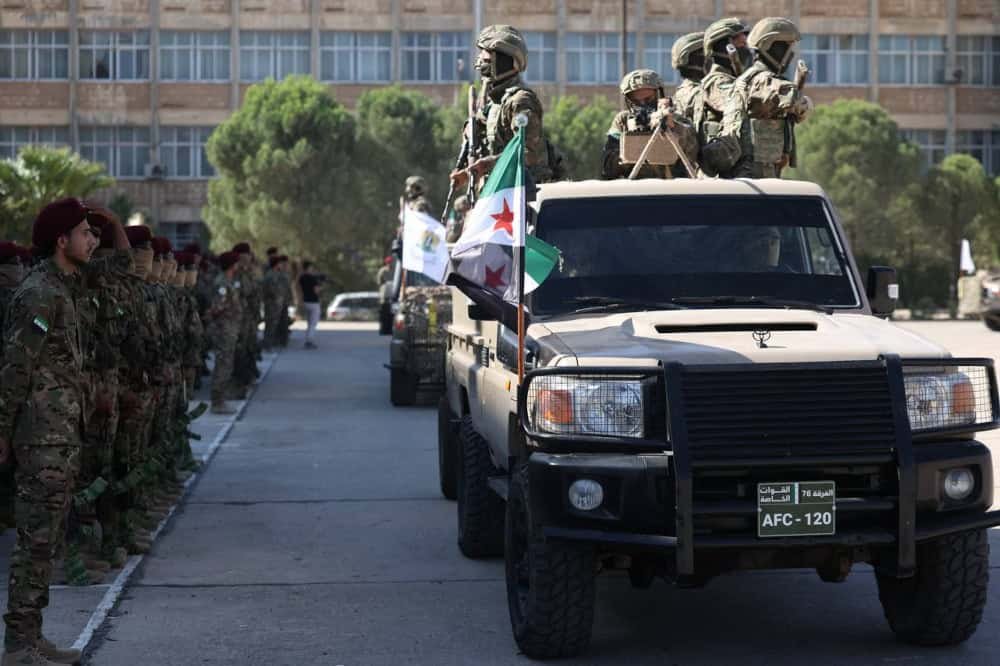
While still making use of older Soviet-era equipment, Syria’s military is rebuilding and rearming after the fall of former leader Bashar al Assad in December 2024. Additionally, the Israel Defense Forces targeted much of Syria’s advanced weapons following Assad’s overthrow, leaving the country with a less-sophisticated arsenal.
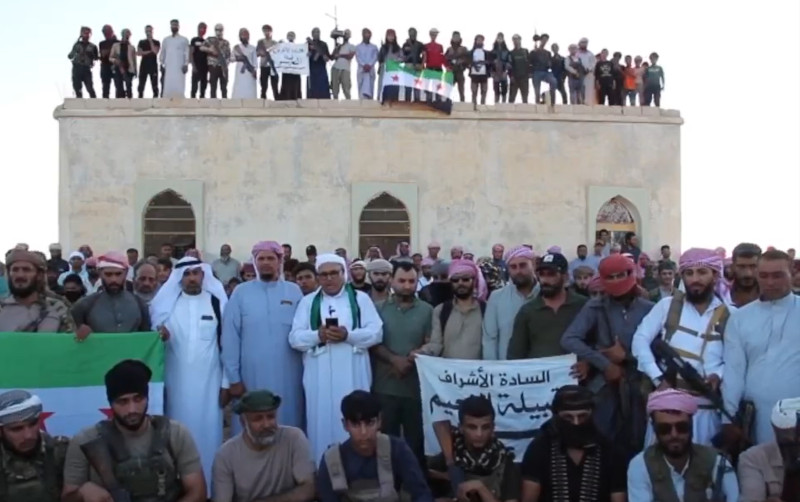
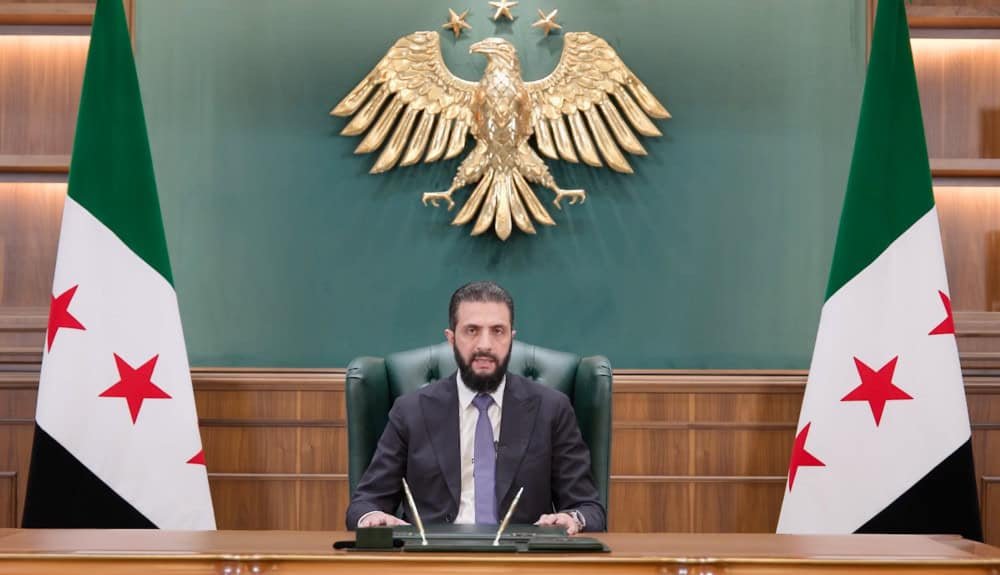
In a rush to build a unified military after the regime collapsed, Damascus largely absorbed existing militias wholesale, turning former armed factions into dedicated divisions and placing their wartime commanders at the helm. The result was a military divided between officers from HTS, the Islamist coalition once led by President Ahmad al Sharaa, and commanders from the Syrian National Army (SNA), which operated in the Turkish-occupied areas under Ankara’s command.
The new Syrian Ministry of Defense is planning for a military of approximately 300,000 personnel, though its current size may be closer to 200,000. Despite modernization plans, Syria’s military is said to be primarily “dismounted militias with little specialization visible, relying mainly on unarmored vehicles and reinforced by only a few surviving main battle tanks (T-72s and T-55s) and infantry fighting vehicles (BMP-1s),” according to the International Institute for Strategic Studies. Much of this equipment is quite old. For example, the Soviet Union began using T-55 and T-72 tanks in 1956 and 1972, respectively.
Unchecked extremism may hinder US hopes
Though working mostly with older equipment, the Syrian government has conducted raids, thwarted attacks, and arrested Islamic State cells and Hezbollah operatives, but the extremist problem is systemic. As Damascus continues to include some extremists in its ranks while failing to vet recruits entering its new military adequately, it is difficult to see how the United States can rely on Syria as a credible counterterrorism partner capable of preventing an Islamic State resurgence.
Hoping to extend Syria’s support to other US priorities, US Central Command (CENTCOM) Commander Admiral Brad Cooper talked about engaging the Syrian government and supporting efforts to build Syrian security capacity in May 2026. However, initial US efforts to work with Syria’s new leadership to confront extremism started well before May.
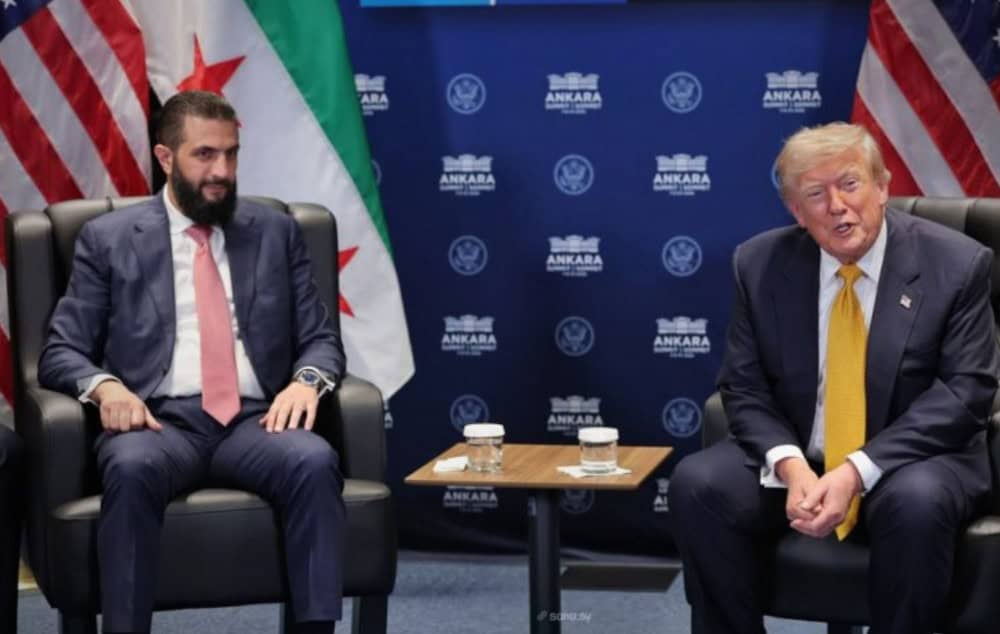
Damascus formally joined the US-led anti-Islamic State coalition in November 2025, following President Sharaa’s visit to the White House. While the US military completed its withdrawal from Syria in April 2026, Syrian authorities have continued compiling a significant record of arrests and disrupted plots. However, the extremism problem extends into the Syrian military itself.
Damascus has integrated fighters from several designated terrorist groups into its armed forces, including Katibat al Tawhid wal Jihad (KTJ), an Uzbek jihadist faction whose members were folded into the Syrian army’s 84th Division, and the Turkistan Islamic Party (TIP), a Uyghur jihadist organization listed by the United Nations. TIP leader Abdul Haq al Turkistani continues to reside in Afghanistan and is a member of Al Qaeda’s Shura council. Despite the group’s inclusion in Syria’s new military structure, its Syrian contingent reportedly remains beholden to Turkistani, who maintains close ties to the Taliban, as well as Al Qaeda. KTJ, though smaller than TIP, has likewise maintained longstanding ties to both the Taliban and Al Qaeda.
The problem is not theoretical. At the end of 2025, two US service members and one interpreter were killed in an ambush carried out by a member of the Syrian security forces. A second warning sign occurred in January, after Damascus assumed responsibility for detention facilities in northeastern Syria following clashes with the Kurdish-led Syrian Democratic Forces, a former key US counterterrorism partner. The fighting left the Syrian government in control of camps holding Islamic State members and their families, including the Al Hol refugee camp. Soon afterward, detainees reportedly escaped from the camp with the assistance of foreign fighters serving in the Syrian military. According to five unnamed sources cited by a Syrian journalist, “the first large, organized smuggling operation out of the camp was led by a foreign commander in the Syrian army.” The same sources alleged that foreign fighters aligned with the Syrian government opened the camp’s northern fence and helped move foreign women out in a coordinated convoy of vehicles. UN sources have since claimed that some of these women went on to join the Islamic State.
However, despite the ongoing issues of extremism related to the Islamic State within the unified Syrian military, Damascus has used its forces to disrupt Hezbollah’s weapons-smuggling networks through its territory. During the Syrian Civil War, Hezbollah supported the Assad regime and used Syria as a major conduit for weapons transfers from Iran. The regime’s fall diminished that possibility, but the smuggling routes remained active. Since then, Syrian authorities have interdicted thousands of weapons and components, including cruise missile parts, drones, and small arms. Syrian forces have also foiled Hezbollah-linked terrorist plots aimed at Israel near the Golan Heights.
The extra pressure on the Lebanese terror group is a welcome development for Washington and Jerusalem, which are in the midst of ongoing negotiations with Beirut concerning Hezbollah’s continuing refusal to disarm and engage in talks.
Turkish influence may overwhelm Syrian independence
The Syrian military’s issues with extremism are amplified by its dependence on Turkey. Under an August 2025 military cooperation agreement, Turkey committed to providing Syria with weapon systems and training in areas that include counterterrorism.
That influence is reinforced by the backgrounds of several senior figures now embedded in Syria’s defense establishment. Among the most prominent is Salim Idris, who previously served as the defense minister of the Turkish-backed Syrian Interim Government and the commander-in-chief of the SNA. He now sits on the Defense Ministry’s advisory body and has played a role in developing the military’s professional education system. Other former SNA commanders remain closer to the operational chain of command. Fahim Issa, who previously commanded the Turkish-backed Sultan Murad Division and later the SNA’s Second Corps, has risen into the senior leadership of the new military.
Ankara may push Damascus to diverge from the United States on key strategic objectives, particularly those involving Israel. Sharaa has repeatedly expressed interest in reaching a security arrangement with Israel, which has remained cautious because of the extremist elements within the new Syrian government. Turkey, by contrast, increasingly views Israel as a regional competitor, and has been attempting to rally other nations in the region into security and economic pacts that pointedly exclude Israel.
In Syria specifically, Ankara has been continually increasing its presence. Israeli jets struck deep inside Syria on August 18, targeting the Abu Duhur Air Base in Idlib Governorate, roughly 70 kilometers south of the Turkish border. The Israeli Prime Minister’s Office reportedly said that Israel and Syria had previously reached an understanding to preserve the security status quo.
Israel’s concern is not without cause. In June, Turkish President Recep Tayyip Erdogan reportedly urged his Syrian counterpart not to crack down on Hezbollah out of concern that doing so would strengthen Israel’s position in Lebanon. The risk, therefore, is that Turkey’s growing institutional leverage over the Syrian military could not only limit Damascus’s ability to pursue an independent security policy, but potentially hamper efforts at Israeli-Syrian reconciliation, a critical US interest. This could hurt efforts in Washington to work with Damascus to combat the Islamic State and Hezbollah.
Russian plans to maintain presence
Ankara’s growing influence is only one part of the problem. Even as Turkey builds new leverage over the Syrian military, Damascus has not severed all of the institutional ties to Russia that it inherited from the Assad regime. Despite the regime’s fall and the widespread assumption that Russia has been pushed out of Syria, Moscow has worked to preserve a military foothold and has recently used its remaining presence to facilitate military resupply to its troops traveling to and from Africa.
A newly signed agreement between Damascus and Moscow establishing Syrian control over Russian bases does not specify the future scope of Russia’s presence, but it also does not rule out a continued Russian military presence in the Mediterranean. Despite leaving transmitters off in an apparent attempt to limit tracking, a Russian naval convoy was reportedly sighted off Syria’s Tartous port, with some of the vessels sighted being under US sanctions. Two of the vessels then docked to unload military supplies to Russia’s forces still in the country.
That alone poses a challenge to US interests, since Moscow could use these facilities for power projection. Russia previously relied on Syrian bases to support operations and surveillance across the eastern Mediterranean, as well as military activities in Africa. Damascus, meanwhile, appears to see benefits in allowing Russia to remain, whether through access to cheaper oil and grain or, potentially, future deliveries of military equipment.
Foreign influence in Syria has the potential to present real problems for US interests. Prior to the Syrian Civil War’s conclusion, Russian– and Iranian-backed groups threatened and, in some cases, attacked American forces. Though the US no longer maintains forces in Syria, Washington may need to incentivize Damascus to shape the Syrian military before its current structures become dominated by extremists, Turkey, or Russia.
Ahmad Sharawi is a senior research analyst at The Foundation for Defense of Democracies (FDD), focusing on Middle East affairs, specifically the Levant, Iraq, and Iranian intervention in Arab affairs, as well as US foreign policy toward the region. Justin Leopold Cohen is a senior research analyst at FDD’s Center on Military and Political Power.