

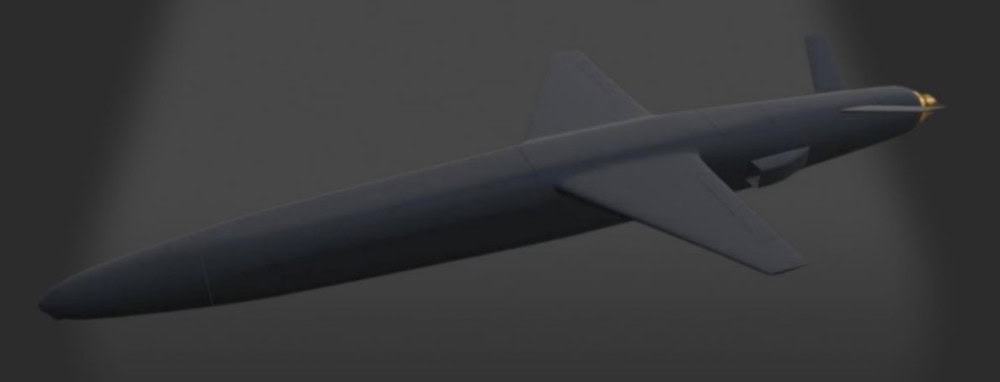
Ukrainian intelligence on Monday published a teardown of a redesigned version of Russia’s Geran-5 small cruise missile, based on a specimen that landed nearly intact in a Ukrainian field. The new weapon, designed to fly higher and faster than its predecessor, is part of Moscow’s efforts to outrun new Ukrainian interceptor drones as it wages war on civilian infrastructure.
Designated the “Geran-5 K5-K,” the missile is manufactured by a Russian plant in Alabuga, the main producer of the Geran family of unmanned aerial vehicles (UAVs) and missiles. This version has a more aerodynamic, shorter fuselage, reduced from 6.5 meters to 4 meters. It features mildly swept fixed wings and a V-tail.
Evidence that Russia had begun employing the K5-K first emerged in late September. Footage posted on social media indicates Moscow has since conducted regular strikes with the new missile, but the older version apparently remains more common. The K5-K may still be in low-rate initial production as the Russians work out the kinks.
The new missile’s payload size (90 kg) and flight range remained consistent, according to Ukraine’s military intelligence agency, known as the HUR. The example studied by the agency’s experts contained a TBBCh-90 thermobaric warhead. However, the K5-K’s maximum flight altitude increased to 6 kilometers, up from 5 kilometers for the previous version, which had itself previously been modified to improve performance. The HUR also said the missile’s “cruising speed increased to over 450” kilometers per hour, and it can reach 1,000 kilometers per hour “during certain maneuvers” (presumably meaning its terminal dive).
Interestingly, when it released its analysis on the K5-K, the HUR reduced its published estimate of the original Geran-5’s cruising speed from “450-600 km/h” to “400-450 km/h.” The HUR’s estimate for the K5-K’s speed may also evolve as more data becomes available. The current figure may be less a precise measurement than an initial observation that the new missile is designed to be faster.
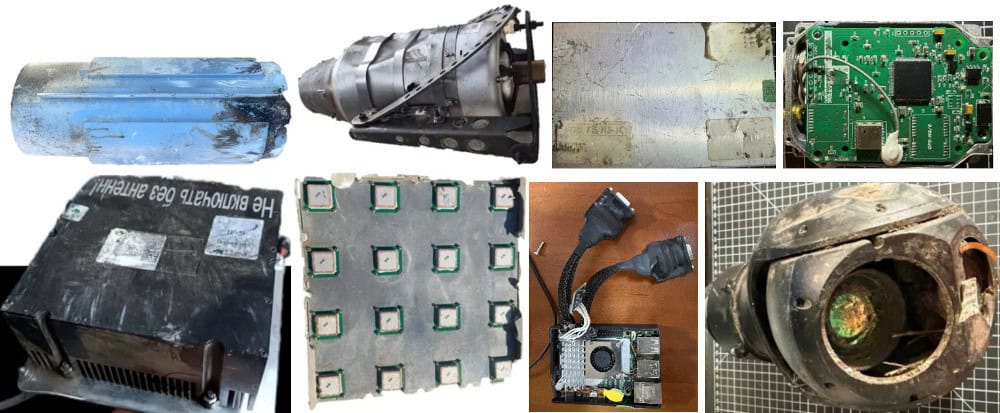
Whereas its predecessor uses a TF-TJ2000A turbojet engine from China’s Telefly, the K5-K is powered by a TRD-200 turbojet assembled in Alabuga using Chinese components, the agency said. The HUR also recently reported that the plant had begun localizing production of engines used in the Geran-4 jet-powered one-way attack drone, seeking greater production volumes.
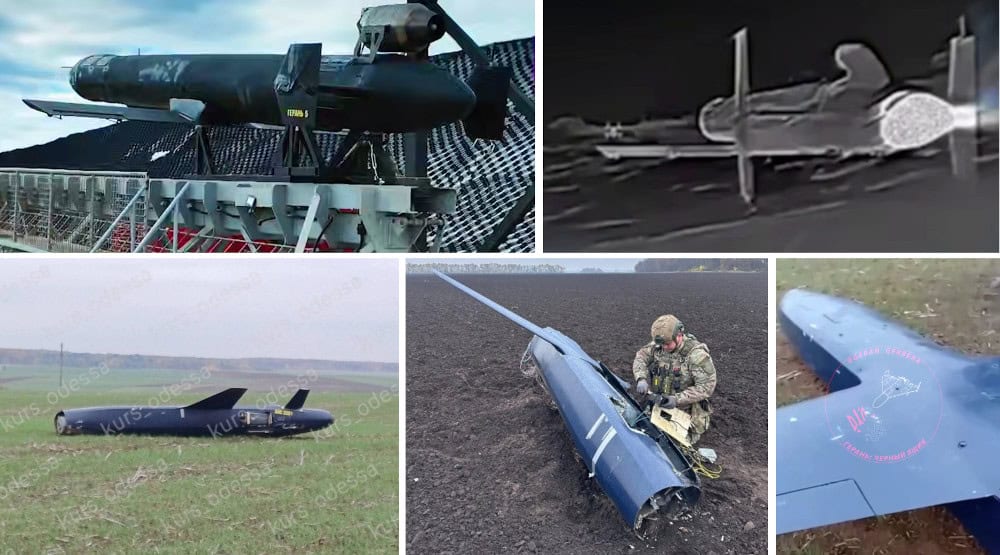
According to the HUR, the K5-K’s avionics are “identical” to those recently found in an upgraded version of the Geran-4 drone. The missile uses a satellite-aided inertial navigation system for guidance. To boost resilience against satellite jamming, it has a 16-element controlled reception pattern antenna (CRPA) that is a “localized copy” of a model made by China’s Harxon, which is known to have supplied CRPAs to the Alabuga plant. It also has a magnetic compass that can reduce inertial navigation error even when satellite signals are unavailable.
The missile can also be remotely piloted via a mesh-network radio modem and the dual-spectral camera located under its nose. However, communications are typically unreliable for targets deeper than 100-200 kilometers. For redundancy in jammed environments, the K5-K has a new “Susanin” scene-matching guidance system, which uses a Chinese microcomputer to compare live camera footage against prestored reference data.
Of the 93 electronic components the HUR identified, 52 came from the United States. Another 10 each came from Chinese and Swiss companies.
The Geran-5 K5-K and its predecessor are part of Russia’s growing arsenal of small cruise missiles designed to be relatively cheap and easy to produce. These complement Moscow’s long-range one-way attack UAVs and more exquisite legacy cruise and ballistic missile systems. As winter looms, Russia is using these weapons to assault Ukraine’s critical infrastructure. Recent barrages have left residents of Kyiv short of both electricity and water.
Russia began using the Geran family of munitions in 2022, importing them from Iran before localizing production in 2023. Initially, Russia focused on churning out ever-larger numbers of the propeller-powered Geran-2 one-way attack UAV. But Ukraine developed cost-effective counters, including mobile machine-gun teams and eventually interceptor drones.
This year, Moscow shifted production to jet-powered munitions. Russia is currently producing around 2,000 Geran-2s compared to roughly 4,000 Geran-4 and Geran-5s per month, plus maybe 350-400 other, faster small cruise missiles, chiefly the Banderol/Dan-T.
These jet-driven weapons are too fast for reliable defeat by Ukraine’s previous-generation electric-motor interceptor UAVs, which must be considerably faster than their prey given their short battery life. While it routinely shoots down roughly 90 percent of Russia’s propeller-powered drones, Ukraine is currently intercepting only around 60 percent of the Geran-4/5s, relying heavily on its overstretched fleet of fighter jets.
Ukrainian industry has now developed several faster interceptor drones and is working to scale up production. But Kyiv is chasing a moving target. Moscow likely intends to continue ramping up production of small cruise missiles over the coming year, and further improvements in speed are possible.
Some interceptor-drone systems that are optimized to combat the slower, currently more numerous Geran-4 struggle against quicker targets. Although a few electric interceptor drones currently on the market have demonstrated the capability to down the older Geran-5s, the interception window is small, and faster small cruise missiles may be out of reach. Some companies are advertising AI-enabled guidance systems that enable their drones to intercept targets head-on, reducing the demand for speed, but this still seems to be a work in progress.
Jet-powered interceptors, capable of greater speed and endurance, are better suited for keeping pace with tomorrow’s threats. However, they are costlier and more complex to manufacture. A handful of different models have begun to see action, so far in limited quantities. Here, the main challenge is producing or importing enough turbojet engines. As Defense Minister Yevhenii Khmara noted in October, Ukraine will need many thousands of these engines every month for both offensive and defensive systems. Various European manufacturers are currently working to increase output to help meet that demand.
Western countries are also pitching in to fund production of interceptor drones. However, that is not the only way they could provide assistance.
Even if Ukraine scales up production of these munitions, fighter aviation will remain critical to defending its skies, both to counter jet-powered drones and small cruise missiles and to counter larger, traditional cruise missiles such as the Kh-101. However, over half of Ukraine’s F-16s are consequently sitting idle due to a maintenance bottleneck in Belgium. Resolving this issue will likely be critical to Ukraine’s ability to maintain an effective air defense.
John Hardie is the deputy director of FDD’s Russia Program and a contributor to FDD’s Long War Journal.


