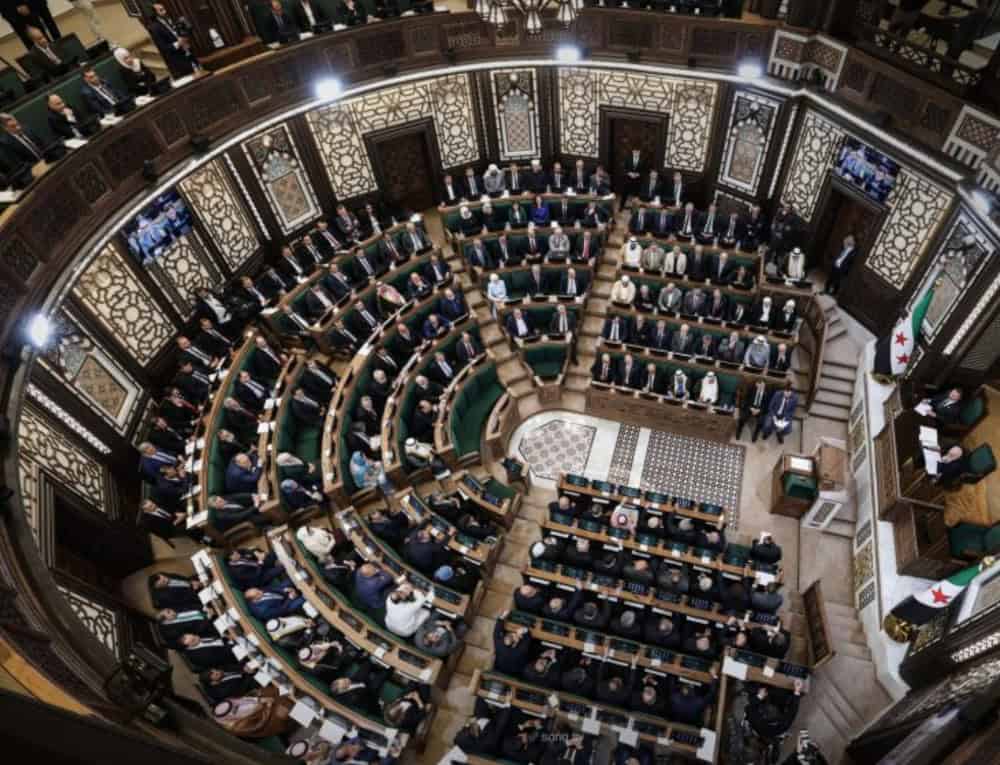
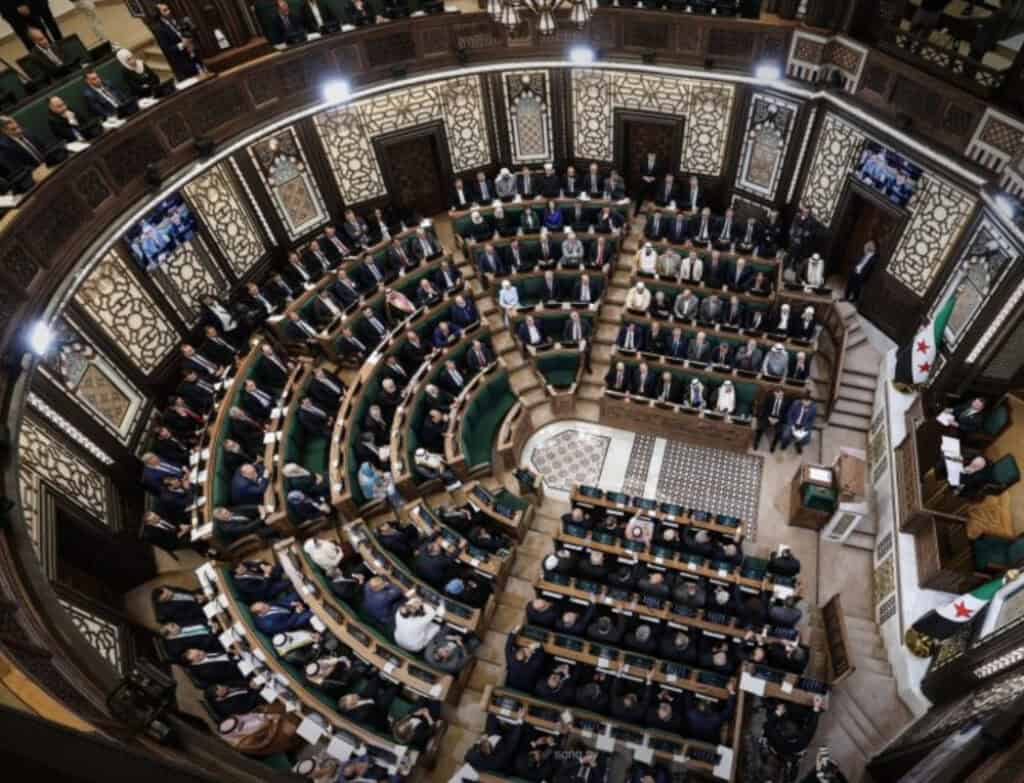
Syria convened its new parliament on July 12, the first to meet since the fall of the Bashar al Assad regime in December 2024. The new parliament, called the People’s Assembly, met after Syrian President Ahmad al Sharaa appointed the final 70 members of the body on July 1. Amid this domestic development, Syria’s government has continued establishing international relationships. On July 13, a Turkish Navy vessel made an inaugural visit to Latakia, and a Syrian emergency response team that participated in search-and-rescue operations in the wake of Venezuela’s earthquake returned home.
The new Syrian People’s Assembly is made up of 70 representatives appointed by Syria’s president and 140 who were chosen by local committees over the past year. The process took significant time, in part, because Damascus is still working to unify the country under its rule. The Druze minority region of Suwayda is still not under government control after clashes between Druze militias, tribes, and government forces last year. In addition, the partly Kurdish regions in northeastern Syria only came under government control after an agreement in January. Simultaneously, Turkey continues to withdraw from the last areas it still controls in Afrin in northern Syria.
President Sharaa spoke at the parliament’s opening. “President Ahmad al-Sharaa affirmed that the launch of the People’s Assembly marks an important national milestone and a new step toward boosting consultation and responsibility while building state institutions founded on dialogue, competence, and the rule of law,” the Syrian Arab News Agency (SANA) noted.
The body chose Abdul Hamid al Awak as speaker of the People’s Assembly and appointed members to other roles. Reports on the new parliament have contrasted its quiet conduct with the type of cheering that used to be common in the old Assad-era parliament. Syria received praise from countries in the region and from Europe following the opening of the new assembly.
Sharaa has indicated that he supports holding general elections in the future, a development that would expand the electoral base beyond the government-backed committees that have served as local electors over the last year. While the local committees and Sharaa appointed some minorities to parliament, there have been concerns that Kurds, Druze and other groups are underrepresented.
“Kurdish officials have criticized the elections as unfair, saying Kurdish representation should be higher. Sulaiman Oso, a senior ENKS [Kurdish National Council in Syria] member, told Rudaw English on Wednesday that Kurds make up nearly 15 percent of Syria’s population but account for only around 5 percent of the incoming parliament,” the Rudaw Media Network reported on July 1.
One pro-government Druze Syrian, Laith al Balous, was appointed by Sharaa. In addition, 15 women were appointed on July 1, bringing the total number of women representatives to 22. Among those chosen by the president was an actress, among several non-politicians appointed to the new assembly.
The parliament’s opening comes as Damascus continues to consolidate power and energetically engage with other countries. On July 13, a Turkish naval vessel, the TCG Istanbul frigate, arrived at Syria’s Port of Lattakia. “The ministry [of National Defense] said it was the first time the navy visited neighboring Syria since the collapse of the Assad regime in 2024,” Turkey’s Daily Sabah noted. Sharaa was also in Ankara for a NATO summit on July 8, and Turkey has emerged as one of the closest partners of the transitional government in Damascus.
Damascus continues to engage in international relations at a rapid pace. “Director of the Consular Affairs Department at the Ministry of Foreign Affairs and Expatriates, Mohammad al-Omar, affirmed that Syrian diplomacy has succeeded, in record time, to bring Syria back to the core of the regional and international arenas,” SANA noted on July 11. Syria’s Minister of Foreign Affairs and Expatriates Asaad Hassan al Shaibani traveled to Saudi Arabia on July 15. On July 14, Sharaa hosted Lebanese Minister of Economy and Trade Amer Bisat in Damascus, roughly two weeks after reports indicated that the White House was encouraging Syria to intervene in Lebanon against Hezbollah. Damascus has instead sought to focus on economic ties.