Moscow officially acknowledged its new S8000 Banderol air-launched cruise missile for the first time in a state media report published this week. This comes as the missile, designed as a low-cost option for long-range strikes, appears to be seeing growing action in Ukraine.
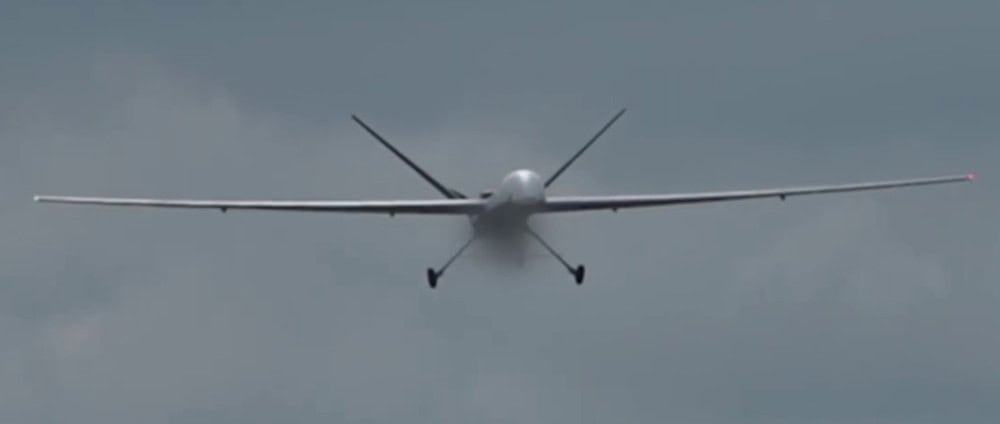
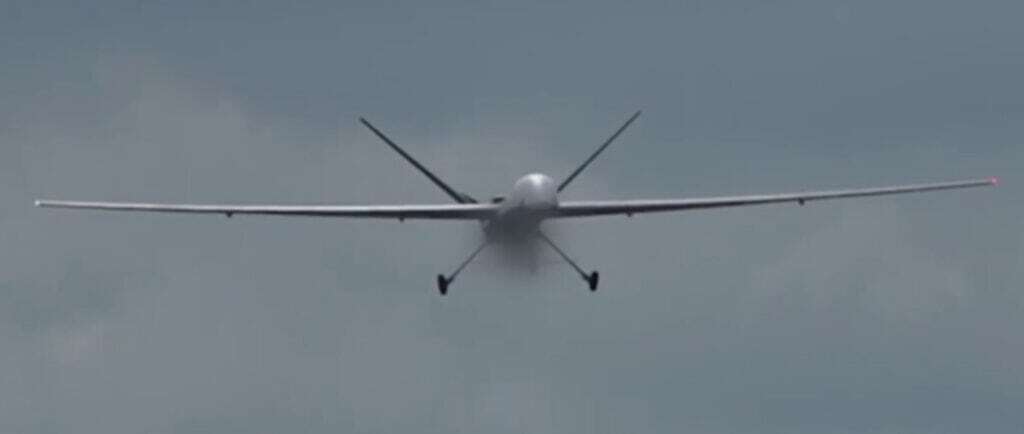
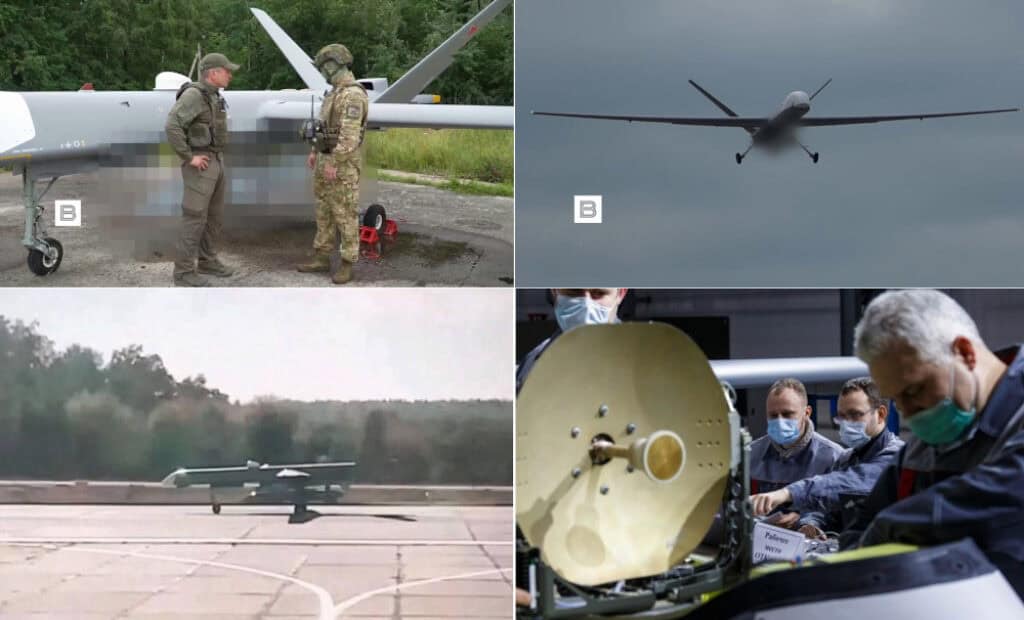
The report, published by VGTRK on July 12, shows a Russian serviceman and the prominent propagandist Vladimir Solovyov inspecting an Inokhodets (aka Orion) medium-altitude, long-endurance (MALE) remotely piloted aircraft. The drone is carrying what the report asserts is a Banderol missile under its fuselage, though the munition is blurred out. The aircraft (or another of the same model) is then seen taking off.
Notably, the Inokhodets drone shown in the video features a larger nose section intended to accommodate the Aktsent-SM satellite communications system, which extends the drone’s range of control. This system was not included in the initial Inokhodets model procured by the Russian Defense Ministry, and the newer version has only rarely been seen in public combat footage. Previous photos of Inokhodets drones carrying Banderol missiles, published last year by unofficial sources, showed the earlier version of the drone.
When using the Inokhodets to carry the Banderol, the Russians apparently remove the drone’s gyro-stabilized multispectral targeting system, typically found under the nose or central part of the fuselage. While the drone retains its smaller electro-optical observation system affixed under the nose, this setup makes the aircraft unsuited for reconnaissance and dynamic-targeting missions.
Background on the Banderol cruise missile
Ukraine’s military intelligence directorate, known as the HUR, first revealed the existence of a munition called the Banderol in April 2025 but offered few details at the time. Shortly thereafter, Moscow briefly displayed the missile (or a mockup of it) in footage from the Kapustin Yar test range, without specifying the munition’s name or showing it in action. Meanwhile, Ukrainian sources reported a smattering of Banderol strikes in the Odesa and Mykolaiv regions in southern Ukraine.
Later that spring, the HUR released a technical breakdown providing more information about the new missile. The Banderol, whose name means “parcel,” is about 5 meters long. It is simple in design and clearly intended to be budget-friendly. As with most Russian missiles, many of its components are foreign-made, including some from the United States and other Western countries.
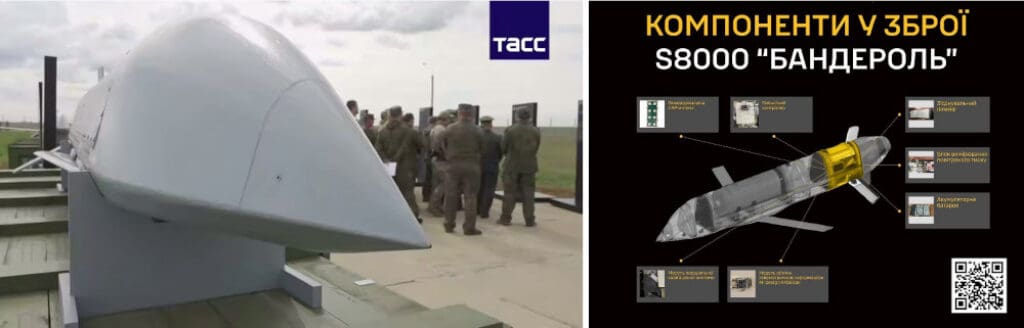
Powered by a small, commercially available Chinese turbojet engine, the Banderol “can travel up to 500 km at a cruising speed of 500 km/h” and can “execute tighter turns than other standard Russian cruise missiles,” the HUR noted. It carries a relatively small high-explosive fragmentation warhead that includes about 50 kilograms of explosives.
The missile navigates using inertial and satellite guidance. The HUR said it had a Kometa-M8 controlled reception pattern antenna (CRPA) for resistance against electronic warfare. The Russians may have subsequently installed a more robust version, the Kometa-M12.
The Banderol’s developer and manufacturer is the Russian company Kronstadt, the prime contractor behind the Inokhodets drone, the missile’s main carrier. “Adaptation is underway to enable deployment from Mi-28N attack helicopters as well,” the HUR said.
Using MALE drones to launch standoff munitions provides an additional role for a class of aircraft that struggles to survive when inside an enemy’s air defense envelope, as shown in both the Ukraine and Iran wars. America’s General Atomics has similarly announced plans to test its MQ-9B family of remotely piloted aircraft as cruise-missile carriers this year.
The missile’s growing employment in Ukraine
Moscow’s decision to begin breaking the Banderol’s cover coincides with an apparent surge in the missile’s use in Ukraine. Since mid-May, the Ukrainian Air Force has recorded 16 strikes involving this munition, after reporting none since last September. In most cases, Ukraine did not specify how many were launched, though it reported five in the latest barrage on July 16.
Russia plans to produce 120 Banderol missiles per month this year, according to Serhii “Flash” Beskrestnov, an expert who served as an advisor to Ukrainian Defense Minister Mykhailo Fedorov until Fedorov was ousted this week. However, Russia likely has not yet reached that rate, Beskrestnov wrote on social media on July 14.
Prior to its full-scale invasion of Ukraine, Moscow drastically underestimated the number of precision-guided munitions it would require, as the Russian Air Force’s then-commander acknowledged in 2024. The Banderol is part of a broader move to field lower-cost, easier-to-produce standoff munitions—a trend also embraced by the United States and other Western countries. Other recent Russian developments include the Izdeliye-30 air-launched cruise missile and the UMPB-5 series of bombs.
Like the US military, the Russians evidently see low-end missiles like the Banderol, as well as the Geran family of one-way attack drones derived from Iranian Shaheds, as a complement rather than replacement for more complex capabilities. Moscow continues to invest in the production of legacy missile systems such as the Iskander and Kh-101 as well as development of new high-end weapons. However, it seems that the Ukraine war has impressed upon Russia the need for substantial magazine depth and a high/low mix of long-range strike capabilities, an approach that will likely persist after the current conflict has ended.