Ukraine last week unveiled a set of sweeping reforms for military personnel, promising higher-paying, fixed-term contracts in place of indefinite service. Kyiv hopes these measures will help redress its military’s chronic manpower shortage. However, its promises to also begin discharging long-serving troops and reform controversial mobilization procedures raise questions about how it will accomplish these goals simultaneously.
Long-brewing problems
The reforms, which Ukrainian officials had foreshadowed earlier this spring, were announced on June 12. “I expect every element of the changes now being implemented to show its effectiveness this summer,” President Volodymyr Zelenskyy declared.
Ukraine’s manpower problem stems more from a crisis of confidence than a simple shortage of military-age men. As recently appointed Deputy Defense Minister Mstyslav Banik acknowledged in a June 15 briefing, many Ukrainians view military service as a one-way ticket. Potential troops, he noted, look at friends, relatives, and neighbors who have served continuously since 2022 and see little certainty about when they might return to civilian life. Likewise, many existing troops are exhausted after years of fighting with no end in sight.
This has fueled draft dodging as well as desertion and absence without leave (AWOL). Whereas in 2022, volunteers flocked to military recruitment centers, officials now resort to rounding up men. Desertion and AWOL during basic training are also common, though Ukraine has recently managed to improve retention. And service members often go AWOL to gain some temporary respite or to transfer between units.
New contract system
By establishing “clear and understandable rules of the game,” as Banik put it, the Ukrainian military hopes to both improve conditions for current troops and make service more attractive to civilians.
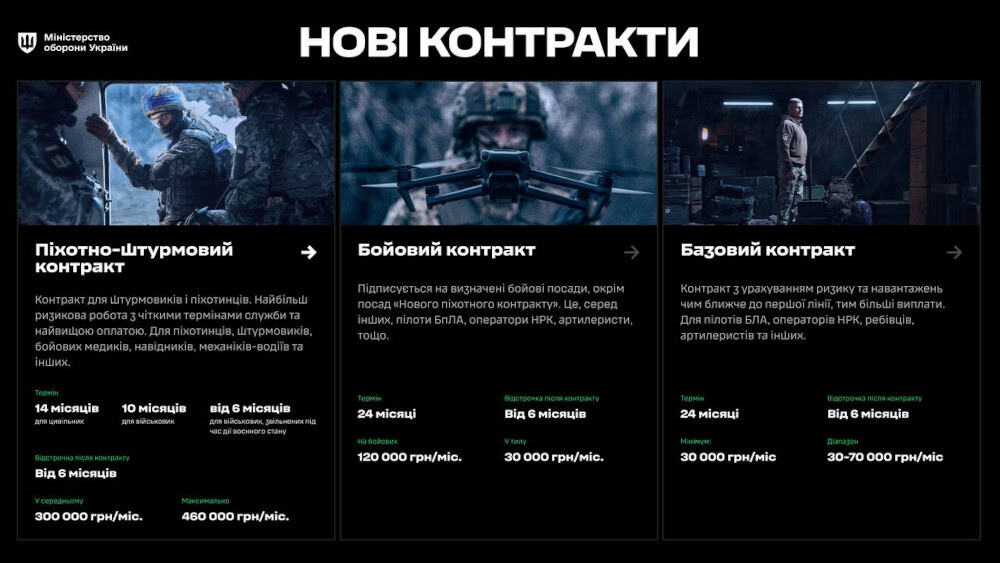
The Ukrainian Ministry of Defense (MoD) seeks to accomplish this through a new contract-based system. It introduces three categories of contracts: an “infantry-assault contract” that lasts 10 months for current service members or 14 months for civilians; a 24-month “combat contract” for support personnel such as drone operators, artillerymen, and electronic warfare specialists; and a 24-month “basic contract” for rear-area roles.
These contracts are paired with a tiered compensation structure that offers higher salaries for positions involving greater risk. Under the new framework, assault infantry personnel are supposed to earn an average of 300,000 hryvnias (around $6,700) per month, roughly 10 times the average monthly salary in Ukraine. Troops serving in combat-support and rear-area roles receive more modest but still increased levels of compensation. Kyiv is also boosting pay for corps and brigade commanders, officials say.
Banik said the MoD was able to find the money for these pay increases within its existing budget, which is funded in part by Europe. To prevent fraud, the Ukrainian military will expand its Mission Control system to “record and verify service members’ presence at specific locations and times,” the MoD said.
A central feature of the reforms is a new deferment system that grants protection from future mobilization after contract completion. Troops are supposed to gain a clear understanding of when their service will end. After completing his or her contract, a servicemember will receive a deferment of at least six months, lasting longer based on time in combat and previous service. Existing troops who choose not to sign a new contract will remain in service at their current pay rates until Kyiv orders demobilization when the war ends, Banik explained.
To help reduce the AWOL rate, Ukraine is also streamlining the process for transferring between units and returning from AWOL, using the Army+ application. Troops may now transfer between units “once per year … without requiring approval from their current chain of command, provided the transfer remains within the same sector of the front,” Banik said. In addition, the MoD notes that within the next three months, AWOL personnel may return to service in one of 55 high-quality units without first passing through reserve battalions or lengthy administrative procedures. A dedicated call center will guide troops through this process.
Lastly, Ukraine aims to expand recruitment of foreign volunteers so they comprise 30 to 50 percent of assault infantry positions. Banik said Kyiv is exploring a model in which private companies will help identify and pre-screen foreign recruits before they undergo state security vetting.
Next stages of reform
Many of the most politically sensitive questions, however, remain unanswered.
Ukrainian officials say a second stage of reform will focus on mobilization procedures and the controversial Territorial Recruitment and Social Support Centers, which have faced growing public criticism over mobilization practices. Banik acknowledged that the current model is having a “fairly negative impact” on society. But he declined to provide details on plans for reforms, beyond a promise that these measures would be announced later this year.
Moreover, Kyiv asserts that it will begin gradually discharging the longest-serving troops by the end of 2026. Yet the criteria for eligibility, the timeline for implementation, and the number of personnel who may ultimately be released remain unclear. Ukrainian officials confronted such questions when considering 2024 legislation on mobilization reforms. Ultimately, the parliament punted on the thorny issue of discharging long-serving soldiers, as the top brass insisted that Ukraine would otherwise be unable to hold its lines.
It therefore seems unlikely that Ukraine will be able to release troops en masse before the war ends. And with the Kremlin still clinging to maximalist demands, the conflict appears poised to drag on into 2027.