

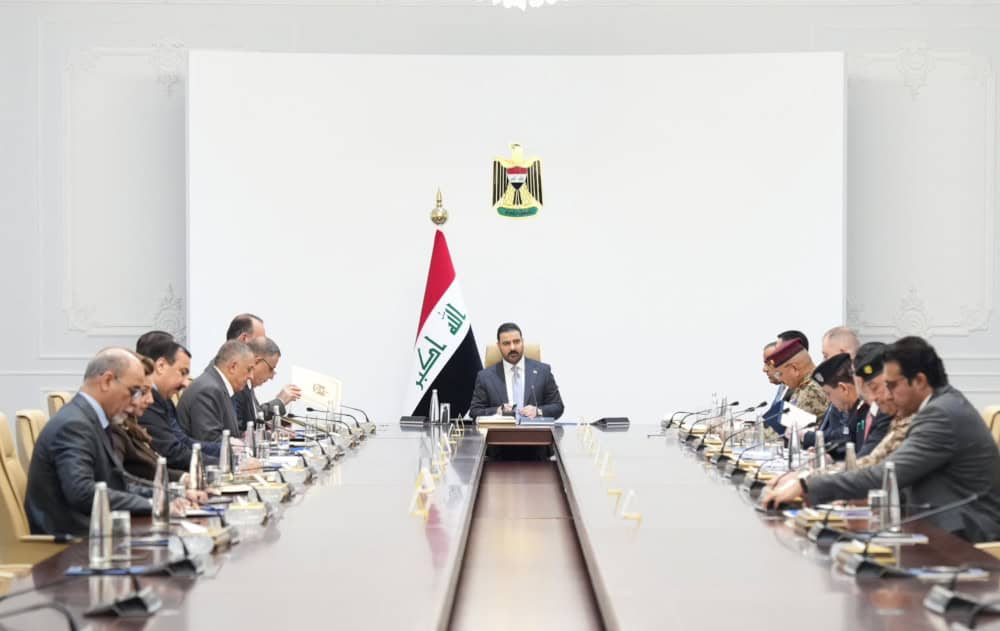
Iraqi Prime Minister Ali al Zaidi has moved to investigate allegations of oil smuggling at Jurf al Sakhar, an area southwest of Baghdad. The site, also called Jurf al Nasr, is occupied by Iranian-backed militias, particularly Kataib Hezbollah. Zaidi’s decisions in the oil smuggling case are bringing him into direct confrontation with Kataib Hezbollah. On November 15, Iraqi security forces completed preparations to enter Jurf al Sakhar, and reports in Iraq indicated that Zaidi had given Kataib Hezbollah an ultimatum to hand over the site to the government.
The latest crisis follows months of attempts by Zaidi to rein in Iran-backed militias and other armed groups. Baghdad has set a goal of placing the militias’ weapons under state control by June 2027. While some groups have agreed, several powerful militias, such as Kataib Hezbollah, continue to be holdouts. Many of these groups are also part of the Popular Mobilization Forces, a state-backed paramilitary force.
The controversy over oil smuggling increased on November 9 after Al-Hurra published satellite images and details from an investigation into the allegations. The prime minister set up a committee to investigate the allegations. “The committee, which visited the area controlled by the influential Kataib Hezbollah militia, confirmed the findings of a report by the Federal Intelligence and Investigations Agency on oil smuggling operations and the existence of refineries,” The National in the UAE reported.
On November 14, Zaidi fired nine “senior security and administrative officials and referred suspects to the judiciary” in the wake of the smuggling investigation. The fired officials are from Babil Governorate, which includes Jurf al Sakhar. The dismissals came after Zaidi chaired an emergency committee meeting to review the investigation’s findings.
Kataib Hezbollah denied its role in oil smuggling on November 15. “The group insisted that Jurf al Sakhr, also known as Jurf al-Nasr, and the issue of ‘resistance weapons’ must remain outside political disputes, accusing the United Arab Emirates, Saudi Arabia and the United States of exerting pressure through al-Zaidi’s government,” Shafaq News in Iraq noted.
As tensions have grown between Zaidi and Kataib Hezbollah, the powerful Shiite Coordination Framework, a bloc that includes numerous Shiite political groups, has sought to mediate. Some of these groups, such as the Badr Organization, also have militias within the PMF. Hadi al Amiri of Badr and former Prime Minister Nouri al Maliki are among those who have sought to mediate with Zaidi. Maliki is a political rival of Zaidi who sought to return as prime minister. US opposition helped push Maliki aside and paved the way for Zaidi’s appointment.
Iraqi security forces deployed around Jurf al Sakhar on November 15. “The Commander of the Federal Police Forces, Lieutenant General Mohammed Qasim al-Fahd, stressed on Sunday the importance of field monitoring and enhancing operational readiness to carry out various missions in the Jurf al-Nasr area, north of Babil Governorate,” the Iraqi News Agency reported on November 15.
On the same day, Chief of Staff of the Iraqi Army Abdul Amir Yarallah convened a meeting to discuss the situation. The commanders agreed that the “case constitutes an infringement on the sovereignty of the state, an attack on public funds, and an assault on the resources of the Iraqi people, which requires handling it with the highest degree of responsibility and firmness,” Iraq’s official Security Media Cell added.
Zaidi has stressed the importance of creating a stronger state based on the rule of law in recent statements. At the opening of a new Coptic Christian cathedral in Baghdad on November 12, he highlighted these themes in a speech.
“There is no place in Baghdad or any other Iraqi city for the corrupt or those who would undermine the state and its resources; we will not tolerate any violation of the law, under any pretext whatsoever,” Zaidi also stated on November 14.
Reporting from Israel, Seth J. Frantzman is an adjunct fellow at FDD and a contributor to FDD’s Long War Journal. He is the senior Middle East correspondent and analyst at The Jerusalem Post, and author of The October 7 War: Israel’s Battle for Security in Gaza (2024).


