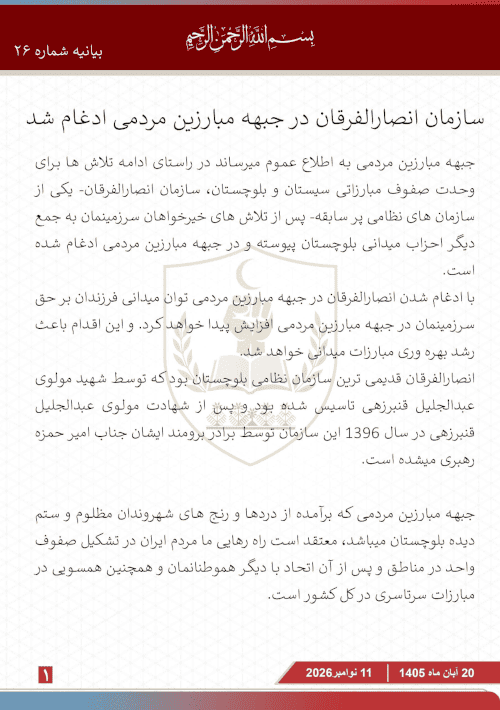
The Sunni Iranian Baluch insurgent group Ansar al Furqan announced on November 11 that it had joined Jebhe-ye Mobarezin-e Mardomi (JMM), a coalition of Baluch armed groups formed in Iran in December 2025. The coalition initially brought together Jaish al Adl, PADA Baluch, Harakat-e Nasr Baluchestan, the Mohammad Rasulullah group, and independent Baluch fighters. Ansar al Furqan had previously declined to join the alliance and continued operating independently.
Although JMM comprises factions with histories of Salafi-jihadist ideology and ethnic Baluch nationalism, the coalition has increasingly framed its armed campaign as part of a nationwide struggle against the Islamic Republic. Its founding manifesto called for cooperation among Iranians regardless of ethnic or ideological differences, while its subsequent statements invoked solidarity with protesters across the country.
However, JMM’s November 11 statement announcing Ansar al Furqan’s incorporation adopted more explicitly Islamic and Baluch-centric language than its recent nationwide appeals. The press release described the province’s population as “proud heirs to the rich Baluch and Islamic cultures” and invoked a Quranic verse urging unity: “And hold fast, all together, to the rope of Allah, and do not be divided.” The statement portrayed the Baluch as an oppressed people rising against tyrannical rulers while continuing to call for unity among all Iranians.
The religious emphasis may have been a compromise intended to accommodate Ansar al Furqan’s more pronounced Islamist ideology and reported connections to Al Qaeda. Founded in 2013 through the merger of two Sunni militant groups, Ansar al Furqan historically advocated implementing Islamic law and restoring the caliphate. Molavi Nasrallah Baluch, identified as the group’s spokesman, reportedly issued a separate statement confirming the merger and citing the same Quranic verse about unity. However, another statement attributed to the group disputed the full merger, claiming only a limited number of its fighters had joined JMM.
The shift in the insurgency
Iran’s Baluch insurgency has evolved from sectarian violence and attacks on civilians toward a nationalist movement against the Islamic Republic.
Jaish al Adl, JMM’s principal armed faction, emerged after the dismantling of Jundallah, a Sunni Baluch militant network whose leader, Abdolmalek Rigi, was executed in 2010. The United States designated Jaish al Adl as a Specially Designated Global Terrorist (SDGT) entity in 2019 under Executive Order 13224, placing it on the Treasury Department’s Specially Designated Nationals (SDN) list. That same year, the State Department amended Jundallah’s FTO designation to list Jaish al Adl as an alias, formally recognizing it as Jundallah’s successor.
Jundallah’s attacks were not limited to regime security forces. In May 2009, it claimed a suicide bombing at a Shiite mosque in Zahedan that killed at least 25 worshippers. In December 2010, the group targeted Shiite worshippers observing Ashura in Chabahar, killing approximately 39 people. These sectarian attacks resembled Al Qaeda in Iraq’s strategy of targeting Shia religious gatherings and holy sites.
Jaish al Adl retained the Islamist ideology and historical separatist ambitions of its predecessor but increasingly concentrated its operations on the Islamic Revolutionary Guard Corps (IRGC), law enforcement, and border guards. Under JMM, the insurgency has adopted a broader Iranian nationalist narrative, portraying attacks on regime forces as retaliation for repression nationwide rather than religious or ethnic grievances alone.
Between January and October 2026, about 40 attacks have been carried out in Iran’s Sistan and Baluchestan Province, with JMM claiming responsibility for most of them.
Janatan Sayeh is a research analyst at the Foundation for Defense of Democracies focused on Iranian domestic affairs and the Islamic Republic’s regional malign influence.