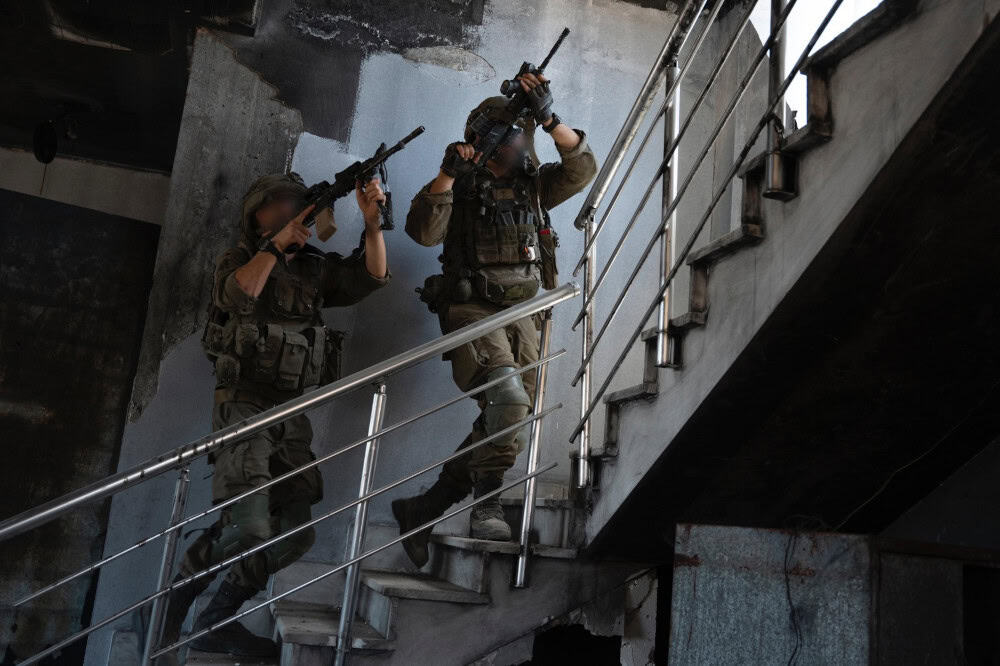
After eliminating two successive heads of Hamas’s military wing in roughly two weeks, the Israel Defense Forces has turned its attention to the commanders, specialists, financiers, and cell leaders responsible for attempting to rearm and rebuild the group and other Gaza terrorist organizations.
On May 29, the IDF and Shin Bet killed Imad Hassan Hussein Aslim, the deputy commander of Hamas’s Gaza City Brigade and commander of the Zeitoun Battalion, who the IDF said led his battalion’s October 7 infiltration into Israeli territory and had recently advanced dozens of attacks against Israeli forces in Gaza. The next day, the IDF eliminated Jamal Abu Aoun, whom it identified as a Hamas squad commander also working as a doctor at Yafa Hospital in Deir al Balah.
The Israeli campaign has since widened from Hamas’s battlefield chain of command to the broader terror infrastructure sustaining attacks during the ceasefire. Ahmed Abu Mogheib, described by the IDF as leading a rocket-firing squad in the Gaza Popular Resistance Committees terror group, had also reportedly been involved in smuggling efforts prior to his elimination on June 2. In addition, the IDF eliminated Hamas and Palestinian Islamic Jihad terrorists who led engineering divisions and financial networks the next weekend. These strikes follow an uptick in Israeli military action against Hamas’s rearmament network. The Israeli military renewed these efforts after the terrorist group rejected the disarmament plan that the Board of Peace, the UN-led authorized organization overseeing Gaza’s ceasefire and reconstruction, presented to it two months ago.
Hamas’s disarmament, a key condition of US President Donald Trump’s 20-point peace plan for the territory, hit another diplomatic snag in recent days. Despite mediators in Egypt hosting talks between Hamas officials residing in Doha and expatriate leaders of Palestinian Islamic Jihad, the Gazan groups have seemingly not changed their position on disarmament.
Between May 29 and June 10, the Israeli military reported 15 strikes and ceasefire violations:
- On May 29, the IDF, working with the Shin Bet, said it killed Aslim, adding that he had commanded his Zeitoun Battalion to raid Israeli territory during the October 7 massacre. Aslim had “in recent years and particularly lately… advanced dozens of terror attacks against IDF forces operating in the Gaza Strip,” according to the IDF.
- Also on May 29, the IDF eliminated three Hamas terrorists who it said were operating near IDF forces.
- The same day, the IDF killed a separate Hamas member whom it said “was advancing sniper plots in the immediate timeframe against IDF forces operating in the Gaza Strip.”
- On May 31, the IDF Air Force reportedly destroyed “three weapons storage facilities belonging to the Hamas terror organization … where charges, long weapons, sniper rifles, and additional combat equipment were stored.”
- On June 1, the IDF eliminated Aoun, stating that he was a “squad commander in the military wing of the terror organization Hamas, who simultaneously operated as a doctor at Yafa Hospital in Deir al-Balah.”
- On June 2, the IDF’s 252nd division reported that it had “eliminated five terrorists from terror organizations in the Gaza Strip in recent days, who had advanced terror plots against our forces in the immediate timeframe.”
- Also on June 2, the IDF struck and killed a “Terrorist Who Took Part in Abduction of Hirsch Goldberg-Polin z”l, Eli-H Kohen, Alon Ahal, and Or Levy from the Armored Corps Unit at Re’im Junction in the October 7 Massacre.”
- On June 3, the IDF killed Ahmed Abu Mogheib, who it reported was “head of a rocket-firing squad” and “acted to promote terror outlines against IDF forces and Israeli civilians, took part in promoting smuggling attempts into the Gaza Strip, and was eliminated after posing a threat to our forces.”
- On June 5, the IDF said that Israeli forces “eliminated a terrorist who planned to carry out terror attacks against IDF forces in the immediate time frame.”
- On June 6, the IDF reported its troops had “eliminated Mohanad Othman Yassin Furana, head of a terrorist cell in the military wing of the Hamas terror organization.” Furana had been advancing multiple plots against the IDF recently, according to the Israeli military.
- On June 7, the IDF said it had “eliminated Zakr Abu Karam, commander of a Nukhba unit in the Hamas terror organization. Abu Karam was one of the leaders of the incursion into the Kisufim area during the October 7 massacre.” Karam had spearheaded terror plots throughout the war and stashed weaponry in his house “while attempting to rehabilitate the organization,” per the Israeli military.
- On June 8, the IDF reported that it had eliminated three senior members of the Palestinian Islamic Jihad terror group:
- Muhammad Atiyya Hassan Abu Afash led PIJ’s engineering and specialization division. The IDF said, “He worked extensively to harm our forces and was considered an active and central terrorist in the organization.”
- Farhat Zuhair Farhat Harara served as Afash’s deputy and was “assassinated along with [Afash].
- Abdullah Riyad Mas’ud Qadoum helmed PIJ’s anti-tank system and had “promoted many anti-tank missiles against [IDF] forces over the past few years.”
- On June 9, the IDF targeted the “main headquarters of the Hamas Maritime Police,” which, the Israeli military claimed, “was used to promote and carry out terrorist plots against IDF forces.” Multiple Hamas members died in the strike, including Ismail al Laham, who commanded a squad in the group’s military wing.
- Also on June 9, the IDF eliminated two additional PIJ members. Iyad Muhammad Abd al Aziz Nofar was a commander in the group’s Nukhba forces, and Ahmad Abd al Hamid Hamad Maruf led a cell that had “carried out rocket fire plots toward the territory of the State of Israel.”
- On June 10, the IDF announced that it had eliminated Khathar Jamasi and his deputy, Muhammad Khrazin. The IDF claimed the two were “key money transfer agents for the Hamas terror organization in the Gaza Strip” who had “managed money transfers to Hamas’s military wing in the Strip amounting to tens of millions of dollars, using a network of dozens of money changers in the Gaza Strip.”