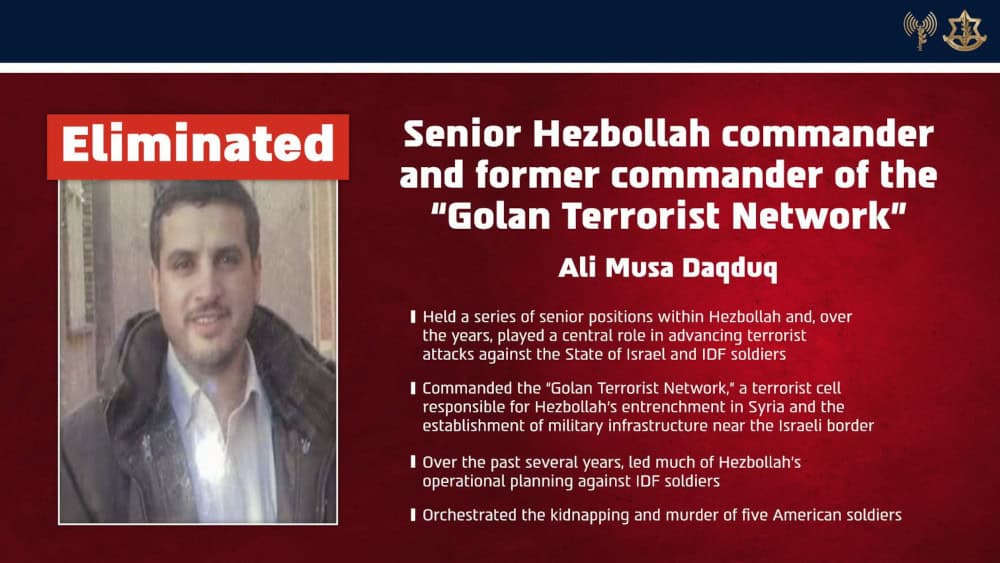
The Israel Defense Forces (IDF) confirmed that it killed Ali Mousa Daqduq, a top Hezbollah military leader and a commander in the Radwan Unit, the group responsible for infiltrating the Israeli border. Daqduq played an instrumental role in establishing Iraq’s Iran-backed Shia militias during the early 2000s and was in US custody at one point in time. A US defense official had claimed Daqduq was killed by the Israelis in 2024, but his death was never confirmed.
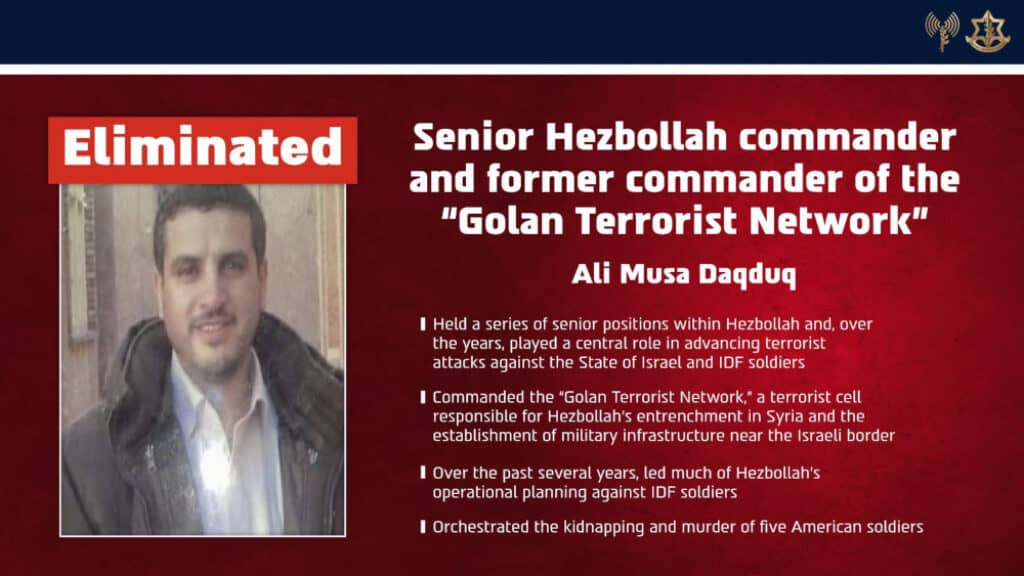
The IDF said that Daqduq was “eliminated” in a post on X on June 14. Daqduq was described as a “senior Hezbollah commander who held a series of 5 senior positions within Hezbollah.”
Daqduq played a central role in advancing terrorist attacks and combat operations against Israel and IDF soldiers,” the IDF stated. “In 2007, he orchestrated the kidnapping and murder of 5 American soldiers.”
The 2007 incident that the IDF linked to Daqduq was the attack on the Karbala Provincial Joint Coordination Center that was carried out by the Iranian-backed Khazali Network. Five American soldiers were kidnapped and subsequently executed by the terror group. This attack was facilitated by Iran’s Islamic Revolutionary Guards Corps, which created a mockup of the Karbala Provincial Joint Coordination Center to help the terrorists train for the operation.
The Khazali Network is led by Qais Khazali (or Qais Qazali), the head of Asaib Ahl al Haq, another Iranian-backed militia and a US-designated Foreign Terrorist Organization. Like Daqduq, Khazali was in US custody but transferred to Iraqi custody and freed by the Iraqis as the US withdrew from Iraq in 2011. Khazali immediately retook control of his militia, despite promising to lay down his arms.
Khazali confirmed Daqduq’s death and described him as “among the first to answer the call of duty during the American occupation of Iraq” in a eulogy posted on X.
Khazali reported killed in 2023
The report of Khazali’s death highlights the difficulties inherent in confirming the targeted assassination of terrorist leaders. Without the possession of a corpse and subsequent confirmation with DNA testing, or a martyrdom statement by the terror group, it is difficult to know if a targeted strike actually killed the commander.
In the fall of 2024, an unnamed US defense official claimed that the IDF had killed Khazali. However, the IDF never confirmed the reports of Khazali’s death, nor did Hezbollah confirm that Israeli forces killed Khazali.
Daqduq’s legacy in Iraq
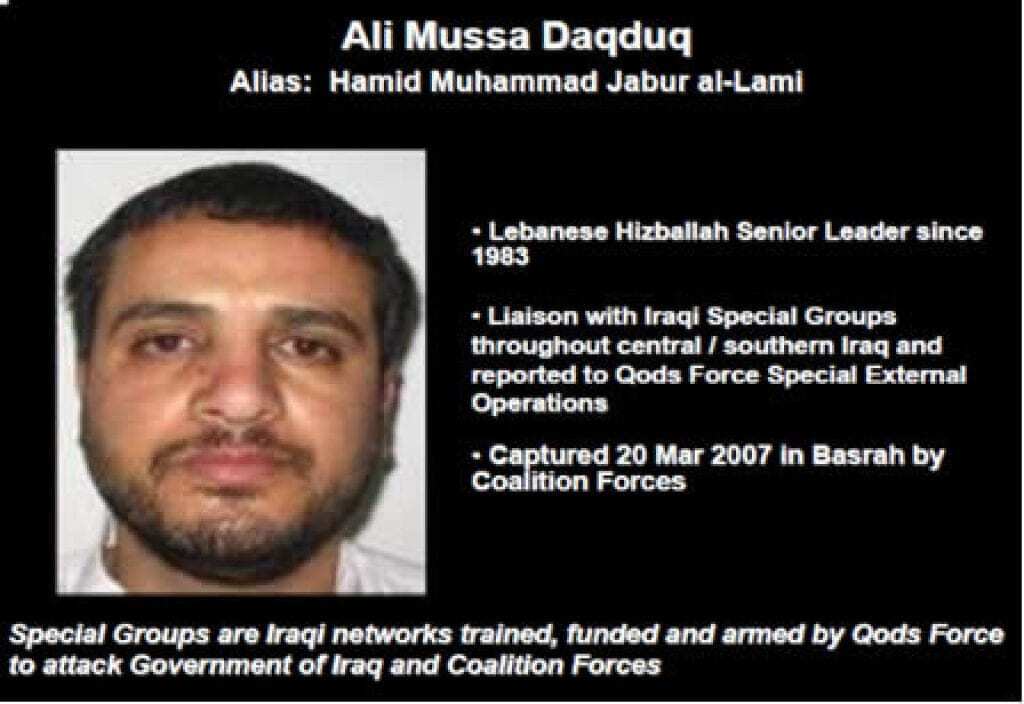
The US government added Daqduq to its list of Specially Designated Global Terrorists in November 2011 for his role in establishing the Iran-backed militias that are responsible for the murder of at least 600 American soldiers in Iraq.
According to the US Treasury Department, “In approximately 2005, Iran asked Hezbollah to form a group to train Iraqis to fight Coalition Forces in Iraq. In response, Hassan Nasrallah established a covert Hezbollah unit to train and advise Iraqi militants in Jaish al Mahdi (JAM) [or Mahdi Army] and JAM Special Groups, now known as Asaib Ahl al Haq [League of the Righteous],” a Mahdi Army faction which is a US-listed Foreign Terrorist Organization. Asaib Ahl al Haq has emerged as one of the most powerful Shia terror organizations in Iraq today.
Daqduq worked closely with former Islamic Revolutionary Guards Force—Quds Force commander Qassem Soleimani, Abu Mahdi al Muhandis, the former head of Iraq’s Popular Mobilization Forces and the founder of Hezbollah Brigades, Qais Khazali, the founder and leader of Asaib Ahl al Haq, and Abu Mustafa al Sheibani, the founder of the Sheibani Network and current leader of Kataib Sayyid al Shuhada, also a US-designated Foreign Terrorist Organization, to establish a network of militias loyal to Iran.
The US killed Muhandis and Soleimani in an airstrike in Baghdad in 2020.
The Iranian-backed militias that Daqduq, Hezbollah, and Iran spawned are now powerful entities in Iraq and Syria. In Iraq, the militias wield significant political power in parliament. At the same time, the military branches dominate the Popular Mobilization Forces, an official arm of the Iraqi security establishment that reports only to the prime minister.
In 2007, Daqduq was captured by the US military. After 11 months, he was transferred to Iraqi custody and released in November 2012 after being acquitted of terrorism charges. Following his release in 2012, the US added Daqduq to its list of Specially Designated Global Terrorists. He soon returned to Lebanon and was placed in charge of training Hezbollah’s special forces.