
Welcome to From the Batman News Desk, a new series of op-eds and articles covering various aspects of Batman history. Each week one of the Batman News writers will share their thoughts on Batman characters and concepts across comics, film, television, and more.
I’m sure you’ve heard many of the accusations levied against Batman. Everything from him being responsible for crime in Gotham to his fight against that crime being totalitarian and itself evil. In fact, these sorts of perspectives have gone beyond simply being hot takes one might hear from fans. Even the comics themselves have acknowledged and sometime gone so far as to promote them. So how much validity is there to these ideas? Would Gotham be better off without Batman at all?
In this “Batman on trial” series, we’ll break down some of the biggest criticisms against Batman and examine their validity. Starting off with the accusation that Batman causes more supervillains than he stops.
This is the one that I think has been most explicitly addressed by the text, so I figured it would be a good place to start. Now, no one is claiming that all crime in Gotham is Batman’s fault. After all, the fact it was such a problem in the first place is a pretty big part of his origin story. Joe Chill is a personification of that criminal element, and Gotham is clearly in a bad place when Bruce returns from his training abroad. What does get placed at his feet are the more flamboyant and extreme types of crime that the city is known for. the Mob and gangs are one thing, but ever since Batman showed up is when you start getting costumed megalomaniacs who try to blow up half the city.

This idea forms the central point of a number of stories. Batman: The Long Halloween, in addition to serving as an origin story for Two-Face, also explores the transition from a Gotham ruled by gangs to one controlled by supervillains. That comic served as a big inspiration for the movie The Dark Knight, where Gordon compares the rise of costumed villains to the tendency for villains to always respond in kind to a more weaponized police force. Both stories place Batman as the focal point which causes the rise of a new type of criminal.
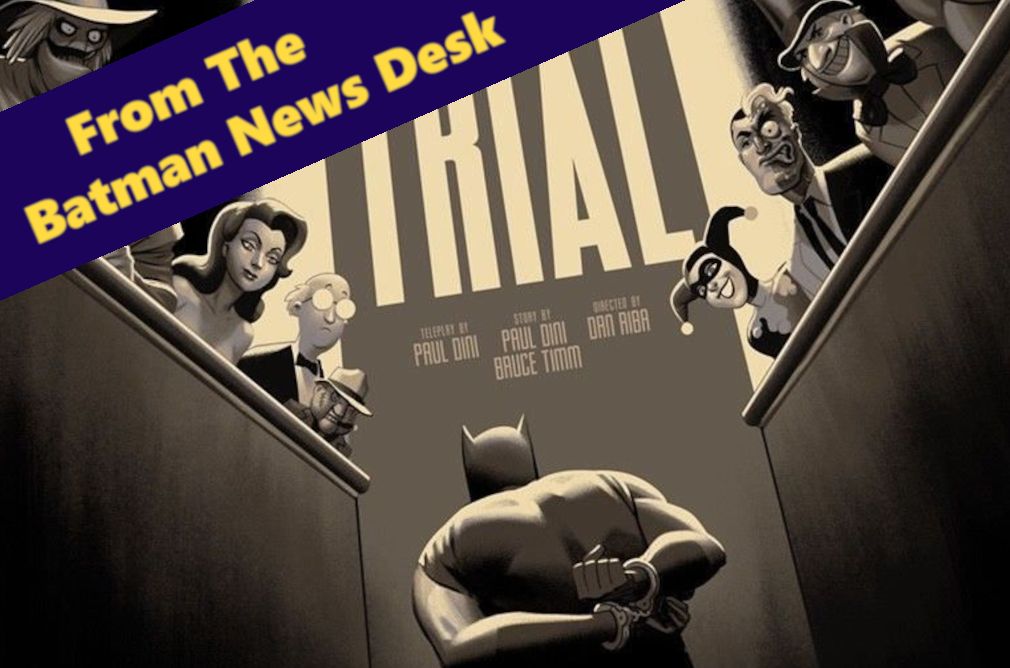
Other examples include the episode “Trial” from Batman: The Animated Series, which even directly prosecutes Batman for causing his rogues gallery to become criminals. This trial is a sham conducted by the villains themselves, but it establishes that the idea has been around for a while. More recently, writer James Tynion created the criminal “Victim Syndicate” in his run on Detective Comics, where each member was collateral damage from Batman’s war on crime, now out for revenge. Their perspective is even lent a decent amount of credence by the narrative, with characters like Stephanie Brown, Harper Row, and Leslie Thompkins admonishing Batman for the harm he causes.

However, if there’s one character that acts as the load-bearing pillar of this theory, it’s the Joker. He is in many ways the Ur-example of a Batman villain, and that gets extended to his origin as well. First established in 1951’s Detective Comics #168, his origin is that he was a criminal who fell into a vat of chemicals while trying to escape Batman. It’s the clearest, most direct cause and effect instance of Batman “creating” one of his villains… and yet it still isn’t that true, is it?
If you notice, he was already a criminal doing crimes when his accident happened. One might argue that Batman’s actions are what caused him to go insane, but even that doesn’t hold up to closer scrutiny. Nowhere is this more famously examined than in Alan Moore’s Batman: The Killing Joke. Perhaps the most iconic moment from that story is Joker’s speech, wherein he tries to convince Batman that all it takes is “one bad day” to drive anyone to criminal insanity. Everyone remembers that part, but they forget that the comic then goes out of its way to say he’s wrong.

That “one bad day” isn’t what drove Joker to be the way that he is. Whatever was broken inside him was there long before he ever encountered Batman. The incident only allowed it to manifest in a particular way. The same or similar can be said about almost every other villain who blames Batman for their actions. They are consistently the result of ego and delusion. That “Trial” episode I mentioned earlier even explicitly says as much in the lawyer’s final speech. The Victim Syndicate’s anger, while sympathetic, is misdirected.
Go down the list of his rogues, and very few of them ever even met him before they started doing crimes. However, in fairness, it’s worth looking at some of the more notable examples that could be used for the argument. The big ones would probably be Joker, Two-Face, Riddler, Bane, Failsafe, and (depending on your definitions and/or editorial’s whims at a given moment) Red Hood. Joker we’ve already addressed, and Two-Face’s rage is directed at the injustice of the system as a whole rather than Batman specifically. In fact his tragic origin is a direct consequence of the “traditional” mafia-based crime that costumed villains supposedly replaced.

Riddler I only include because he is so driven to outsmart Batman, but that’s only because Batman holds the title of World’s Greatest Detective(tm). If it wasn’t him, it would be whoever else he felt would most prove his intelligence, whether it be other superheroes or the detectives in general. Matt Reeves’ movie Riddler is maybe a bit different because he is directly inspired by Batman to act, making Batman arguably responsible in that instance. However, not only is the film not “canon” for our purposes, but learning to not be the kind of person who inspires people like Nygma is Batman’s primary character arc in the film.
Bane’s motivation is, ironically, very similar to Riddler. He went after Batman specifically because he wanted to prove that he was the most powerful. His whole thing was wanting to be the top dog, whether it was in Santa Prisca or Gotham (though I’d love to see an Elseworlds where he is told about Metropolis instead). He wouldn’t be happy until he had proven to himself that he was the best, and similar to Riddler, if it wasn’t Batman it would be someone else.

Red Hood and Failsafe are interesting in that they occupy a similar narrative roles, both in that they were created directly by Batman and that they ultimately find that his problem is that he’s not totalitarian enough (definitely more on that in a later entry). They’re probably the best examples to use for the argument as a whole. Let’s take a step back, though, and look at what that entire argument would then be reduced to. 95+% of Batman’s villains exist totally independent of him, with only one or two who exist as a direct result of his actions. The first is regularly referenced as “Batman’s greatest failure”, and the other is the same idea but told much worse. If we’re simply asking whether Gotham would be better off in terms of whether there would be less bad guys, the answer is a resounding “no”.
The one part of this argument that maybe holds some weight is that Batman’s presence lends to the criminals’ sense of theatricality. It is true that before Batman showed up, no one else in Gotham was dressing up like storybook characters or incorporating oversized props in their crimes. However, other than a vague sense of “inspiration”, it’s very hard to draw any sort of cause and effect there. It’s also an accusation that you could equally apply to just about any superhero. Their villains don’t tend to show up until after they do.

At a certain point, you somewhat have to come at it from a meta perspective. It’s honestly because new villains generally make for more interesting stories. Sure, without any sort of causal link it just becomes a coincidence, but that’s simply the nature of the genre. Whether it’s Marvel or DC, initially there weren’t any costumed superheroes, and then they were everywhere. You can certainly have fun with that notion, like Grant Morrison making all of Batman’s history tied in a causal time loop, but at the end of the day it’s just comics.
This all creates a pretty definitive case against the misconception that Batman is the cause of crime in Gotham. When examined, it’s generally the ego-driven ravings of his villains themselves. Almost all of them would have turned to crime for reasons totally unrelated to Batman, and the tiny few who are in direct response to Batman tend to believe he needed to be doing more. In the world as defined by the comics, without Batman, almost all of these people would still be terrorizing Gotham but with no one to stop them. They do only exist because of Batman in the real world, but that’s simply a fact of creating new villains for any hero to face.
Tune in next time where we take a look at the other side of the coin for this argument: Yes these criminals already existed, but isn’t Batman the bad guy for beating the poor and mentally ill?
COMMENTS