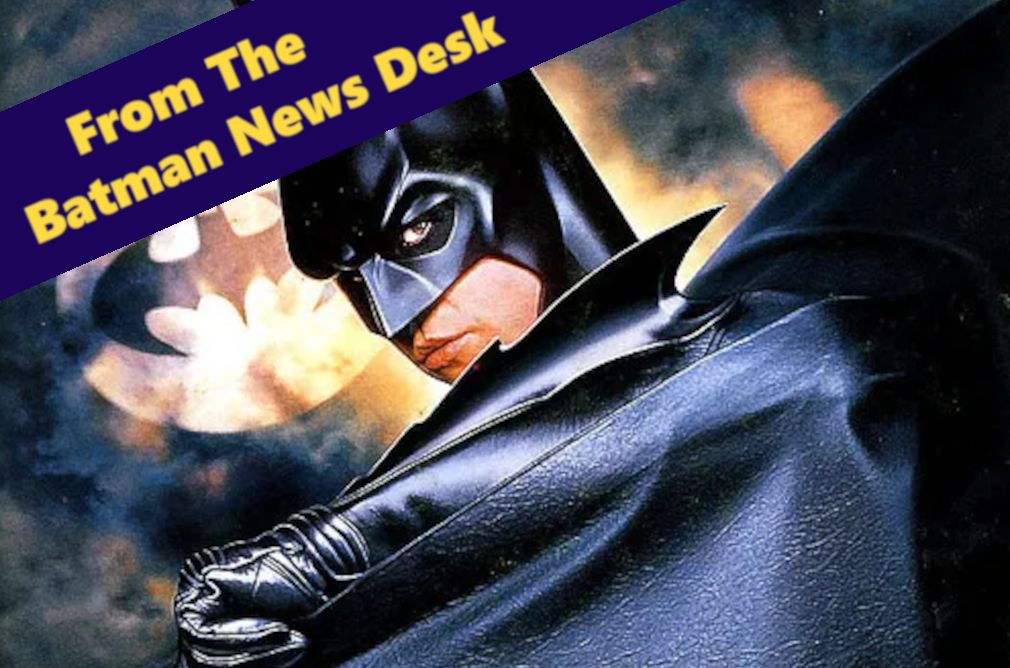

Welcome to From the Batman News Desk, a new series of op-eds and articles covering various aspects of Batman history. Each week one of the Batman News writers will share their thoughts on Batman characters and concepts across comics, film, television, and more.
In 1995, the so-called “MTV Generation” was already in full swing. Bands like Aerosmith or artists like R.E.M were taking over the airwaves, and hip-hop began embracing grittier street sounds. In comics, Batman was the edgiest he’d ever been up till that point. Following the iconic Knightfall saga, new Batman Jean Paul Valley tore across the pages of the main title, eventually replaced by an era of Bruce’s moody, tortured avenger soon after. Similarly, Tim Burton’s successful Batman (1989-1992) films were redefining cool with their gothic, but ultimately slick portrayal of the modern hero. Regardless of Burton and Warner Brother’s disagreements, another Batman film was inevitable. So, before audiences knew it, Joel Schumacher’s Batman Forever (1995) had arrived, and with it, a brand new sound.
The March
Schumacher chose Academy Award Winning composer Elliot Goldenthal as the film’s main composer. At the time, he was famous for his work on Alien 3, Pet Semetary (1989), and Interview With A Vampire (1994). According to the Beyond Batman: Scoring Forever – The Music of ‘Batman Forever’ (2005) documentary, Goldenthal alleges that Schumacher chose to “cast” the composer first. Despite the many iconic Batman scores, Goldenthal made it his business to keep the score free of previous influences. Instead, Goldenthal’s inspiration came from the legendary Richard Wagner, Sergei Prokofiev, and childhood imagination. As a result, the core of the Batman Forever score became a motif a child can hum to themselves. The real magic of his heroic march is that depending on the tempo or choice of instrument, it changes its power and overall meaning.
Combined with the freakish visual effects and set design, Goldenthal’s swanky score transports audiences to another world. In contrast to Burton’s melancholic Gotham, Schumacher and Goldenthal embody this version with brightly corrupt indulgences and celebrity idolatry. From the very first frame of the film, the sound design takes flight, using its sweeping musical cues and detailed foley to paint a grand gothic picture. Yes, there are shots of Val Kilmer’s statuesque Batman’s buns and rubber nipples, but it’s too late to complain. By the time you realize it, you’re in the Batmobile hurtling towards danger with a suspicious craving for McDonalds! However, the key to the score is its mythic scope. Goldenthal reliably sketches Batman out of heroic brass, rhythmic drums, and hypnotizing strings. While the city sounds wild and untamed, Batman’s march remains consistent and true.

The Ahem… Sexual Tension
Weirdly enough, the underlying fabric of Batman Forever is its uncompromising horniness. From the homoerotic costume design, intimate sets, and psychosexual dialogue, there is sex all over this movie. Even the body of the unmistakably phallic Batmobile resembles lace hosiery. Which makes sense, considering how much the film wants you to know how badly “chicks dig the car.” By the way, the women that proposition Chris O’Donnell in that infamous scene are the members of the R&B group En Vogue, which is admittedly a neat cameo. Anyway, outside of Two-Face’s extremely horny gun molls, the worst offender is Nicole Kidman’s Dr. Chase Meridian. Although Burton also leaned into making Batman a sex symbol, Chase Meridian’s role was mostly temptation for temptation’s sake. Unfortunately, none of the female characters pass the Bechdel test whatsoever.

Still, Goldenthal adorns Kidman’s character with an appropriately sultry theme. The longing saxophone that follows her more intimate scenes embodies her lingering but distant desires. In addition, I really enjoy the few noir-like piano notes that really emphasize the lustful curiosity between her and Batman. Though, as their more serious scenes are about Bruce, the score reflects a more somber version of Bruce’s motif. Similarly, Edward Nygma’s celebrity obsession with Bruce are faintly sexual as well. As for O’Donnell, the film portrays him as a himbo and overall heartthrob. However, whether doing laundry barefoot or leaping on furniture, the score consistently portrays him as a badass. Notably, these sequences sound like kung-fu action movies with electric guitar riffs and clanging metal.

Sanctioned Buffoonery
Green with envy, Jim Carrey’s physical transformation throughout the film is both a major highlight and point of criticism. Naturally, the music heavily depicts this transformation in stages. Firstly, Edward’s theme is anxious and meshes with the humdrum pace of a rigid corporate office. What stands out about it are the sharp schizophrenic stabs punctuating his mood swings and often euphoric thoughts. This culminates in the eerie scrambled computerized noises within his manic “feeding off your brain” jingle. Outside of the office, we see how pathetic the character lives, brilliantly cued to The Flaming Lips song “Bad Days.” As the character comes into his Riddler identity, the music is free to sound more alien, sometimes accompanied by insincere, sarcastic violin arrangements. By the end, his score is magnanimous and loud, proclaiming his deification.
On the other hand, Two-Face has the zaniest score in the entire picture. Built of almost entirely big brass, his themes appropriately create villainous moments of awe and suspense. It is a shame that the Harvey side of the character isn’t at the forefront of the movie, as opposed to the abundant and eccentric gangster motifs. Instead, the film chooses to use Two-Face and Riddler as opposites, portraying Harvey as the brawn to Edward’s brain. The character comes into the film fully formed, and remains anthemic and fun, utilizing extremely cartoony sound effects and goofy exclamations. Harvey has several major set pieces featuring helicopters, underground ambushes, car chases, heists, a circus, and hostage situation above a “watery grave” below. Personally, Goldenthal’s playful “Two-Face Three Step” motif, and “Two Face’s Demise” are my favorites in the entire film.

Partners
Finally, the heart of the film surrounds the parallel between Kilmer’s Bruce and O’Donnell’s Dick Grayson. Initially, the Haly’s Circus sequence has an exciting drum heavy sequence of music meant to characterize the wonder of the circus. Each of the Flying Graysons breathlessly perform death defying stunts, punctuated by satisfying fanfares of relief. Unfortunately, when Two-Face eventually attacks, there is only the suspense of a ticking timebomb, and ends with no fanfare of a death defied. Sadly, the sting of O’Donnell’s sell and the somber character defining score makes the scene tragically memorable. Most importantly, Bruce and Alfred take in the very adult Dick Grayson, because of how closely their tragedies align.
Mainly, Dick’s trauma reignites repressed memories from Bruce’s childhood that influence his relationship with Meridian, Grayson, and his ultimate declaration at the end of the film to remain Batman forever. Yes, I know! In these dream sequences, Bruce imagines himself as a child wandering in a church reading a red book, underscored with somber, ethereal strings. Curiously, these quieter moments, like during the telling of the “Robin” story, are the most subtle parts of the movie. As the film progresses, the duo continously criticize one another in a series of tense arguments, leading to Bruce questioning his own motivations. These particular moments of doubt have their own serious worrying score. As a result, a hopeful alternative reinforces their genuine connection in sections of the film where the duo support one another.

A Batman Forever Of Its Time
To audiences around the world, Batman Forever ended up a smash hit, if not critically mixed. The troublingly campy tone, plot holes, and nipple bound Batsuit became points of contention, but the soundtrack was a cultural phenomena. For instance, Seal’s “Kiss From A Rose” ended up winning four Grammy awards in 1996 and arguably remains his most popular record to this day. At the same time, the pop soundtrack remains a fascinating time capsule of ninety’s music as a whole. The album features artists like Brandy, U2, Method Man, Nick Cave, and Iggy Pop among others. Heartbreakingly, due to the poor reception of its far campier sequel, Batman Forever became a joke for decades. In spite of that, it would see favorable mentions every so often in films like Ingrid Goes West (2017).
Of course, the true shame is the underappreciation for Elliot Goldenthal’s score. While Danny Elfman’s memorable score overtook the Batman ’66 theme song as the quintessential Batman theme, Goldenthal’s score deserves respect. So too does the late Val Kilmer’s performance. Goldenthal’s detailed depiction of the character and his world in music, in his words, “dictated by character” is becoming rarer these days. A lot of superheroes don’t even have memorable themes anymore, or often feel phoned in. Goldenthal would go on to score films like Michael Mann’s Heat (1995) and Julie Taymor’s Frida (2002), but Batman Forever’s score is timeless.
Images and music belongs to WarnerBros. Batman Forever (1997)
Next week: nostalgia of a different kind!
COMMENTS