By Kate Hemsley, Emma Brady Reid and Karen Till
This is the fourth of a series of ‘Eye on the World’ blogs written by Geography staff and students participating in a MA Spatial Justice community geography research partnership with Our Shared Plate (OSP), a food climate action initiative of the social enterprise Neighbourhood Network. Focusing on publicly-engaged research methods in Human Geography, the blogs consider how OSP supports sustainable communities through community growing initiatives, and advances food sovereignty and environmental education.

In our previous “Eye on the World” blogs written by MA Spatial Justice students, Maynooth Human Geography staff and our public-engagement partner Our Shared Plate (OSP), we have noted the many benefits of community gardens, allotments and shared growing spaces in supporting sustainable communities. In 2024, OSP began supporting shared growing spaces in nine neighborhoods in Laois, Longford and Kildare counties, and within their first year, OSP saw over 1,000 participants and hosted 49 workshops on topics including composting, planting, edible hedges, and cooking. OSP advances food independence and sovereignty, climate action and resilience, as well as celebrates the kinship dynamics created with food sharing. OSP participants have become more educated on sustainability practices, which help combat the high cost-of-living, and now contribute to improving food security in their neighbourhoods by substituting some groceries usually purchased with produce from their community garden (informal conversations with OSP participants; see also Dubová and Macháč, 2019). Another benefit of community gardens is the fact that the produce is 100% local and fresh, thereby eliminating the use of plastic packaging. OSP are now extending their work supporting healthier communities across Ireland to strengthen local food supply chains.
In this blog, we describe the psychological, social and cultural benefits of the green spaces co-created by OSP and local residents. People who come to these communal growing spaces create personal and social bonds over their shared love of food. We discuss how building community through gardens improves people’s mental health (Egli et al. 2016) by offering a place for people to connect with one another. At the same time, sharing and eating food is pleasurable – it is embodied and sensory, and relies on relationships of hospitality and trust. The first half of our blog offers the personal insights from Paul Corden, a volunteer gardener at the OSP community garden at the Newbridge Family Resource Centre (NFRC) (Figure 1) that the MA Spatial Justice students got to meet last semester. The second half of this blog describes OSP artist in residence Jennie Moran’s artistic response to the stories shared by residents participating in OSP through her food-based philosophy of hospitality.
Building Community in Newbridge
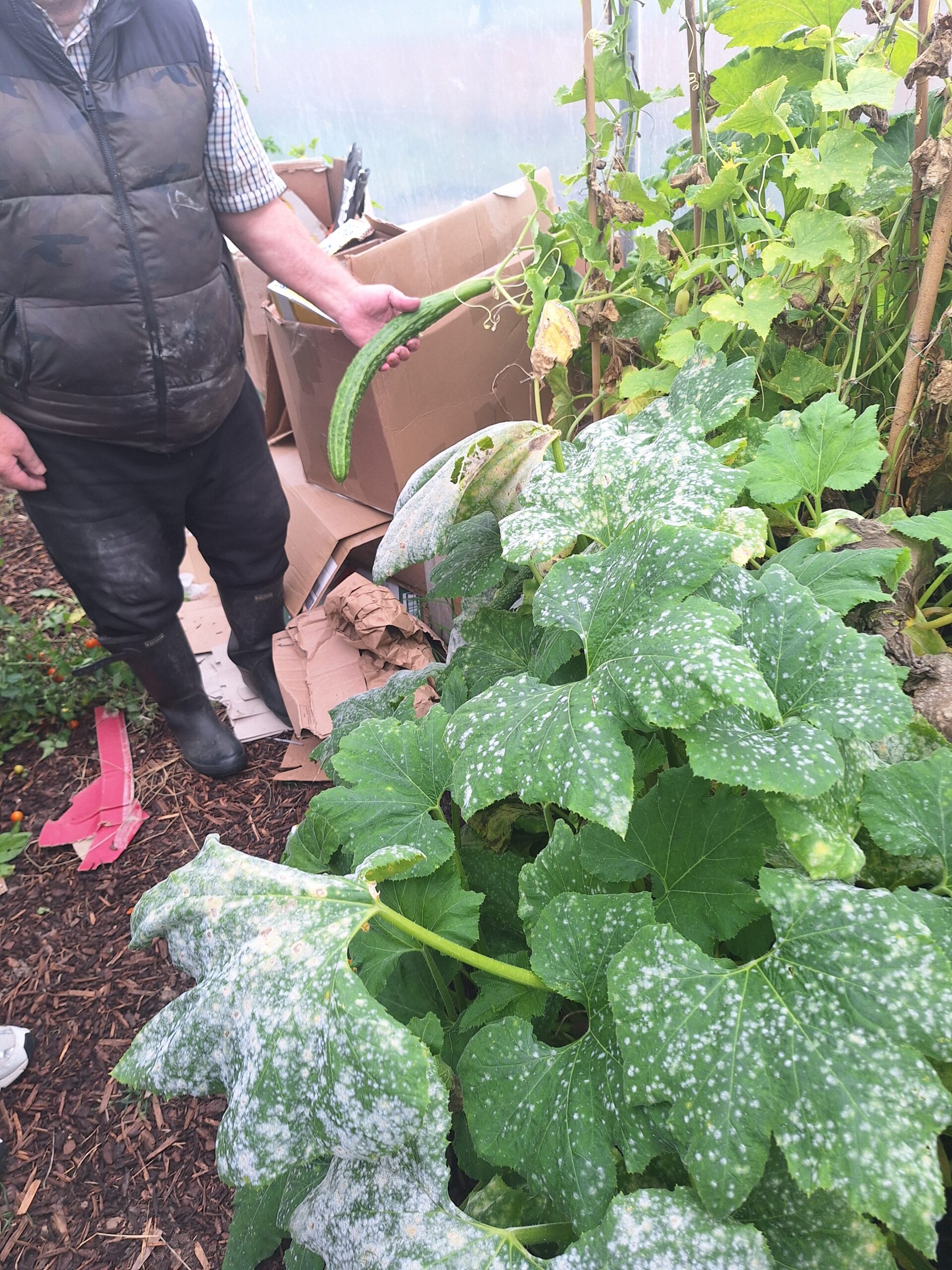
As we mentioned in our second blog, Paul Corden was one of the NFRC members who co-led our ‘Public Engagement and Spatial Justice’ MA class in a tour of the OSP and NFRC Community Garden last October (Figure 1) and who taught us how to plant spring garlic in a planting workshop (Figure 2). We were delighted also to listen to Paul share his OSP experiences as an invited speaker at NN’s end of year celebration in December 2025 at Fumbally Stables. We felt very privileged to have met and learned from Paul, and wanted to hear more of his story, so invited Paul to do an interview with us, which he generously agreed to. Our discussion below is mainly based on that conversation (December 2025, with Kate Hemsley and Karen Till).

In his interview, Paul described his life experiences that led him to become a volunteer gardener at NFRC. Paul first travelled from the UK to Ireland in 1999 on holiday to visit friends and had such a good time that he decided to move here to experience ‘a different pace of life’. Paul easily found work and contributed to many construction projects; he began digging foundations primarily around Newbridge. After ten and a half years, Paul lost his job, following the global economic crash in 2008. This new way of life had its challenges, and Paul experienced some negative health impacts as he adjusted. He told us that after two years of looking for work, he became depressed: ‘I was frustrated and I finished up in hospital. They recommended me to the Platinum Clubhouse, and I found myself again. I then joined … the Men’s Group and I find myself volunteering’. At NFRC, the Platinum Clubhouse is a programme supported by HSE EVE that focuses on community-based recovery programmes, including skills training and volunteering. Paul became a cornerstone in these community spaces and continues to contribute to the Clubhouse’s kitchen; his involvement in the Men’s Group led to creation of raised beds at the NFRC. At the NFRC more generally, he is always there to lend a hand, often welcoming new people and helping them to adjust.
When OSP approached the NFRC about creating a community garden, the staff and volunteers were delighted as they already had the space and the community interest but needed the expert-led workshops and extra support OSP provided in the planning and implementation of the garden (OSP 2025b). These workshops resulted garden designs created by local participants. As part of the ‘Pixels + Pictures’ working group in October-December 2024, OSP workshop leader and horticulturalist Lucy Bell (Figure 3), facilitated workshops in which participants proposed and discussed what they wanted in their community garden, and then worked together to create the appropriate design. Paul was a key contributor.

In his conversation with us, Paul detailed the process of designing the different components of the garden, including a sensory garden, an idea inspired by a Men’s Group participant who is blind. Paul recalled that his colleague ‘wanted somewhere where he could smell and touch and hear the sound of wind in the grass’. Paul continued, that today this has become an important space for their eco-social community: ‘[c]rows and seagulls and people enjoy the sensory garden. Walking around the creche, children absolutely adore the freedom of exercising and playing games around the sensory garden’ (Figure 4). About the collaboration between NFRC and OSP, Paul described the creative process as ‘incredible’, saying: ‘We were tucked away in a lock-up cabin, throwing ideas up into the air and catching them’, adding ‘I was delighted to have an outlet for the produce that we’ve been growing… And to be able to share them with the local community, Our Shared Plate, the Platinum Clubhouse, the staff; and having the children in to show them everything growing is a bonus as well’.

Paul’s story and experiences highlight the positive social and mental health impacts of developing a deep emotional attachment to place through community building processes. As the 2025 Maynooth Geography final research report noted, OSP offers a model of co-creating ‘enabling environments’ (HLPE, 2014) that empowers residents and community members. In urban planning literature, scholars have also found that a stronger and more positive sense of belonging is developed when participants are part of a community-engaged planning process based on co-production. Such practices may support psychological and social relations that build healthy community bonds (Ellery & Ellery, 2019), thereby also strengthening social systems of support that contribute to climate resilience (Randolph, 2012). In our conversation, Paul echoed these academic findings. When asked what the highlight of his OSP experience was, Paul remarked ‘I am just proud of the fact that we’re creating something to be shared’ (Figure 5). Beyond sharing produce, creating a community garden means sharing trust and friendships. Indeed, many of the people who were involved with the NFRC community garden noted at OSP workshops that they were unaware of how diverse their neighbourhood was (OSP 2025b). When residents play a major role in designing and contributing to a multi-functional and inclusive community garden, they also decide what, where and how they wish to create more inclusive social spaces together. The additional benefits of growing and sharing food may lead to offering others support and care, creating more diverse friendships and establishing relations of trust with strangers. As we discuss in the next section, sharing food includes such cultural benefits, including relations of hospitality.

OSP artist in residence, Jennie Moran, created an audio art piece, ‘Food is Never Just Food’ (Moran, 2025) (which you can listen to here and watch an animated version here), in response to stories that OSP participants shared over food. Her artwork, supported by Kildare County Council Arts Service, considers food as a language that ‘tells our story, carrying our past, our connections, and our identity’ (OSP 2025a). The audio work considers the role of food in the places of our earliest ancestry, from ancient times to Irish stories in the present-day, thereby connecting our shared humanity. Jennie understands food as ‘the space of possibility that opens up between guest and host when they willingly engage in mutual respect’ (Moran cited in RTÉ, 2024, np). Reflecting upon her food-based philosophy about hospitality in her new book, How to Soften Corners (Morin, 2024), Jennie’s practice draws upon Jacques Derrida’s 1996 lecture, ‘Step of Hospitality/No Hospitality’, in particular the following passage:
‘Let us say yes to who or what turns up, before any determination, before any anticipation, before any identification, whether or not it has to do with a foreigner, an immigrant, an invited guest, or an unexpected visitor, whether or not the new arrival is the citizen of another country, a human animal, or divine creature, a living or dead thing male or female’ (Derrida cited by Moran in RTÉ, 2024, np).
Jennie is founder of Luncheonette, described as ‘a mobile hospitality service’ travelling to where it is needed, which included the end of year celebration by NN and OSP in Dublin. Jennie co-curated an evening of food, stories and gifts, including OSP’s Community Workbook described in our previous blog. On a chilly December eve, guests were greeted with warming turmeric tea, following by fresh local crudités, bread and other delicious foods (Ural dahl with fresh coriander was a new dish for many of us) (Figure 6). The evening was interspersed by storytelling, including by Paul Corden, music and informal conversation.

Through the eco-social relations, spaces and sensations of food, Jennie finds ‘[t]he law of hospitality’ as ‘profoundly beautiful’, embodying ‘all that is good and decent about us. It is the spirit of human co-existence made visible and recognisable’ (Moran cited in RTÉ, 2024, np). As part of our public-engagement module with OSP before this event, we listened to part of Jennie’s ‘Food is Never Just Food’. MA Spatial Justice class members were asked to respond to the artwork by writing and sharing a memo about their relations to food with the class the following week. This writing practice triggered many personal memories. Many of the students discussed how the sharing food by strangers made them feel welcome in a new place and was also a gesture inviting them to become part of their community. Others also mentioned fond memories of parents and grandparents who shared food with family or made sure that their children did not waste food. In all of our written reflections, we identified how integral food was to our individual and social lives, and how sharing food builds connection.
We reflected upon an unexpected example of the hospitality resulting from OSP’s practice that was shared with us by Maynooth Geography researcher, Tristan Dunne (2025 conversation with Nicole Rachel Tucker and Karen Till) and noted in OSP Community Newsletters (OSP, 2025c). In Rathdowney, Co. Laois, OSP partnered with the recently built Spring Crescent neighbourhood for people seeking international protection from Ukraine and Tuath Housing. Following consultation with the community, and with the help of local Men’s Shed volunteers, OSP supported residents in creating raised beds in their back gardens, providing a horticultural planting workshop and seedlings; later in the year, the community created a shared herb and edible garden in the common community green (OSP, 2025c). At that very first (rainy) workshop, residents brought out food to those planting their raised beds. At another workshop, they brought harvested produce and cooked together (Figure 7), sharing recipes from home and learning new recipes. Sharing food was a way that residents (from different parts of Ukraine who did not know each other beforehand) changed a social relationship from stranger to neighbour.

At these workshops, residents also generously shared food with OSP team members, Maynooth Geography researchers and other volunteers attending events. At the 2025 Street Feast in April (Figure 8), for example, residents made and shared Ukrainian delicacies. They were also delighted to learn new ways of cooking, such as the outdoor cooking classes Lucy Bell ran that day that brought the foods of their old and new homes together by making borscht and roasting sausages.

Concluding Comments
One thing that we all share in common is our connection to food. Community gardens are spaces where the families, residents and community members can come together and share stories and memories as they cook and eat together (Figures 3 and 8). There are many benefits to having a community garden in your local area, and among them are the long lasting positive bonds between neighbours that are created. Such bonds combat feelings of isolation and support your well-being, while fostering eco-social sustainability. Our reflections about food through Jennie Moran’s artworks also indicate how important food is to us as people and as a society. Sharing food and stories are an inherently intimate acts of trust connecting those involved. By sharing and receiving food, we allow ourselves to be vulnerable and open ourselves up to being cared for.
We conclude with a poem by ‘Rickety Kate’1 that Paul Corden shared with us, which we now share with you, the reader:
I wonder if the cabbage knowsHe is less lovely than the Rose;
Or does he squat in smug content,
A source of noble nourishment;
Or if he pities for her sins,
The Rose who has no vitamins;
Or if the one thing is his green heart knows --
That self-same fire that warms the Rose.
Acknowledgements
We thank Paul, Jennie, OSP, the NFRC and OSP community members for sharing their knowledge and food with us during this partnership.
Kate Hemsley and Emma Brady Reid are members of the MA Geography-Spatial Justice 2025-26 cohort and were participants of the ‘GY619: Public Engagement and Spatial Justice’ class last semester taught by Professor Karen Till. Karen Till has been the Maynooth Geography Lead Researcher with OSP since 2024, working closely with Senior Research Tristan Dunne (PhD Geography) and Professor Gerry Kearns. Special thanks to Molley Garvey, OSP Project Director, and Claire Williams, OSP Community Liaison, and Ellen Duggan, Director of the NFRC, for their contributions to our learning journey and suggestions to this blog. A special thanks to Paul Corden and Jennie Moran who taught us about the value of food in nourishing our places and communities.
Endnote
1. The poem, ‘Affinity’, commonly referred to as ‘Cabbages and Roses’, was first published by Minnie Filson in 1937 under the penname ‘Rickety Kate’.
References
Dubová, L. and Macháč, J. (2019) Improving the quality of life in cities using community gardens: from benefits for members to benefits for all local residents. GeoScape, [online] 13(1) 68-78. https://reference-global.com/2/v2/download/pdf/10.2478/geosc-2019-0005.
Egli, V. et al. (2016) The development of a model of community garden benefits to wellbeing, Preventative Medicine Reports [online] 3, 348-352. https://doi.org/10.1016/j.pmedr.2016.04.005.
Ellery, P.J. and Ellery, J. (2019). Strengthening community sense of place through placemaking,” Urban Planning, 4(2), pp. 237–248. https://doi.org/10.17645/up.v4i2.2004.
High Level Panel of Experts on Food Security and Nutrition of the Committee on World Food Security (HLPE) (2014). ‘Food losses and waste in the context of sustainable food systems. A report by the High Level Panel of Experts on Food Security and Nutrition of the Committee on World Food Security, Rome: Committee on World Food Security. Report available at: https://www.fao.org/fileadmin/user_upload/hlpe/hlpe_documents/HLPE_Reports/HLPE-Report-8_EN.pdf (accessed 28 November 2025).
Moran, J./Luncheonette (2024). How to Soften Corners. Dropout Press.
Moran, J. (2025) ‘Food is Never Just Food’. [MP3 recording.] Available at https://drive.google.com/file/d/1XGX–5HteVPion-W7V9uR01T7_zJmxrf/view (accessed 24 Jan 2026).
Our Shared Plate (2025a) Pilot Progress Report [online]. Available at https://neighbourhoodnetwork.ie/our-shared-plate/ (accessed 24 Jan 2026).
Our Shared Plate (2025b) Community Newsletter: Newbridge [online] Available at https://neighbourhoodnetwork.ie/wp-content/uploads/2025/06/Newbridge-OurSharedPlate_Newsletter_2025-1.pdf (accessed 25 Jan 2026).
Our Shared Plate (2025c) Community Newsletter: Spring Crescent, Rathdowney [online] Available at https://neighbourhoodnetwork.ie/wp-content/uploads/2025/10/Rathdowney-Newsletter.pdf (accessed 25 Jan 2026).
Randolph, J. (2012). Creating the climate change resilient community. In Collaborative Resilience: Moving Through Crisis to Opportunity. Ed. Goldstein, B. Cambridge, MA: MIT Press. https://doi.org/10.7551/mitpress/8752.003.0009
RTÉ (2024) How To Soften Corners: Jennie Moran’s philosophy of hospitality
(28 Apr 2024). Available: https://www.rte.ie/culture/2024/0427/1445027-how-to-soften-corners-jennie-morans-philosophy-of-hospitality/ (accessed 4 April 2026).