
Last week, ABC News reported that Iran’s Islamic regime may have activated sleeper cells in the United States to launch terror attacks in response to the US and Israeli military campaign against it. Within days, one such attack might have happened, though it is unknown whether the assailant had official orders from the Tehran regime and its proxies or was acting on his own. Last Thursday, Ayman Mohamad Ghazali drove his truck to Temple Israel in West Bloomfield, Indiana, and tried to ram through security. Inside the synagogue, which runs a preschool program, there were 140 children alongside the staff. The 41-year-old Lebanese American was killed by security and was the only casualty in the terror attack.
As Ghazali’s identity surfaced, within hours of the attack, there also emerged a narrative about a motive: his siblings, Ibrahim and Qassem, and Ibrahim’s two minor children had been killed in an Israeli airstrike just days before. The mayor of Dearborn Heights, Ghazali’s home and the seat of the largest Shiite Lebanese community in the United States, issued a statement emphasizing that the perpetrator had just lost relatives in an Israeli strike. Drop Site News’ Ryan Grim reported on X that Ibrahim was “a school bus driver in [his] village,” while Qassem was “a personal trainer and soccer coach.” A New York Times headline, since changed, referred to Ayman Ghazali as “a quiet restaurant worker.” There was a decided shift in the narrative to the idea that Israel’s killing of civilian relatives caused Ghazali, acting alone and simply driven by grief, to commit a terrorist attack.
However, as it turns out, Ayman Ghazali’s slain brothers were Hezbollah fighters. Ibrahim, according to Israel, was a commander in Hezbollah’s Badr unit who was in charge of overseeing missile launch operations. He was the target of the Israeli strike that also eliminated the other family members on March 5, including his children.
Ayman Ghazali’s family links to Hezbollah were known to US authorities, according to official information provided by the Department of Homeland Security to news outlets. Authorities will now investigate and may be able to establish motives behind the attack and determine whether he acted alone. Regardless, Ghazali’s ties to Hezbollah are not an anomaly.
Data obtained through the risk intelligence platform, 240 Analytics (disclaimer: the author is a senior advisor for the platform), show multiple links between Hezbollah and United States Shiite Lebanese residents and nationals.
Data extracted from Lebanon’s voters’ registry show 15,322 Lebanese nationals who permanently reside in the US and are registered to vote in Lebanon. 240 Analytics data show that of these individuals, 276 hold accounts with Al Qard al Hassan (AQAH), a US-sanctioned entity that functions as Hezbollah’s de facto bank. Of those people, almost 200 require further verification due to namesake ambiguity, while 89 are confirmed matches and AQAH account holders. Of those 89 individuals:
- Three are confirmed Hezbollah members.
- 30 have proven family connections to Hezbollah members.
- 24 have relatives who hold AQAH accounts and are conclusively identified as Hezbollah members from original AQAH records.
- At least three have corporate associations with identified Hezbollah business partners. Among them is Ayman Ghazali, whose brother, Ibrahim, held a bank account at AQAH, a clear link to Hezbollah.
240 Analytics data returned evidence of a business connection between a Dearborn Heights resident and a Lebanese company controlled by Ali Tabaja, the son of Hezbollah’s US-sanctioned business leader, Adham Tabaja. Searches also returned results on some residents of the greater Detroit area, mostly located in Dearborn and Dearborn Heights, who have family links to Hezbollah members.
These ties to Hezbollah and its financial arm raise multiple concerns. Aside from any terrorism risk, some diaspora members who are Hezbollah sympathizers have historically been involved in providing financial support through donations and by offering their businesses and bank accounts to support illicit financial schemes. An individual’s status as a resident or national of the United States has allowed, as exposed in multiple cases prosecuted by US authorities, the exploitation of the US financial system to sustain terror-financing activities.
Some communal institutions that identify with Hezbollah foster and perpetuate allegiance to the group through their activities. For example, expressions of mourning for the terror group’s fallen are not unusual across the Lebanese Shiite diaspora, and US communities are no exception.
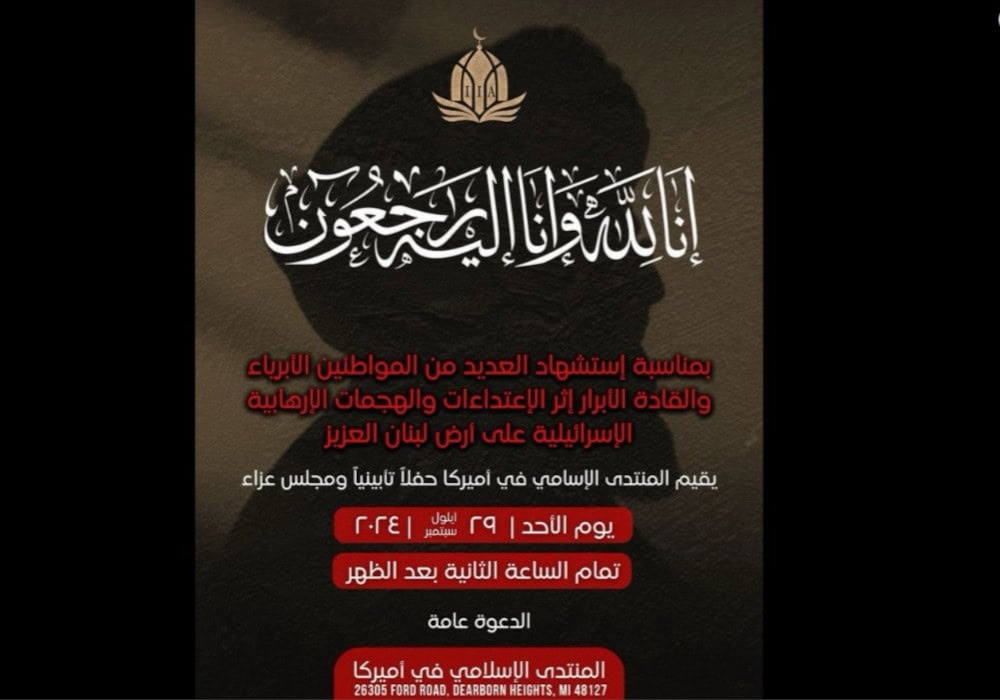
Ghazali’s slain family members were commemorated at an event held at Dearborn’s Islamic Institute of America on March 8. Previously, on October 8, 2024, the Islamic Institute of America announced a commemoration for Fadi Hussein Rmaiti, another Hezbollah fighter slain while fighting against Israel on October 7. As with Ghazali, Rmaiti had family in Dearborn Heights. In addition, the same mosque held a memorial event on September 29, 2024, for the “martyrs” slain by Israel. The poster for the event, published on Facebook (see also above), bore a silhouette resembling the late Hezbollah leader Hassan Nasrallah, whom Israel had eliminated two days before.
On March 1 of this year, the Taha Foundation, another Shiite institution in Dearborn Heights, published a condolences message to the entire Islamic nation for a “grave loss, the martyrdom of Grand Ayatollah Sayyid Ali al-Husseini al-Khamenei,” the supreme leader of Iran who was killed in an Israeli airstrike.
The Islamic House of Wisdom (IHW), also in Dearborn, organized a vigil to pray “for the soul of Sayyed Al-Shohada” (the prince of martyrs, a title usually attributed to Imam Hussein, Shia Islam’s most revered figure) on September 28, 2024, the day after Hezbollah leader Hassan Nasrallah was eliminated in an Israeli strike. It also held a memorial service for the Islamic Republic of Iran’s late president and its foreign minister, Ebrahim Raisi and Hossein Amir Abdollahian, who died in a helicopter accident in May 2024. In addition, the mosque marks Al Qods Day, an event launched by the Islamic Republic of Iran on the last Friday of Ramadan as a day of mobilization to champion the Palestinian cause.
In a Facebook post, one of the IHW’s leading clerics, Imam Mohamad Ali Elahi, described Hassan Nasrallah’s funeral on February 23, 2025, as a “day of victory for morality, truth, justice, and humanity. Sadness and celebration. Mourning and motivation. Emotion and allegiance. Grief and gratitude. People seemed to see Moses, Jesus, Mohammad, Ali and Hussein (pbut) in the service.” Community members, including a local jail’s Muslim chaplain, approvingly endorsed the Imam’s words.
The foiled attack against Temple Israel did not emerge in a vacuum. Communal institutions, including some among international Lebanese Shiite communities, have long nurtured support for Hezbollah, the Islamic Republic of Iran, and their ideology. Part of this support stems naturally from familial ties to Hezbollah members back in Lebanon, along with the Lebanese terrorist group’s active efforts to leverage these communities, especially for financial support.
On March 19, Fox News published a photograph of Ayman Mohamad Ghazali “that he sent to his sister in Lebanon the day of the attack.” In the image, he is wearing military fatigues and holding an assault rifle, with superimposed Arabic sentences exalting “martyrdom and vengeance.” Ghazali may or may not have acted alone when he attacked Temple Israel in West Bloomfield. Regardless, the ideological sentiments that likely drove him to seek mass murder at a preschool last week, along with his close ties to Hezbollah, are not an isolated incident.