

-
Written by: Mark Waid, Christopher Cantwell
-
Art by: Vasco Georgiev
-
Colors by: Matt Herms
-
Letters by: Buddy Beaudoin
-
Cover art by: Dan Mora (cover A)
-
Cover price: $3.99
-
Release date: February 25, 2026
The Flash #30 (DC Comics, 2/25/26): Writer Mark Waid and artist Vasco Georgiev hurl Wally West, Barry Allen, and Bart Allen through a kinetic time‑crisis showdown with Darkseid in a high‑concept, event-adjacent action gauntlet. The spectacle looks great and the pacing hits hard, but the script crams in so many timelines, warnings, and reversals that clarity takes a hit, Verdict: For die‑hard Flash and DC K.O. readers only.
First Impressions
By the time you hit the ending, you can feel how much the creative team wants this to be a definitive statement about the Speed Force, Bart’s role in it, and Barry’s fate, yet the rush to line everything up with DC K.O. and Crisis‑era iconography leaves the whole thing feeling more exhausting than profound. It is the rare issue where you can honestly praise the pacing and still call the reading experience confusing, because the forward momentum is there, but the story keeps zigzagging through time and metaphysics so quickly that the “why should I care right now” part of your brain never fully locks in.
Recap
Plot Analysis (SPOILERS)
From there, the script pushes Bart into the role of would‑be saboteur of destiny, as he tries to engineer a scenario where Barry does not vanish into the Speed Force at that crucial moment. Wally acts as the field general trying to keep everyone alive and focused, while Barry becomes the man stuck in the middle of a fight for his own narrative, largely reacting to forces he only half understands. Darkseid applies pressure through both raw power and philosophical taunts, reminding Bart that tampering with this moment risks shattering the very fabric of the Speed Force he has become.
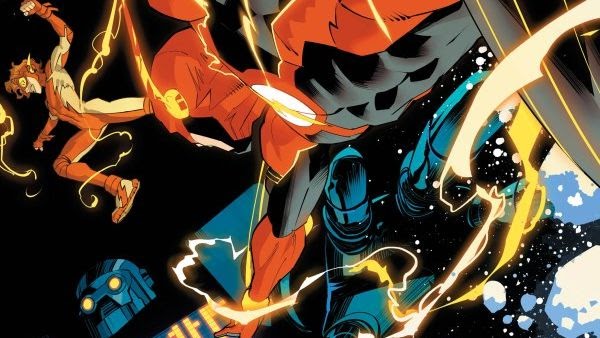
As the battle escalates, the layouts cut rapidly between different angles on the crisis, with speed trails, energy crackles, and overlapping figures stacking on top of each other to sell the sensation of time and space fraying around the Speedsters. Bart’s earlier revelation about being the Speed Force itself resurfaces in flashes of visual metaphor, as the art portrays him not just running through the storm but partially becoming it in streaks of light and fractured silhouettes. Supporting players from the DC K.O. framework and the Dark Legion concept appear at the edges of the conflict, but they mostly function as pressure valves and visual noise rather than clearly defined tactical pieces.
The climax hinges on Bart making a choice about whether to let Barry’s iconic fate play out or to insert himself as the sacrifice, which would theoretically give Darkseid the opening he wants to reshape the Speed Force in his own image. The script tries to thread a needle where Bart both honors the weight of Barry’s original sacrifice and asserts his own agency as the Speed Force, but the sequence plays out so quickly and with such dense visual information that the exact mechanics of what he decides feel muddy. By the final pages, the crisis is technically resolved and the immediate DC K.O. tie‑in obligations are met, yet the emotional landing feels strangely soft, with more emphasis on teasing future consequences than letting this issue’s choices breathe.
Writing
Dialogue swings between energetic quips and big‑idea pronouncements, and while individual lines occasionally land, the overall mix leans too heavily on characters telling you how monumental everything is instead of letting the events demonstrate that weight. Bart, Wally, and Darkseid all speak in a blend of exposition and emotion that aims for mythic but often lands as crowded, since each line has to carry plot detail, character voice, and timeline rules at the same time. Thematically, there are strong ideas on the table, particularly around agency versus destiny and what it means for Bart to be the Speed Force instead of just a user, yet the script keeps racing past its own philosophy to get back to the next explosion of speed trails. What you are left with is writing that feels conceptually rich but practically cluttered, impressive in scope but uneven in execution for anyone who is not already charting the continuity in their head.
Art
Color work leans into high‑contrast bolts of yellow, red, and cosmic violet, which amplifies the sense that the Speed Force is both a character and an environment. The palette choices make Darkseid feel suitably otherworldly compared to the warm reds and golds of the Speedsters, so you can always tell where the god of tyranny sits in the frame. When the issue quiets down for half a panel here and there, the colors shift slightly cooler, hinting at the emotional undercurrent the script rarely pauses to explore. Overall, the art team turns in a visually impressive, kinetic package that sometimes sacrifices panel‑to‑panel clarity at the altar of sheer spectacle, but if you are here for big Flash visuals tied into DC history, you will find plenty to enjoy.
Character Development
Relatability takes a hit because so much of the emotional context depends on external continuity and prior issues, not on what this script gives you in the moment. Darkseid functions as a looming, articulate threat with a consistent voice, but his interest in the Speed Force and Barry’s death feels more like a plot lever than a character obsession you can latch onto. The result is a cast that behaves in ways that are broadly consistent with their archetypes, yet rarely in ways that feel grounded in clear, immediate, on‑page motivations, which keeps you at arm’s length when you should be right there in the storm with them.
Originality & Concept Execution
Pros and Cons
What We Loved
- Kinetic layouts that keep the eye moving and sell the sensation of time ripping at the seams.
- Expressive character acting that gives Wally, Bart, and Barry distinct physical personalities amid the chaos.
- Bold, high‑contrast color work that turns the Speed Force into a vivid, living environment on the page.
Room for Improvement
- Overstuffed script that crams too many concepts and timelines into a single rushed conclusion.
- Emotional beats that rely on prior continuity instead of building clear, on‑page motivations and reflections.
- Cluttered climax where the exact mechanics of Bart’s final choice and its consequences feel frustratingly vague.
The Scorecard
Art Quality (Execution & Synergy): 3.5/4
Value (Originality & Entertainment): 0.8/2
Final Verdict
6.8/10
We hope you found this article interesting. Come back for more reviews, previews, and opinions on comics, and don’t forget to follow us on social media:
Connect With Us Here: Weird Science DC Comics / Weird Science Marvel Comics
If you’re interested in this creator’s works, remember to let your Local Comic Shop know to find more of their work for you. They would appreciate the call, and so would we.
Click here to find your Local Comic Shop: www.ComicShopLocator.com
As an Amazon Associate, we earn revenue from qualifying purchases to help fund this site. Links to Blu-Rays, DVDs, Books, Movies, and more contained in this article are affiliate links. Please consider purchasing if you find something interesting, and thank you for your support.