What’s “Affordability” to a 30-Year-Old?
During the months of January and February 2026 I published a series of eight essays around the theme of abundance – what it says about the richest country in the world and its inability to maintain infrastructure and provide healthcare, affordable housing, public education, energy, and opportunity for every citizen to achieve their potential.
As the series came out, the political climate became fixated on the word “affordability.” Polling by New York Times/Siena University asked voters what they were most worried about affording: “they usually didn’t mention the costs of goods that surged in the wake of the pandemic, like gas, cars and food.” Instead, the survey results suggest that “affordability is about the rising price of entry for a middle-class life: buying a home; paying for child care, college and health care; saving for retirement, and so on.”
Homeownership is the cornerstone of the American Dream, and the primary vehicle for building long-term wealth. For many thirty-somethings the inability to afford a home is a primary factor in delaying or opting out of marriage and parenthood.
Empty-nesters and retirees who in past decades would have exchanged their 3- and 4-bedroom homes for a smaller home now have reasons for not moving: High mortgage rates discourage taking on new loans; high demand and low supply make prices for smaller homes and townhouses as high as the older homes being sold; decades of appreciation can generate large capital gains taxes upon sale. Trading home ownership for apartments is less attractive as rents increase.
Thirty-somethings and empty-nesters suffer from being unable to afford the type of housing into which they wish to transition. Thirty-somethings look forward to first-time home ownership; empty-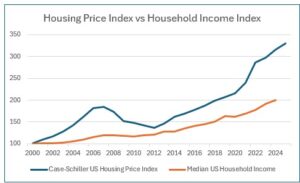 nesters look for opportunities to downsize their residences or avoid maintenance costs. Both demographic segments confront the simultaneous rapid increase in housing prices and modest income gains, making housing unaffordable. From 2000 to 2025 median household income doubled; in the same period median housing price more than tripled. Adjusted for inflation, the gap widens – median household income barely rose over the period, while median house price increased about 65 percent.
Facilitating the construction of housing units with amenities targeted for empty-nesters and retirees who no longer want or need a 3- and 4-bedroom home may be the strategy that can unlock the logjam preventing first-time home buyers from entering the market. Families looking to “move up” to a larger home would follow the retirees, and first-time buyers would have “starter” homes to choose from.
There is a variety of options for bringing housing costs down.
— Local and state governments are introducing legislation and design innovations to reduce housing costs. In zoning ordinances, mixed housing densities allow more units per acre. “Granny flats” can be added on single family lots. Reducing parking requirements in dense areas reduces land costs. Mixed-use developments combine housing with retail, office , entertainment and other types of land use. Grocery stores such as Whole Foods, Meijer and Jewel-Osco, Target Stores and recently Costco have opened smaller format stores topped by hundreds of residential units.
— Encouraging development of housing with amenities targeted to retirees would be an effective strategy for relieving a housing logjam. At scale, such a strategy would free retirees’ existing housing for families wanting to move up to their second homes, making their homes available for first-home buyers.
— Provisions in local building codes are being reviewed and weighed on a cost-benefit basis for possible elimination from the codes. Some jurisdictions estimate that savings of reverting to earlier building codes or dropping green energy mandates can reduce construction costs by $20,000-30,000. Alternative building materials, 3-D construction and factory-built modular units can result inl arge savings in labor costs.
— Almost one-quarter of the lumber used in home-building is imported, 85% of that coming from Canada. Over half of the major household appliances, such as refrigerators, washing machines and ovens, sold in the U.S. are imported fully assembled and another quarter have significant foreign-made components. The effects of high tariffs on these materials and appliances increase new home prices.
— The U.S. construction industry labor force is composed of 25-30% foreign-born workers, largely Latino or Hispanic, so immigration policy is a factor in home building and home prices. Foreign-born workers are highly represented in certain manual trades. The Hispanic/Latino share of drywall installers is 75%, roofers 64%, and painters 50-60%. Labor costs, which vary by building design and region, comprise 30-50% of the cost of new homes, and labor costs are increasing faster than building materials. Home builders project 500,000 new workers are needed in 2026.