

Airstrikes, likely conducted by the United States as part of the US-Israeli operation against the Islamic Republic of Iran and its proxies, have continued hitting Iran-backed militias in Iraq. Many of these targeted groups are part of the Popular Mobilization Forces (PMF), an official Iraqi security institution that officially reports to the country’s prime minister.
The US strategy appears to have expanded from targeting local militia headquarters and bases to going after leadership. The Iraqi militias also continue to target the American presence and interests in Iraq, including conducting numerous attacks against the US Embassy in Baghdad on March 17 and 18, at least one of which caused damage. Despite some reports explicitly stating that the US military is responsible for the unclaimed airstrikes in Iraq, US officials have not commented on any military activity in the country.
Kataib Hezbollah, an Iran-backed, US-designated terror group that controls three PMF brigades, announced the death of Abu Ali al Askari, the group’s spokesperson and a senior commander, on March 16. A security source told AFP that Askari was killed in a strike in Baghdad on March 14. That day, the Iraq-based Shafaq News reported that an airstrike in the Al Arsat area of Baghdad killed four members of Iraqi militias and injured eight more, including prominent leaders.
Haid al Amiri, head of the Badr Organization, an Iran-aligned militia and political group that controls roughly a dozen PMF brigades, said that over 60 PMF fighters have been killed and over 100 wounded in airstrikes since February 28. Both Iraqi militia leaders and political leaders, including Prime Minister Mohammad Shia al Sudani, deny the involvement of the PMF in any “actions outside the framework of the state.” However, the front groups claiming attacks against America’s interests and presence in Iraq are comprised of militias that control PMF brigades.
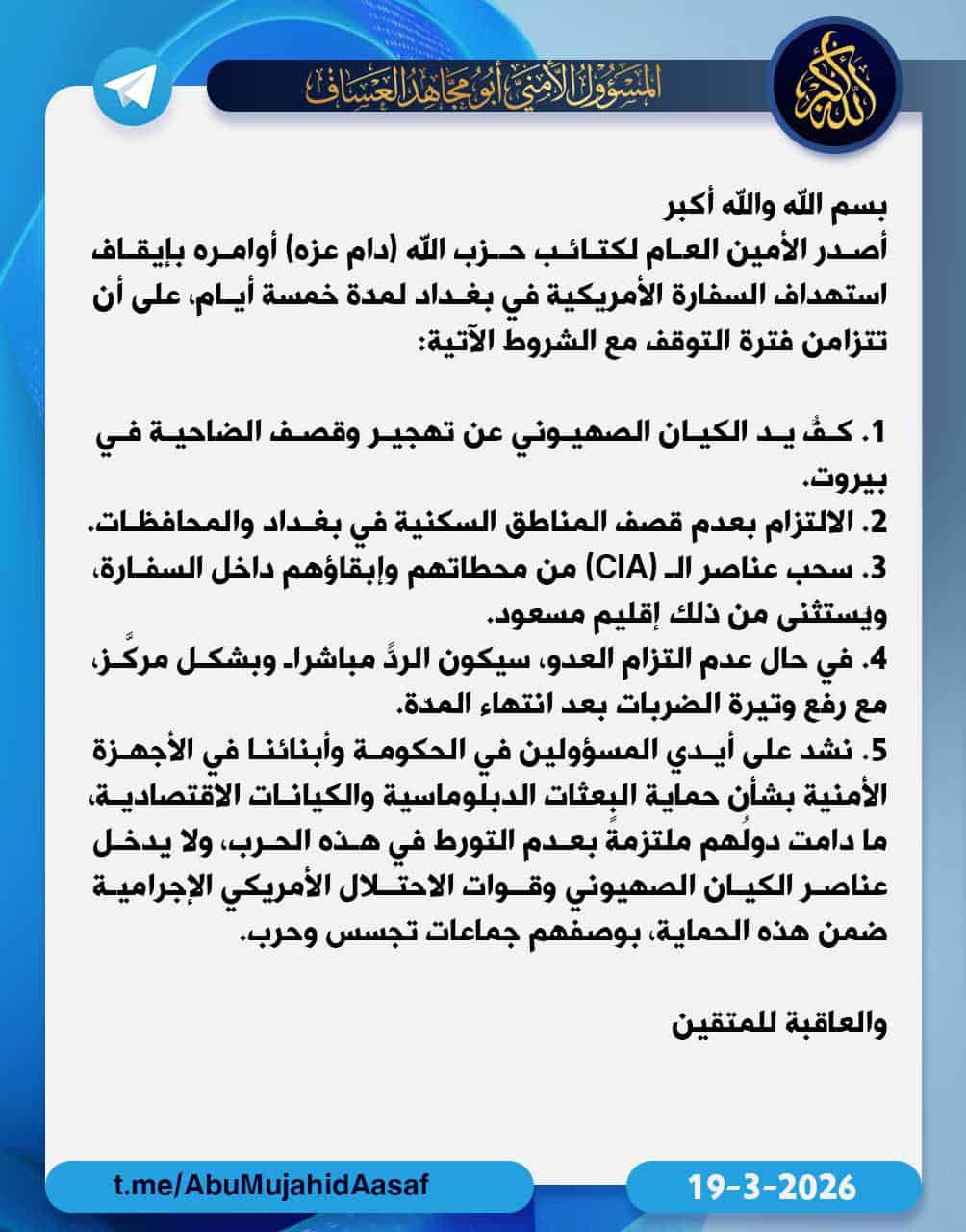
On March 19, the new Kataib Hezbollah spokesperson, Abu Mujahid al Asaf, announced a pause in attacks against the US Embassy in Baghdad, but with three conditional requirements for the US and Israel: 1) an end to Israeli attacks in southern Beirut, Lebanon, a Hezbollah stronghold; 2) an end to attacks on residential areas in Iraq; 3) a withdrawal of CIA operatives from federal Iraq to remain inside the embassy in Baghdad.
According to Iraqi journalist Mustafa Saadoon, the terms of a “tentative agreement between Washington and armed factions in Iraq” called for Washington to cease strikes against militia leaders and their Iranian advisors, which is the practical implication of the second requirement publicly issued by Kataib Hezbollah. No attacks have been reported against the US Embassy in Baghdad since the temporary ceasefire announcement.
On March 19, airstrikes targeted Iran-backed militia bases in Baghdad, Salah al Din, and Nineveh Governorates, and the PMF condemned the targeting of a headquarters in Anbar Governorate and near Mosul in Nineveh Governorate.
In Baghdad, an airstrike targeted a base belonging to the 12th PMF Brigade, which is controlled by Harakat Hezbollah al Nujaba (HHN), an Iran-backed, US-designated terror group. HHN is part of the Islamic Resistance in Iraq (IRI), a front group for Tehran-backed militias in Iraq that has claimed over 100 attacks since February 28.
In Salah al Din, airstrikes targeted the 6th PMF Brigade, which is controlled by the Kataib Jund al Imam, another part of Iran’s network in Iraq, and the 63rd PMF Brigade.
In Nineveh, an airstrike targeted the 30th Brigade, a force comprised of the Shabak minority but tied to the Badr Organization and other Iran-backed militias. The strike killed one person and injured three others. An airstrike also targeted the PMF Nineveh Operations Command headquarters.


