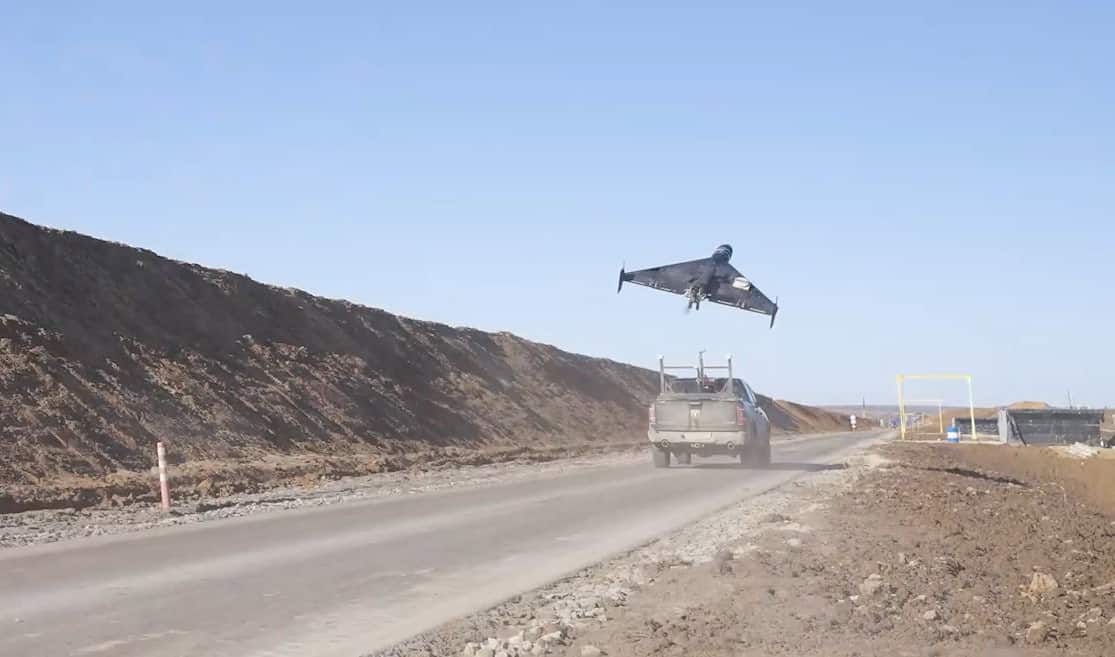
“There’s an axis of aggression between Russia and Iran,” British defense chief John Healey declared on Thursday, accusing Moscow of “sharing tactics, training, and tech” to help Tehran fight the United States and Israel. His statement came amid reports that Russia is sending drones to Iran—presumably Russian-made versions of the same Shahed-136 one-way attack unmanned aerial systems (OWA UAS) that Tehran previously provided to Moscow. By escalating its support for the Islamic Republic, the Kremlin likely aims to help ensure the regime’s survival while bleeding the United States and prolonging a conflict that has benefited Russia.
On Wednesday, the Financial Times, citing Western intelligence assessments, reported that Russia had begun a “phased shipment of drones, medicine and food to Iran” in early March, with deliveries “expected to be completed by the end of the month.” Likewise, The New York Times reported that two senior European officials “said their intelligence agencies believed that Russia was preparing to deliver drones to Iran for use in the war with the United States and Israel.” The Guardian ran a similar story on Friday.
Whereas Russia was already suspected of having provided components to improve Iranian OWA UAS, these reports suggest Moscow may be sending entire drones—something previously alleged by Ukrainian President Volodymyr Zelenskyy. Western officials say Russia has also supplied intelligence to help Iran target American forces, as well as guidance related to drone employment and electronic warfare. According to Healey, that assistance commenced prior to the U.S. and Israeli attack on February 28.
These revelations shed new light on a recent Israeli strike on Iran’s Bandar Anzali port on the Caspian Sea. According to a Wall Street Journal report citing unnamed sources, that strike was intended to disrupt “Russia’s support for Iran in the war.” Iran had previously sent Shahed-136s and other materiel to Russia via the Caspian Sea, providing a relatively cheap means of augmenting Moscow’s long-range strike capabilities. Now those drones may be flowing the other way.
Beginning in 2023, Russia, with Iranian help, localized production of the Shahed-136, which the Russians call the Geran-2 and Garpiya-A1. Russian industry has since churned out these drones in ever-greater numbers, producing an estimated 2,700 per month by mid-2025. That number is expected to keep growing.
The Russians have continually upgraded these drones. This effort has included, among other things, swapping out their warheads, using different materials and coatings for their airframes, inserting satellite antenna arrays with greater resistance to electronic warfare, and equipping drones with modules that transmit telemetry data.
More recently, Russia fitted Shaheds and other drones with Chinese radio modems and cameras to enable mesh communications and operator-controlled strikes, including against dynamic targets. It has even put anti-aircraft missiles on Shaheds to threaten helicopters or fighter jets attempting to shoot them down. The Russians have also developed various jet-powered OWA UAS (as has Iran), whose extra speed makes them more difficult to shoot down with inexpensive countermeasures.
While they will not have a decisive effect on the outcome of the Iran war, Russian drone supplies could exacerbate the OWA UAS threat to US forces and their allies. Although the vast majority of Iranian drones get shot down, those that manage to slip through have done damage. One strike in Kuwait killed six American servicemembers, while others have taken out valuable military assets.
Although the Kremlin has tempered its public criticism of the Iran war to avoid souring relations with US President Donald Trump, supporting Iran presents the Russians with an opportunity to exact some payback for America’s support for Ukraine. Moscow also seeks to ensure the stability of the regime in Tehran, with which it has deepened relations in recent years.
In addition, augmenting Iran’s drone capabilities could help Russia prolong a conflict that has been a financial and strategic boon for Russia. Inflated oil prices and a resultant loosening of US sanctions on Russian oil exports are padding the Kremlin’s depleted budget. Bloomberg calculated that the value of Russian seaborne crude exports has doubled, reaching the highest point since March 2022.
Meanwhile, transatlantic divisions have deepened, and the Pentagon may divert air defense munitions previously destined for Ukraine to the Middle East. Moscow hopes that if the Middle East crisis undercuts Western support for Ukraine, Russia will gain leverage in US-brokered peace negotiations. Those talks are currently postponed indefinitely as the Iran war consumes American attention, much to Kyiv’s chagrin.
The prospect of further Russian aid to Iran may cause the United States, along with its allies, to take a second look at leveraging Ukraine’s unmatched experience in employing cost-effective defenses against Shahed-type drones. So far, Trump has shrugged off both Russia’s support for Iran and Ukrainian assistance.