

Kurdish opposition groups in northwestern Iran have actively supported protests against the Iranian regime during the first two weeks of January. They have issued statements backing the protests against the government in Tehran and worked to unify their stance in response to the regime’s crackdown. One group, the Kurdistan Freedom Party (PAK), also claimed that its armed fighters have carried out attacks against the Iranian regime’s Islamic Revolutionary Guard Corps (IRGC).
Iranian officials do not appear to have singled out the role of Kurdish opposition groups directly in official statements on the recent civil unrest. However, Iranian Foreign Minister Abbas Aragchi has accused “terrorist entities” and “separatist groups” of infiltrating protests in Iran and “serving the interests of Mossad and the United States of America,” according to the pro-Iranian Al Mayadeen news channel. “From the perspective of Iranian authorities, the biggest Kurdish threat does not stem from civil society groups but rather exiled opposition groups across the border [in Iraq],” Amwaj Media, a UK-based organization that covers Iran and Iraq, asserted on January 14.
There are a number of Kurdish opposition groups active in northwestern Iran. Among them is the Democratic Party of Iranian Kurdistan (PDKI), which was founded in 1945 and has been active the longest. There is also the Kurdistan Free Life Party (PJAK), which was founded in 2004 and is an affiliate of the Kurdistan Workers Party (PKK). The Kurdistan Freedom Party (PAK) also operated in Iran, and it gained extensive military experience fighting the Islamic State in Iraq between 2014 and 2017. A fourth group, Komala, and several of its breakaway factions are also active in Iran.
Many of these opposition groups have supporters among Kurds who fled Iran for the Kurdistan Region of northern Iraq. In the past, the Tehran regime has targeted Kurdish opposition groups in Iraq, using missiles, drones, and artillery against them. Iraqi Shiite political parties, many of which are supportive of Iran, said on January 15 that they rejected the use of Iraqi territory for attacks on Iran.
On December 31, after protests broke out in Iran, PDKI said that it “expressed its support for the new wave of protests and demonstrations by bazaar merchants and the deprived peoples of Iran.” The statement noted that people had taken to the streets in peaceful protest in response to economic hardships.
“The Democratic Party of Iranian Kurdistan supports the new wave of protests and demonstrations by bazaar merchants and impoverished Iranians. However, the party believes that unless all social classes and groups unite and intensify their efforts to free themselves from this criminal regime, the Islamic Republic will continue to rule and suppress the people,” the statement said.
Protests continued to grow in Iran after the statement, followed by a violent crackdown by Iranian authorities. On January 2, the PDKI issued a second statement calling for peaceful demonstrations and sanctions on Iranian officials responsible for abuses.
On January 5, the PDKI said that seven Kurdish-Iranian parties had gathered for a “high-level meeting” under the auspices of a Dialogue Center for Inter-Party Cooperation. A subsequent PDKI statement noted that the groups discussed the situation in Iran. “The participants expressed their full support for the nationwide protests and popular uprisings against the Islamic Republic,” the group stated. Two days later, on January 7, the PDKI said that the seven Iranian Kurdish parties had called for a general strike on January 8. The Komala group also put out a statement supporting the strike.
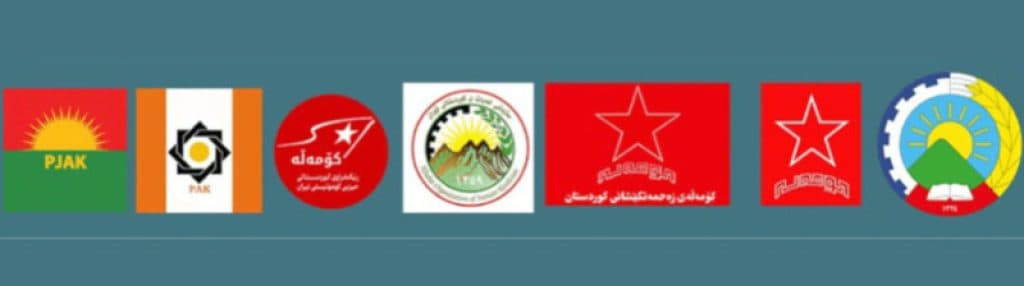
In both the PDKI and Komala statements, the flags of various Kurdish groups were displayed, including those of PDKI, PAK, PJAK, and Komala, signaling coordination between Kurdish opposition groups. Neither the PDKI nor a Rudaw report identified the participants in the meeting. However, the other three flags shown in the statement appear to include two smaller factions linked to Komala.
The PAK party has been vocal against the Tehran regime over the first two weeks of January, also claiming that it is carrying out operations against Iran’s security forces. It has described its fighters in Iran as members of the Kurdistan National Army (SMK), which is the group’s armed wing. On January 13, PAK claimed an attack on an Islamic Revolutionary Guard Corps position in Kermanshah. It also said on January 11 that it carried out operations in Kermanshah and Isfahan.
Other Kurdish parties have also publicly opposed the Iranian regime. PJAK released a statement on January 11 condemning Iran’s crackdown on protests as a “crime against humanity.” The Komala party has also condemned the killings of protesters in Iran, according to a January 14 post by the group’s representative in the US.


