First Impressions
My initial reaction to this issue was a mix of confusion and excitement. The fast-paced action and the reveal of the secret Justice League team were intriguing. However, the plot felt a bit scattered, jumping between different locations without much transition. The art, though, was undeniably powerful and captivating from the very first panel.
Recap
In the first issue of Justice League Red #1, Green Lantern Simon Baz and Power Girl Paige Stetler received a red-light summons to a satellite shielded from the Watchtower’s instruments. This summons was sent by Red Tornado, the Watchtower’s AI, who is now without his android body. Red Tornado has been using his hypervigilance to select heroes for “precision strikes” to avert disasters that are “mathematically certain”.
Plot Analysis
The comic opens with Cyborg at a location in Hsinchu, Taiwan, called Quantum Computing Solutions. He is there to retrieve a stolen quantum processor, a “cutting-edge semiconductor”. After easily defeating a large, armed robot, Cyborg finds the chip and escapes. He confirms the chip belongs to QCS and that he just stole it at the request of Red Tornado.
At the Red Tower in Earth’s orbit, Green Lantern and Power Girl confront Red Tornado. They are upset that Red Tornado lied to them about their missions. They say he told them they were destroying weapons, but one of the “weapons” was actually a machine built to “feed people”. Red Tornado tries to explain his actions, but Power Girl gets angry.
Cyborg arrives at the Red Tower with the stolen chip. Red Tornado explains that the Justice League Red team was formed to stop the “inevitable consequences” of all-powerful beings, specifically the Justice League Unlimited. Red Tornado says he’s taking the necessary actions that the Justice League and Titans are too blinded by “their own public images” to take.
Power Girl, in a rage, tells Red Tornado he has gone too far and that she is going to tell the Justice League everything. Red Tornado responds that if she does, she will unleash a great evil upon the Earth. He then reveals a vision of a splinter group of Brother Blood’s cult, set to sacrifice a kidnapped Red Canary. He states that they were about to “begin to flourish” but that his plan will stop them. Power Girl decides to stay and help Red Tornado, while Cyborg and Green Lantern fly off to save Red Canary. The issue ends with Red Tornado revealing a startling secret to Power Girl.
Detailed Review
Writing
The writing in this issue is nonsensical and leaves a lot to be desired. The plot is thin, with characters jumping to conclusions without any real evidence. The dialogue is predictable and lacks any meaningful depth. For example, when Cyborg says he learned that every hero screws up and his job is to “correct it,” it feels like a forced, cliché moment. The story’s main conflict, the disagreement between the heroes and Red Tornado, feels manufactured and is based on a flimsy premise that Red Tornado can see the future and is the only one who can make the right decisions.
Art
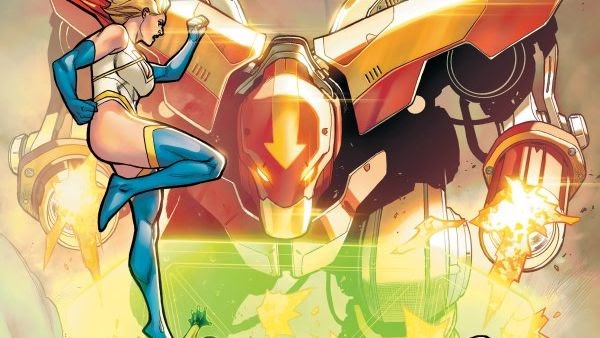
The art in this comic is the one redeeming quality. The action sequences are dynamic and powerful, especially the fight between Cyborg and the giant robot. The character designs are sharp, with Cyborg’s metallic body looking sleek and detailed. The use of colors is also excellent, with the bright blues and reds of Cyborg’s powers contrasting sharply with the darker, grittier backgrounds. The panels are laid out in a way that keeps the eye moving and the pace of the story quick.
Characters
The characters are underdeveloped and one-dimensional. Red Tornado is a stereotypical know-it-all AI who believes he is the only one who can save humanity. Power Girl is portrayed as an angry, impulsive character who is ready to abandon the team at a moment’s notice. Green Lantern is passive and just goes along with whatever Power Girl or Cyborg decides. Cyborg is the only character with a semblance of a personality, but his internal monologue about his job being to correct mistakes is a rehashed trope.
Positives
The art is the shining star of this issue, with Clayton Henry’s dynamic pencils and Arif Prianto’s vibrant colors creating a visually stunning experience. The action sequences are well-choreographed and feel impactful, particularly Cyborg’s fight scene, which is rendered with a sense of weight and power. The use of lighting and shading adds a dramatic flair to every panel, from the high-tech lab in Taiwan to the glowing presence of Red Tornado. The art effectively conveys the story’s high stakes and sense of urgency, even when the plot itself falters.
Negatives
The plot is a mess, riddled with logical inconsistencies and a weak premise. The central conflict, Red Tornado’s supposed ability to see “mathematically certain disasters,” feels like a lazy way to create drama and allows the writer to skip over any real character motivation or development. The characters’ reactions to Red Tornado’s lies are sudden and without any build-up, making their dialogue feel unearned. The entire mission feels pointless, as the comic ends with the heroes still unsure about what’s really going on, leaving the reader with a sense of frustration.
About The Reviewer: Gabriel Hernandez is the Publisher & EIC of ComicalOpinions.com, a comics review site dedicated to indie, small, and mid-sized publishers.
Follow @ComicalOpinions on YouTube, Facebook, Instagram, and Twitter
Final Thoughts
Justice League Red #2 is a classic case of style over substance. While the art is top-notch and a pleasure to look at, the weak, nonsensical plot and one-dimensional characters drag the entire experience down. The story is an aimless and confusing mess that relies on a flimsy premise. It’s a shame, because the potential is there, but this issue fails to capitalize on it, leaving you feeling like you just read a beautiful, empty shell of a comic.
4.5/10