
On the morning of Saturday, March 28, the Israel Defense Forces (IDF) targeted a press-marked vehicle on the Jezzine-Kfarhouna road in south Lebanon. The strike killed Ali Shuaib, an employee of the Hezbollah TV station Al Manar, and the siblings Fatima and Mohammad Ftouni, who worked for the pro-Hezbollah Al Mayadeen satellite news channel. In a subsequent statement, the IDF acknowledged killing Shuaib, alleging he was an intelligence unit operative in Hezbollah’s Radwan Force commando unit operating under the guise of a journalist.
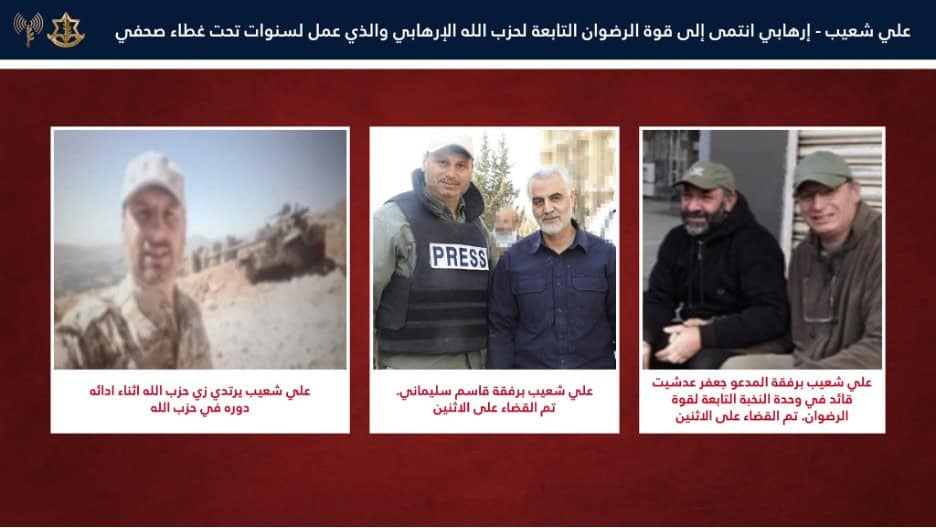
IDF Spokesman Colonel Avichay Adraee claimed that Shuaib formally joined Hezbollah’s military apparatus in 2020, but “had been cooperating with the organization since 2013.” Adraee’s post included images of Shuaib in a military uniform, alongside the deceased Iranian Islamic Revolutionary Guard Corps-Qods Force commander Qassem Soleimani, and with Radwan Force Nukhbaunit commander Jaafar Adsheet.
The IDF claimed Shuaib had “operated systematically to expose the positions of IDF soldiers operating in south Lebanon and along the frontier,” including during the current conflict. Adraee said Shuaib, “as part of his duties in the intelligence unit would photograph and collect intelligence information and transfer it to the Radwan Force under his journalistic guise,” including exposing current IDF positions, “posing a real threat to the lives of our soldiers in south Lebanon.”
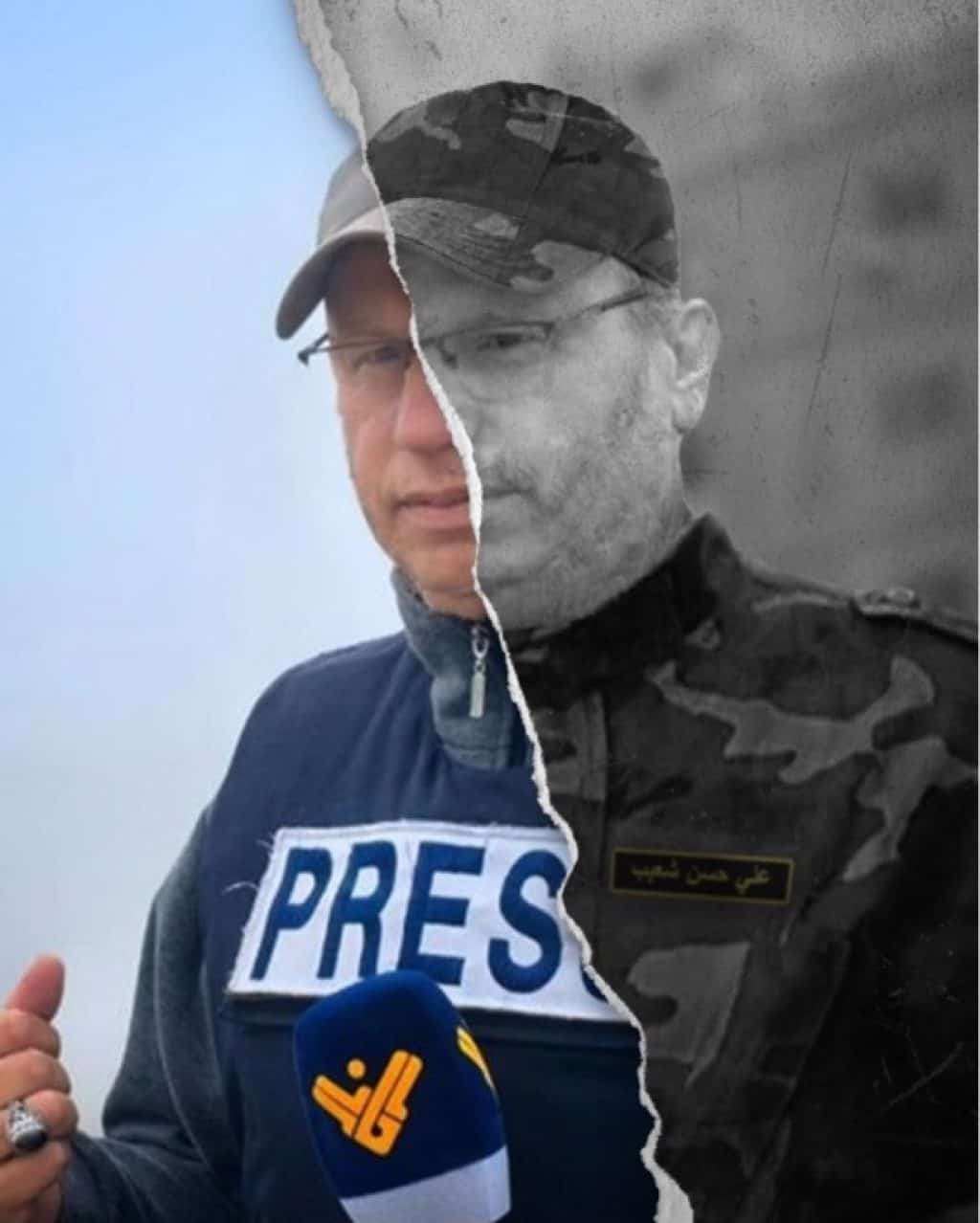
The IDF also said Shuaib was linked to the broader network of Hezbollah’s operatives, both within and beyond the Radwan Force, and incited against Israeli troops and civilians while disseminating Hezbollah propaganda. The IDF’s X account then uploaded an image of Shuaib, split between his press and military uniforms. The image stirred controversy when the IDF acknowledged to Fox News that the image showing him in uniform “was photoshopped.”
Al Manar—Hezbollah’s official TV station
Al Manar is Hezbollah’s main and direct TV station, wholly owned and controlled by the group, even though the control structure is layered. The legally visible shell company is Lebanese Media Group (LMG), which remains identified as the parent company by Al Manar’s site in its footer.
In 2006, the US Treasury Department designated Al Manar as a “media arm of the Hizballah terrorist network,” saying it has “facilitated Hizballah’s activities” and noting that at least “one al Manar employee engaged in pre-operational surveillance for Hizballah operations under cover of employment by al Manar.”
The Treasury designation does not name this employee. However, he was most likely Mohammad Hassan Dbouk, a former head of Hezbollah’s Canadian procurement cell who, after returning to Lebanon, provided preoperational surveillance for Hezbollah attack squads working under the cover of Al Manar. Dbouk’s footage was used to plan attacks against Israeli forces and later produce propaganda videos.
Treasury’s designation also noted that Al Manar has raised funds for Hezbollah through broadcast advertisements. The same designation targeted the Lebanese Media Group (LMG), “the parent company of […] al Manar,” stating that “prominent Hizballah members have been major shareholders of the Lebanese Media Group.”
Al Manar in the Hezbollah organizational hierarchy
Hezbollah’s ownership and control of Lebanese Media Group/Al Manar are not disputed. Ultimately, the organizations are subordinate to the same ruling Shura Council, Hezbollah’s high governing body headed by the group’s secretary-general, as the Jihad Council that controls Hezbollah’s military arms. However, there is ambiguity about the media organizations’ exact position in the group’s hierarchy.
Historically, the Lebanese Media Group and Al Manar were controlled by the Executive Council’s Information and Media Unit. But a 2001 report in the now-defunct As Safir, a pro-Syrian newspaper aligned with Hezbollah’s “resistance” worldview, said that Hezbollah’s sixth conclave decided to place the Information and Media Unit under the Political Council, “subordinating the TV [Al Manar] and radio station [Al Nour] and all other institutions of a media nature to the oversight of a supervisory council headed by the Secretary-General,” who was Hassan Nasrallah.
This restructuring, the report said, was made necessary “because the next phase [of Hezbollah’s activities]” that followed Israel’s May 25, 2000, withdrawal from south Lebanon “required extreme precision in terms of media confrontation, whether with the Israeli enemy or dealing with domestic affairs.” This restructuring occurred, as the report indicates, because Hezbollah does not consider Al Manar a media outlet in the classical sense, but one of many tools to “confront the Israeli enemy.” This status would have placed LMG/Al Manar under the control of Hezbollah’s Political Council, with direct oversight from Nasrallah.
However, on December 15, 2025, Al Akhbar News, a pro-Hezbollah daily newspaper, reported that “as part of the changes within Hezbollah’s organizational structure after the recent war, the Shura Council — the highest authority in the party — decided to form a new body to manage the party’s media portfolio.” The new entity would be headed by Hezbollah MP Ibrahim Al Musawi and be comprised of “membership [including] representatives of all Hezbollah’s media institutions, including the TV stations [i.e., Al Manar], electronic media [presumably, this includes Hezbollah’s Military Media) and the Media Relations Unit.” Al Akhbar said that “based on available information, the new body belongs to/is controlled by Hezbollah Sec. Gen. Naim Qassem, until a subsequent decision is made to either maintain this hierarchy or transfer it to a new central council.” This status would have given Hezbollah’s secretary-general even closer control over Al Manar.
The concept of one Hezbollah in service of resistance
Hezbollah has long rejected the distinction between its military and political “wings,” with Nasrallah once scoffingly dismissing the idea as an “English innovation.” Current Secretary-General Naim Qassem, while still the group’s deputy secretary-general, was even more explicit on Hezbollah’s unitary nature. In 2012, he said, “In Lebanon, there is one party called Hezbollah. We have no military or political wing. We don’t have a ‘Hezbollah’ and a Resistance Party. Hezbollah is a party that practices politics, resistance, operates in the path of God and to serve man—in short, Hezbollah.”
Qassem rebuffed the “divisions that some try to promote,” specifying that “everything we have in Hezbollah, from leadership, cadres, and different capabilities, is in service of the resistance, and to uphold the resistance. We have no priority other than resistance, from the party’s leadership down to its very last mujahid.’”
Qassem reiterated the point in 2015:
The Europeans behaved stupidly by placing Hezbollah’s military wing on their list of terror groups but not the political wing. Don’t they know that we in Hezbollah—all the way from his eminence the Secretary-General [Hassan Nasrallah] (may God preserve him) to every mujahideen—we all work [together] in jihad, political, fighting, and social, educational, and cultural work. We do not section up or differentiate, but they did according to their whims.
Media, according to Hezbollah’s key figures, plays a critical role in promoting the “resistance” in terms of military effect. Nasrallah, in 2003, described the media as one of the most important weapons of conflict, battle, and resistance,” even impacting battlefield outcomes. Qassem reiterated this sentiment in 2025, saying that the media’s role was “very important” in shaping the battle’s image, and praising the pro-resistance media’s real results by presenting a “bright image” of Hezbollah’s fighting forces. Al Manar’s own English “About Us” page likewise highlights its active role in “mold[ing] the Resistance ideology” and mobilizing its audience.
As a result, Hezbollah’s leadership has acknowledged that Al Manar has, at least, a quasi-combat support role. Al Manar began terrestrial broadcasts on June 3, 1991. However, its initial Lebanese government broadcast license, granted in 1996, described it as a “resistance channel,” meaning the license would expire with the Israeli occupation.
Al Manar was granted a full broadcast license as a national television station in July 1997 under Law 382, Lebanon’s 1994 Audiovisual Media Law. But Hezbollah’s leadership continued to acknowledge Al Manar’s role as one of the “resistance’s” many active tools long after this point. On the occasion of Al Manar’s 30th anniversary on June 8, 2021, Nasrallah said the outlet was founded to provide the resistance “image” support, and likened its staff’s presence in various conflicts, including the 2006 war with Israel, to “the presence of the mujahideen on the frontlines.” On February 2, 2024, then-Hezbollah Media Relations chairman Mohammad Afif quoted Nasrallah as saying that “victory would be lost without Al Manar.”
Al Manar acknowledges this partisanship, with its then-director Nayyef Krayem describing it as a “weapon” on May 8, 2000. Hassan Fadlallah, Al Manar’s director at the time, highlighted Al Manar’s lack of neutrality to US journalist Jeffrey Goldberg in 2007. “Neutrality like that of Al Jazeera is out of the question for us,” he said. “We’re not looking to interview [former Israeli Prime Minister Ariel] Sharon. We want to get close to him in order to kill him.”
Al Manar also acknowledges it has a partisan battlefield role as an active participant. Its directors-general have, at different times, described the outlet’s relationship with the “resistance’s” fighters as symbiotic. Ibrahim Farhat, for example, has repeatedly emphasized this symbiosis and described Al Manar as a “martyrdom-seeking” institution—including in spreading “the resistance’s narrative,” which is crucial to recruitment, fundraising, and retention of popular support. Al Manar runs advertisements for Hezbollah’s military fundraisers, including its periodic “Equip a Mujahid” drive to purchase all fighting equipment except for rifles.
Since its inception, Al Manar has also actively weaponized events to advance Hezbollah’s military objectives. In the 1990s, it capitalized on the delay that Israel’s military censor caused in the Israeli media relaying events from the South Lebanon Security Zone to project its own version first into Israeli households, seeking to impact the Israeli national psyche and shape Israel’s military decisions.
In a 2025 retrospective, Abdullah Kassir, deputy chairman of the Executive Council for media affairs and a former Al Manar general manager, described Al Manar’s direct role in operation-information warfare during the 2006 war. Kassir said that the station would turn Nasrallah’s speeches into digestible messages supported by maps and coordinates, in cooperation with the war media, including his threats to strike Haifa and beyond.
Al Manar has maintained this function during the current conflict with Israel. It carries real-time battlefield claims from the “Islamic Resistance” and provides advance notice of Hezbollah releasing battlefield and operational footage.
Ali Shuaib’s verifiable role in Hezbollah
Ali Shuaib is not the first Al Manar employee to be killed during wartime. Several such individuals died during the 2024 phase of the conflict with Israel. Their official obituaries reflect Hezbollah’s perception of their media roles as serving a military function. They were, therefore, eulogized in the same manner as Hezbollah’s fighters killed in action against the Israelis as being “on the road to Jerusalem.”
Shuaib, per his obituary, has been with Al Manar since before Israel’s May 2000 withdrawal from south Lebanon and has been present on several active fronts, including Lebanon, Syria, and Iraq. His social media channels and battlefield accounts openly sought to aid Hezbollah’s military effort in the information/psychological warfare sphere by promoting the group’s wartime narratives.
Shuaib’s posts suggest he did not see his role as being that of a neutral battlefield observer or journalist. Instead, he appears to have seen himself as an active participant within his available means—media and information. Prior to the October 8, 2023, Hezbollah attack on Israel, Shuaib was a fixture along the Blue Line, the de factoborder between Israel and Lebanon, and routinely posted “confrontations selfies” with IDF troops along the frontier.
Prior to the war, Shuaib routinely reported and photographed Israeli troop movements and positions on both sides of the frontier line, sometimes at point-blank range. Shuaib openly continued to do so during the current conflict. The IDF claims that Shuaib exploited the relatively unimpeded proximity to Israeli troops offered by his journalistic credentials to report IDF movements and positions to Hezbollah’s command.
After Shuaib’s death, Hezbollah’s media ecosystem implicitly acknowledged his function in supporting the “resistance” through media activity. Al Nour Radio, another LMG subsidiary, said that Shuaib was “the first to know of the resistance fighters’ victories, his voice had the impact of bullets in the battle. … He was no ordinary correspondent.” Hezbollah’s official Al Ahed newspaper likewise said, “Resistance media martyr Ali Shuaib did not merely report the news. He was also a partner in creating victory.”