
The home of Nechirvan Barzani, president of the Kurdistan Region of Iraq, was targeted in a drone attack on March 28. The following day, Reuters, citing security sources, reported, “Air defenses shot down a drone near the residence of the leader of the Iraqi Kurdish ruling party, Masoud Barzani,” the former Kurdish president and Nechirvan’s uncle, in Erbil. Iranian-backed militias and Iran have heavily targeted the northern Iraqi region since US and Israeli airstrikes on Iran began on February 28. According to the Rudaw Media Network, there have been more than 500 drone and missile attacks on the Kurdistan Region during the conflict.
Attacks within Iraq have escalated in the last week of March. Six Kurdish Peshmerga were killed in an Iranian missile strike near Erbil on March 24. In addition, an Antonov-132 military aircraft of the Iraqi Air Force was damaged in an attack on an Iraqi air base near Baghdad International Airport in the early hours of March 30. The Iraqi Ministry of Defense called the incident a “cowardly criminal act” in a post on X and reported that 122-millimeter rockets, a common type of Iranian-made rocket, were used in the attack.
Iran has also threatened to target universities in the Middle East, including in Iraq, after it said that its Isfahan University of Technology had been hit with airstrikes. “Iran and its aligned terrorist militias may intend to target the American Universities in Baghdad, Sulaymaniyah, and Dohuk, along with other universities perceived to be associated with the United States,” a security alert of the US Embassy in Baghdad on March 29 stated.
“Iran has specifically threatened American universities across the Middle East. Iran and Iran-aligned terrorist militias have conducted widespread attacks on U.S. citizens, targets associated with the United States throughout Iraq, including the Iraqi Kurdistan Region (IKR), and Iraqi institutions and civilian targets,” the embassy added.
Countries across the Middle East condemned the attacks on the Kurdish leaders. “The Foreign Ministry expresses the Kingdom of Saudi Arabia’s strong condemnation and denunciation of the targeting of the residences of the President of the Kurdistan Region of Iraq Nechirvan Barzani and the leader of the Kurdistan Democratic Party Masoud Barzani, as well as all attacks on the Kurdistan Region of Iraq,” Saudi Arabia’s Foreign Ministry said on March 30. The Kurdistan Region Presidency’s office also said that the Kingdom of Jordan had condemned the attack on Nechirvan Barzani’s home.
“The United States unequivocally and forcefully condemns the despicable terrorist attacks by Iran’s terrorist militia proxies in Iraq on the private residence of Iraqi Kurdistan Region President Nechirvan Barzani,” the US Department of State said in a March 28 statement. The UN added to the growing list of condemnations.
Within Iraq, many of the country’s political blocs have also spoken out about the attack on Barzani’s residence. Among those slamming the strike were the Shiite Coordination Framework and Shiite political leader Ammar al Hakim. The Azm alliance, a Sunni political group, also put out a statement, according to Iraq’s Shafaq News. These statements come as Iraqi political parties have still not been able to decide on a new prime minister or president for the country in the wake of last November’s elections.
Iraqi Prime Minister Mohammed Shia al Sudani spoke to Barzani in the wake of the attack and said that Baghdad would investigate.
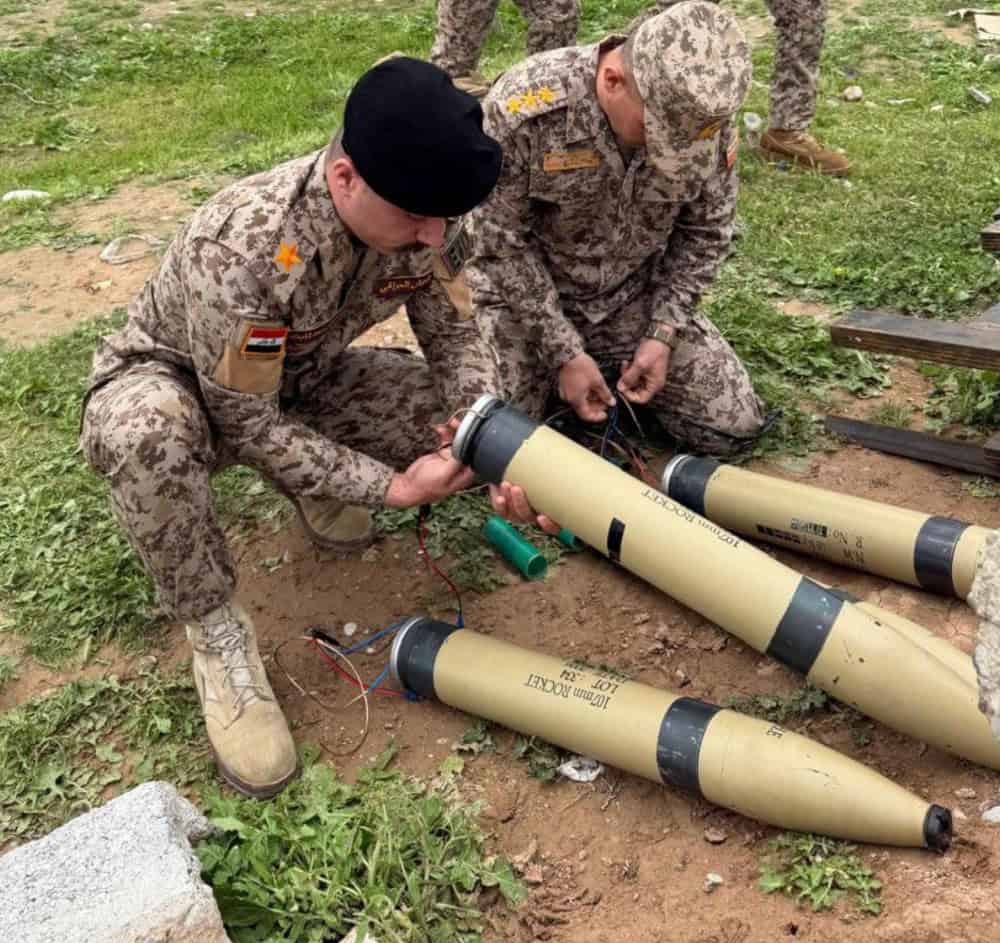
The day after the attack on Barzani’s home, Iraq’s defense ministry claimed that its forces had thwarted a rocket attack on Kirkuk in the semi-autonomous Kurdistan Region. “A joint force from the Eleventh Infantry Brigade, affiliated with the Kirkuk Operations Command, was able on Sunday, March 29, 2026, to thwart an attempt to launch Katyusha-type rockets, after seizing a launch platform containing (2) launch bases and (4) rockets that were prepared for immediate launch,” the ministry said in a statement. The rockets were labelled “107mm” and appear similar to those used by Iranian-backed militias in the past.
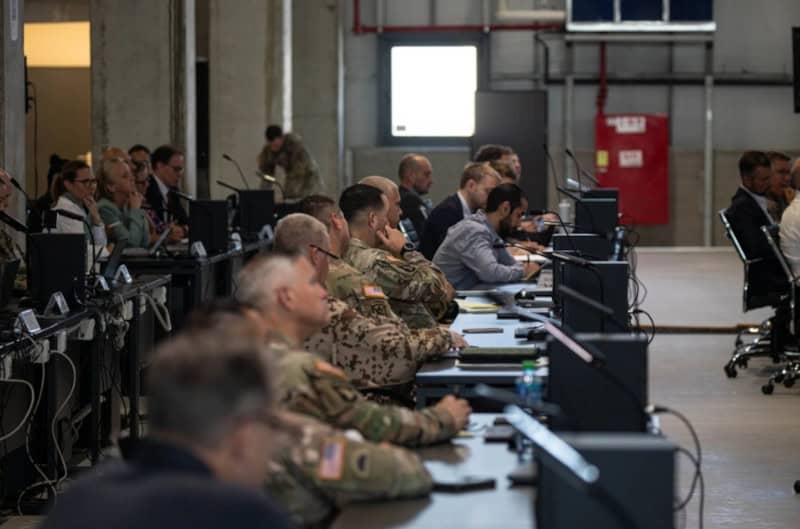
The discovery of the rockets came two days after the US and Iraq announced the establishment of a joint High Joint Coordination Committee to reinforce cooperation between the two countries. “Both sides emphasized their commitment to keeping Iraq outside the scope of the ongoing military conflict in the region, fully respecting its sovereignty, and supporting Iraq in ensuring its territory, airspace, and territorial waters cannot be used to threaten Iraq, or neighboring and regional states,” the US Embassy in Baghdad said in a statement on March 27.