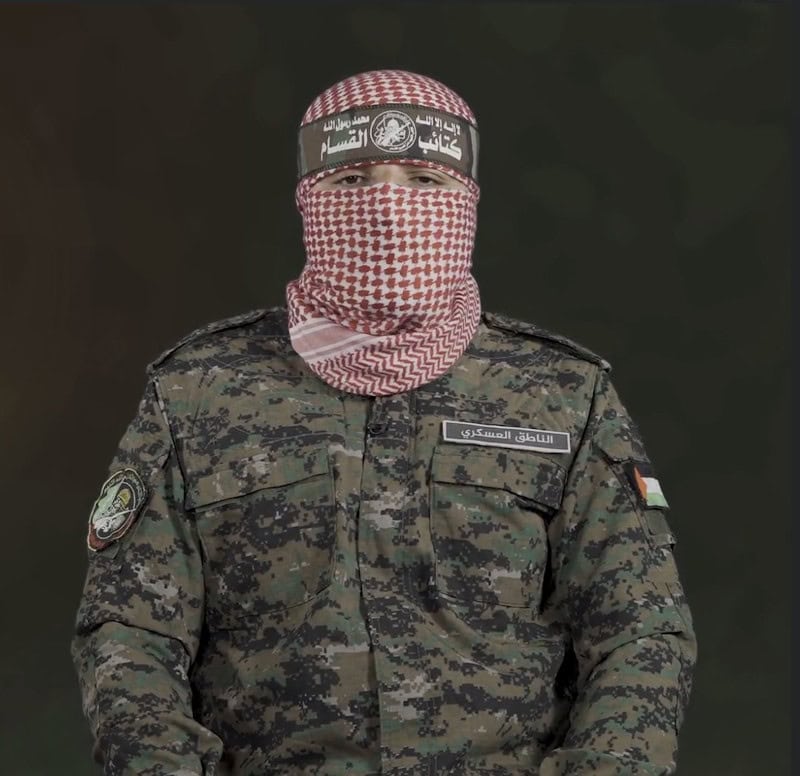

On February 9, Hamas spokesperson Abu Obeida published a written statement on his Telegram channel threatening Palestinian militias that have opposed the Islamist group’s rule in the Gaza Strip. Obeida’s statement follows several successful military operations conducted by the militias, including the Popular Forces and the Counterterrorism Strike Force, against Hamas in recent months.
Obeida’s statement did not explicitly mention the militias. Instead, it referred to “collaborators” backed by Israel and included details associated with these rival groups, indicating that anti-Hamas factions were the targets of the threats.
Obeida framed the militias’ actions as “treachery” and accused them of targeting “civilians” and weakening Hamas fighters who have been trapped in tunnels beneath Israeli-controlled territory in Rafah since the ceasefire began on October 10, 2025. Obeida also mocked the groups, describing them as “effeminate men” who act “tough” under the protection of the Israeli army.
“What the Mustaribeen [Israeli agents disguised as Arabs] collaborators are doing […] reflects nothing but complete alignment with the occupation, carrying out its agendas and coordinating with it,” Obeida said.
Before concluding his statement, the Hamas spokesman warned the militias that Israel will not be able to protect them, and a “dark fate” awaits the “descendants of Abu Righal,” invoking an Islamic historical figure associated with betrayal.
Several militia operations against Hamas members in recent weeks and months may have prompted Obeida to release the scathing statement. Among the notable activities by the militias was the capture of Adham al Akar, a Hamas company commander in Rafah, on January 31. The Popular Forces took responsibility for Akar’s capture when Ghassan al Dhuhaini, the leader of the Popular Forces, was filmed standing next to the Hamas commander, who was wearing only his undergarments.
On February 10, Dhuhaini announced in a now-deleted Facebook statement that Akar would be executed by a firing squad the following morning. A short time after the post, Dhuhaini rescinded the execution, saying that the Popular Forces would detain Akar until he is brought before a “competent Palestinian judicial authority.”
The Khan Younis-based Counterterrorism Strike Force, headed by Hussam al Astal, is another militia that has launched successful attacks against Hamas and its cadres. On January 12, Astal claimed his group was responsible for killing Lieutenant Colonel Mahmoud al Astal, a director of police investigations and senior Hamas member. Weeks earlier, the Counterterrorism Strike Force announced that it had killed two Hamas members and arrested a third during an operation in the Abu al Saber area of the Shaboura Camp in Rafah.
The success of the militias may largely hinge on the support that Israel gives these groups. The Jewish state supplies the militias with air support, weapons, food, cigarettes, and intelligence, The Wall Street Journal reported. Wounded militia members have also received medical treatment at Israeli hospitals, according to Israeli officials cited in the report.
While Hamas’s threats pose an immediate challenge for the militias, another potential obstacle has emerged: the second phase of the ceasefire agreement requires all armed groups to disarm. It remains unclear whether the provision applies to these militias. However, Husam al Astal has previously suggested that the militias should be integrated into a Gaza security force that would commit to combating Hamas and its armed allies and report to the Board of Peace, the US-led international organization managing the ceasefire.