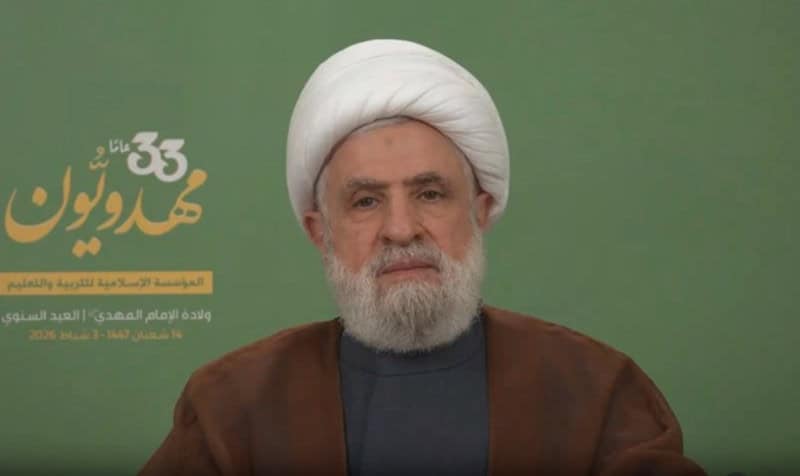

Hezbollah Secretary-General Naim Qassem delivered a speech on February 3 that marked the 33rd anniversary of the establishment of Hezbollah’s Mahdi School System, which, according to Qassem, now has “over 35,000 enrolled students.” The Hezbollah leader addressed several topics in his speech, including the ongoing tensions between the United States and Iran and the fate of Hezbollah’s arms—sounding a defiant tone on both matters.
In the first third of his speech, Qassem claimed that Iran, because it had established a just Islamic government seeking to champion the world’s downtrodden, was, in turn, promised a “great” divine victory during its current confrontation with the United States and Israel:
On the occasion of the 47th anniversary of the victory of the blessed Islamic Revolution in Iran, we must congratulate the Iranian people, their leadership, and all those operating in the Islamic Republic of Iran for the great victory achieved in 1979 under the leadership of Imam Khomeini. … Subsequently, under the leadership of Imam Khamenei … this Republic has shone a great light of freedom, righteousness, morality, jihad, resistance, liberation, and dignity for believing people throughout the world. Congratulations to this Republic, to this blessed revolution to the Iranian people, and to all the world’s oppressed—Muslims and non-Muslims alike—on this great victory. God willing, Iran will continue to be the world’s crown jewel and maintain its ability to defeat America and Israel in the confrontation that is currently occurring. For whoever is with God Almighty and carries the banner of Imam Al Mahdi will inevitably be victorious, God willing.
The second third of Qassem’s speech was devoted to extolling the pedagogy that influences students at the Mahdi School System. Lebanon, Qassem claimed, derived a national benefit from the ideology that Hezbollah’s school system has imparted upon its students, proven by “several martyrs coming from the ranks of the [Mahdi Schools’] teachers, students, and parents.” He continued, “The students who enter these schools do so with their parents’ support and consent. The students who study and persevere then remain committed to these great … principles, which, ultimately, lead them to the defense [of their nation], jihad, honorable and noble political action.”
Qassem then turned to “political matters” in the final third of his speech. Lebanon, he said, was confronting “Global American hegemony” and a campaign by “Global American Arrogance” that uses the excuse of “Israeli national security … to entrench and expand Israel’s occupation” of Arab territories. Therefore, he claimed, Lebanon wasn’t merely confronting a handful of “acts of aggression” by Israel but an “existential aggression seeking to wipe us out.” Qassem sought to prove this assertion by falsely claiming that Israel, during its ongoing operations in Lebanon, was “targeting civilians, homes, municipalities, schoolteachers, and killing randomly when it [could not] target [Hezbollah] fighters.”
The proper response to this campaign and aggression, Qassem said, was national unity, “requiring” all Lebanese “to oppose Israeli aggression, and not the Resistance.” Any other stance, he asserted, was unpatriotic. “We in Hezbollah are ready to discuss how to repel this aggression with whoever believes in doing so,” he said, calling for unifying Lebanese ranks, “as this aggression is not only occurring against us, but against the entire nation.” Disarming Hezbollah, Qassem claimed, would only serve to “strip Lebanon of its strength.”
Instead, Qassem insisted, the Lebanese should “demand of the Israeli enemy, and the American enemy … to stop the aggression and abide by the ceasefire agreement.” They should also admit, he said, that they were “incapable” of disarming Hezbollah. Further, despite conceding in the past that the Israel-Lebanon ceasefire agreement reached on November 27, 2024, required Hezbollah’s disarmament south of the Litani River, Qassem was now noncommittal about his group’s demilitarization south of the waterway.
We were asked when the [Lebanese] army commander announced that the [disarmament] effort south of the Litani River was completed to issue a statement confirming [Hezbollah’s armed presence] was over south of the Litani River. Why should we issue a statement? We have nothing to do with whether it’s over or not. There is an army command and people in charge; they’re the ones who should state what they’ve done. They want to extract a statement from us to hold us accountable for matters for which we’re not responsible. They should assume this responsibility themselves.
In the face of ongoing aggression, Qassem said, there was but one option: “defense, and never surrender,” despite Israel’s military superiority. The past 42 years, he claimed, had proven that Hezbollah’s patience would eventually pay off, “for how long can this difficult period last? Those who accomplished in the past will do so again, even if it takes time—so long as they possess determination and belief.”
In the meantime, Qassem argued, even though Israel could “inflict pain upon [Lebanon,] we can also inflict pain upon them. Everything in its proper time. They can hurt us, but they can’t end us.” Qassem continued, “The existence of the Lebanese people, Hezbollah, the Amal Movement, the nationalist forces, segments from the various religious communities and society, the army, and some Lebanese officials—these represent a tremendous asset capable of achieving great things and liberation. All that is needed is a little patience, coordination, and working together in a unified manner.”
The example given by the “martyrs” of the past, including Hezbollah’s late Secretary-General Hassan Nasrallah, “grants us the drive to continue existing,” Qassem said, “despite the great sacrifices ahead of us.” He added a confrontational note, saying, “Hezbollah is Imam al Mahdi’s party, and go ahead and try to defeat Imam al Mahdi, if you think you can—you’ll only harm yourselves. We therefore remain steadfast in our convictions, victorious through martyrdom and in confronting and defeating our enemies. None should assume there’s only one path to victory. There are two [victory and martyrdom], and we accept them both.”
In conclusion, Qassem stated that Hezbollah and its partners are the factions currently trying to build up the Lebanese State—in contrast to their opponents, whom he alleged were acting out of particularistic or partisan interests. Meanwhile, he said, “The resistance was achieving global victories, while those claiming to support sovereignty are the tools of American diktat who cannot even condemn Israel.”