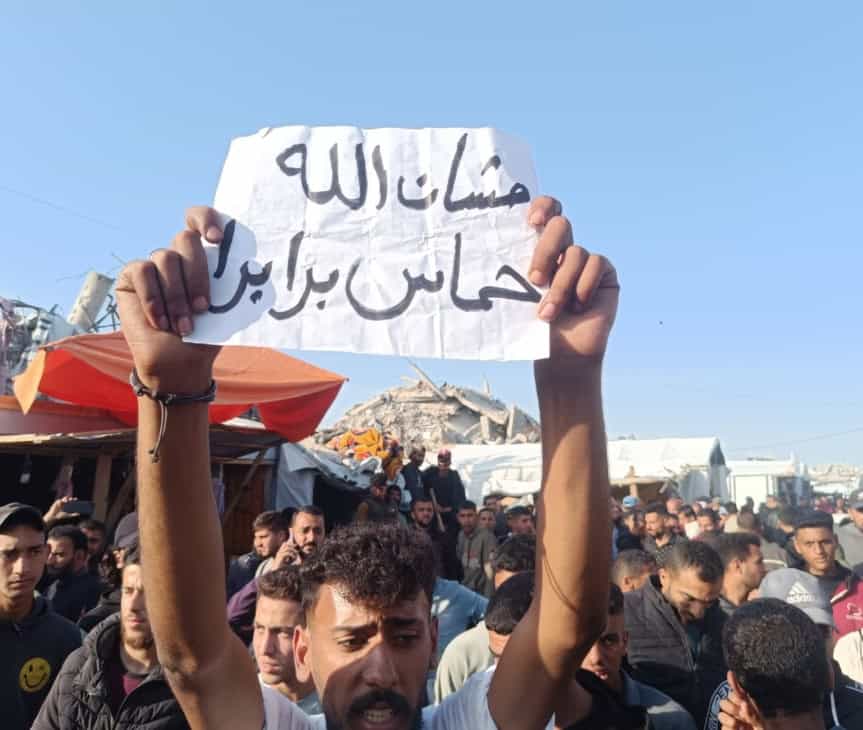
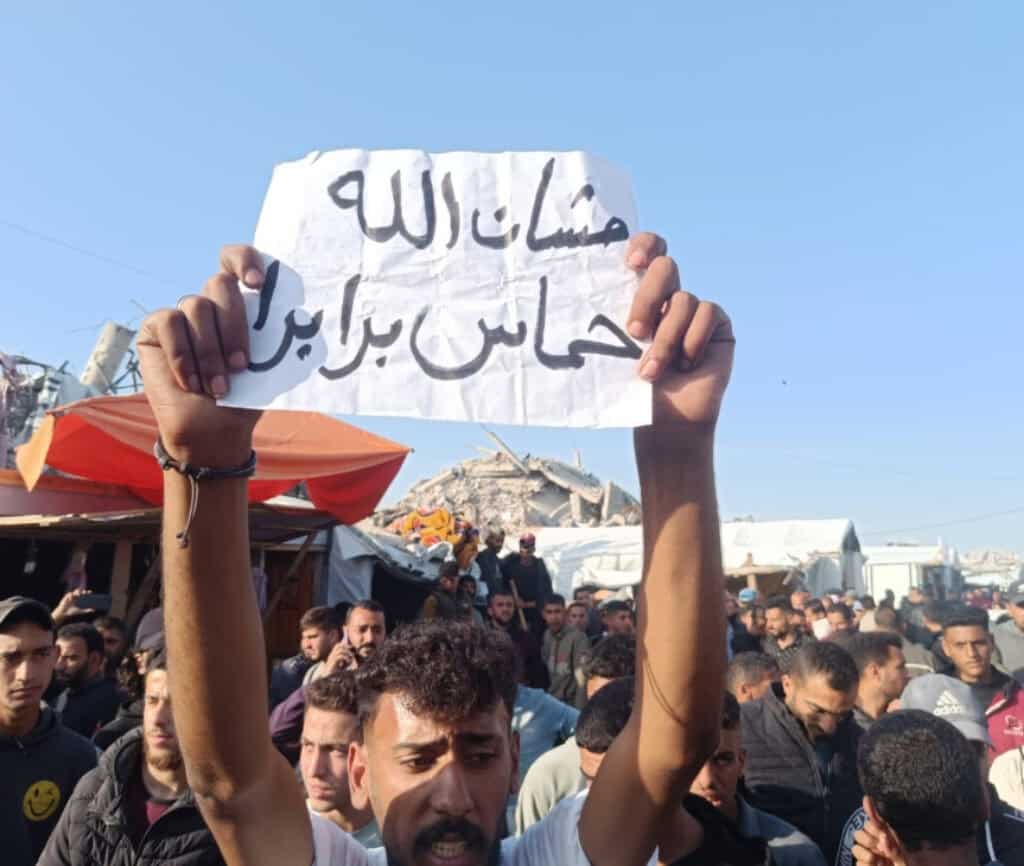
Anti-Hamas organizers in Gaza planned a series of protests for June 26, but an intimidation campaign by Hamas largely suppressed the demonstrations. The terror group threatened Gazans taking part in the event despite Israel’s continued eliminations of the group’s mid-level commanders.
After weeks of projections that grassroots anti-Hamas protests would be the largest of their kind since the Gaza ceasefire began on October 10, 2025, the “June 26 Peaceful Revolution” event was far smaller than planned, though a few hundred individuals were able to organize in Gaza City and Khan Younis.
In weeks prior, Hamas operatives detained, arrested, and intimidated individuals they suspected of participation. Many of those rounded up were held by the terror group in hospitals around Gaza. Calling the protests “Israeli-backed,” Hamas also took to the streets on June 26, stationing armed terrorists along the protest’s planned routes.
Hamas suppressed these protests despite the Israeli military’s continued eliminations of its mid-level leadership.
On June 21, the IDF announced that it had eliminated Hussin Qadara and Muhammad Farra, Hamas members it claimed had run a “financial transfer infrastructure” which funneled “over half a billion” shekels to the terror group. The IDF asserted that, particularly in recent months, this money had paid Hamas members’ salaries.
Working with the Shin Bet intelligence agency, the IDF also eliminated Walid Haniyeh, a nephew of former Hamas political leader Ismail Haniyeh, the current deputy commander of Hamas’s elite Nukhba forces. Haniyeh had personally led a terror cell into Israel during the October 7, 2023, attack and actively coordinated hostage-taking from inside Israeli territory, the IDF said. According to the IDF, he had recently been recruiting and training new Nukhba members.
Israeli forces have also worked to degrade the group’s physical military reconstruction efforts in recent weeks. On June 24, the IDF released a video of the Israeli Air Force destroying four rocket-launch positions across the Gaza Strip, saying, “The launch positions were ready to fire toward IDF forces and civilians of the State of Israel, and therefore posed an immediate threat.” Hamas has not successfully launched a rocket at Israel since the ceasefire began last October.
According to the IDF, 17 targeted eliminations and ceasefire violations occurred between June 10 and 29:
- On June 12, the IDF said it killed Kassem Hassan Saleh and Sami Jamil Abu Dalal, two Palestinian Islamic Jihad (PIJ) platoon commanders, as well as Ubeid Mamoun Saleh Franji, a deputy Hamas platoon commander. The IDF said the three individuals had “planned to execute terrorist outlines against IDF forces in the immediate timeframe,” “posed an immediate threat,” and were killed in “precise strikes.”
- On June 15, the IDF claimed that it killed Saleh Ramadan Muhammad Khalifa, “head of a cell in the Nuseirat Battalion” of Hamas, and Muhammad Musa Diab al Bil, “head of a cell in the Western Jabalia Battalion” of Hamas. The IDF said the two were “planning to carry out terror attacks against IDF forces” and “posed an immediate threat to the troops.”
- On June 17, the IDF announced that it eliminated Mohammed Saeed Ahmed Nimroti, a Hamas platoon commander who “raided the territory of the State of Israel in the October 7 massacre” and “took part in holding many hostages in Hamas tunnel captivity.” The IDF also killed Muawiya Sulaiman Zakar Aydi, a PIJ platoon commander who “raided Kibbutz Be’eri” on October 7 and later took part in “planting explosive charges.”
- Also on June 17, the IDF killed Ahmed Abu Hin, “the head of a sniper cell” in Hamas’s military wing, and Mahmoud Walid Ghabr Abu Hin, a Hamas military wing member. The IDF said that both men “raided the territory of the State of Israel during the massacre on October 7” and had recently worked “to rebuild” Hamas “in violation of the ceasefire agreement.”
- On June 20, the IDF said that it killed Ahmed Samir Muhammad Washah, who it claimed was a Hamas military wing member and “sniper operative” who also worked as an Al Jazeera photographer. Washah had “advanced sniper outlines and additional terrorist operations against IDF forces,” according to the IDF, and was killed alongside two other Hamas members.
- On June 21, the IDF said that it killed Hussin Qadara and Muhammad Farra, Hamas military wing and General Security Service operatives involved in the group’s financial network. The IDF said Qadara was “head of the infrastructure” and Farra helped transfer “more than half a billion ILS” to Hamas’s military wing through “dozens of couriers and money changers in Turkey and the Gaza Strip.”
- Also on June 21, the IDF and Shin Bet said that they killed Zakhi Yosef Mahmoud Abu Mostafa, commander of the Nukhba force in the Khan Younis Brigade. Mostafa “raided Kibbutz Nir Oz during the October 7 massacre” and “took part in the abduction of Yigil Yaakov,” according to the IDF, which also said he had tried to conduct training at Nasser Hospital “in order to avoid elimination.”
- The same day, the IDF announced killing Muhammad Osama Abd al Aziz Saba al Aish, a Hamas Nukhba member who had attempted to advance “training and preparation” for Hamas terrorists and recruit new members to the organization.
- On June 22, the IDF said that it killed Ahmed Munir Khalil Zaza, “the engineering chief of the Western Jabalia Battalion,” who was responsible for “building explosives and booby-trapped houses.” Zaza had recently attempted to plant explosives near the yellow line “with the aim of harming IDF forces,” according to the Israeli military.
- Also on June 22, the IDF said that it killed Hasin Safdi, “commander of the sniping array in Gaza City.” Safdi had been responsible “throughout the war for all sniping outlines” against IDF forces in the Gaza City area and had recently tried to train terrorists and promote “additional sniping outlines.”
- The same day, the IDF and Shin Bet announced the elimination of Sabaei Zahir Abd al Hamid Abu Hasna, a Hamas Nukhba member who “infiltrated the territory of the State of Israel in the October 7 massacre” and “took part in holding Omer Shem Tov captive in Hamas captivity.” The IDF added that Abu Hasna had recently tried to advance cells to attack Israeli forces.
- Also on June 22, the IDF said that it killed three armed Hamas members in northern Gaza who had “attempted to advance terrorist cells against IDF forces.”
- On June 24, the IDF said that it destroyed four rocket launch positions in Gaza that had been “established by terrorist organizations” after the ceasefire took effect. The launchers were “ready to fire toward IDF forces and civilians of the State of Israel,” according to the Israeli military.
- Also on June 24, the IDF announced the elimination of Akram Muhammad Mahmoud Abu Maazi, a Hamas military wing member who “infiltrated the territory of the State of Israel during the October 7 massacre.” Maazi had recently tried “to rebuild the organization and advance terror plots,” according to the IDF.
- On June 25, the IDF said that it killed Adam Muhammad Ibrahim Abu Khdeid, a commander in “the production array of the terror organization [Palestinian Islamic Jihad (PIJ)].” The IDF said the array was responsible for producing and supplying “combat means” to the group’s military wing, and that Khdeid’s infrastructure had tried to produce additional weapons to strike IDF forces and Israeli civilians.
- On June 27, the IDF and Shin Bet said that they killed Walid Haniyeh, “deputy commander of a Nukhba company” in Hamas’s military wing and a nephew of former Hamas political chief Ismail Haniyeh. The IDF said Haniyeh commanded a terrorist cell raid into Israel on October 7 and was involved in directing a cell as it “abducted Israeli civilians to the Gaza Strip.”
- On June 28, the IDF announced the elimination of Abd al Rahman Maher Abd al Karim Ziyada, the commander of a Hamas Nukhba cell who “infiltrated Israeli territory during the October 7 massacre” and stole IDF vehicles into Gaza. The same day, the IDF killed Kamal Muhammad Hamdan Nagar, “head of the tunneling unit in the Khan Yunis area” of Hamas’s military wing.
- Also on June 28, the IDF and Shin Bet said that they killed Mansour Sami Mahmoud Shehadeh, a “commander of the [Hamas’s] maritime police of the central camps,” along with two other Hamas maritime police commanders. The IDF said that the group’s maritime police “operates under the military arm” and “promotes and directs terror plots against IDF forces and the State of Israel.”
- On June 29, the IDF and Shin Bet said that they killed Zahir Barham Khalil Abu Salem, a member of PIJ who “infiltrated the territory of the State of Israel during the October 7 massacre.” Abu Salem “took part in the abduction of Israeli civilians from their homes and their holding in captivity,” according to the IDF.
- Also on June 29, the IDF and Shin Bet said that they killed Ismail al Masri, who was responsible for military security in Hamas’s Rafah Brigade. Masri had been tasked with “advancing activities aimed at undermining the IDF’s freedom of action in the Gaza Strip” and had worked to rebuild Hamas military security “with the aim of harming [Israeli] forces.”