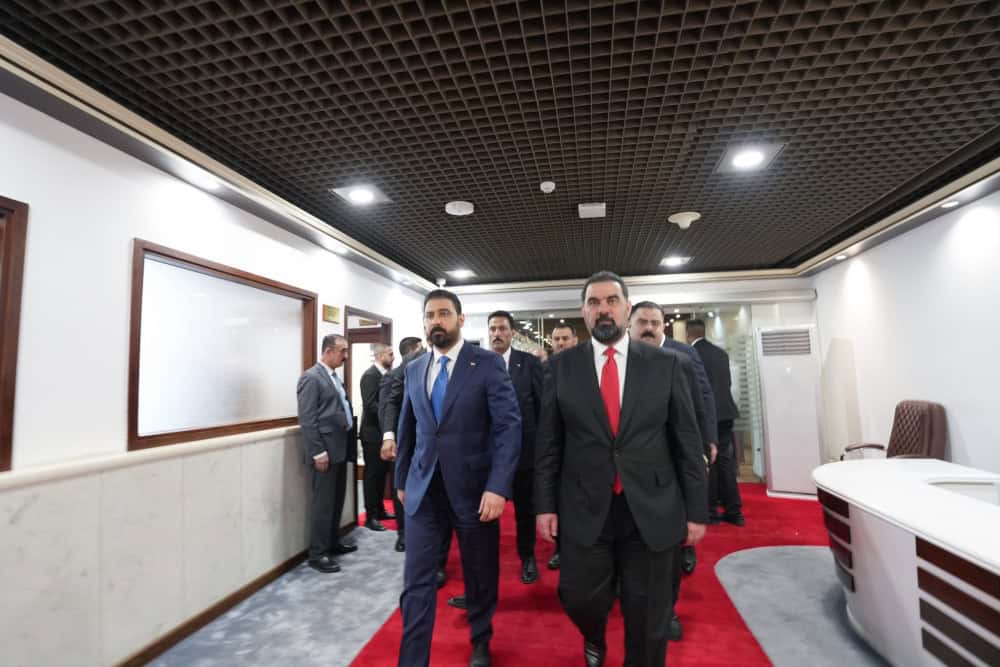
On May 14, Iraq’s parliament passed a vote of confidence in Prime Minister Ali al Zaidi’s government and approved 14 out of 23 ministers. Key ministries, including defense and interior, have not been approved. Zaidi was selected as the prime minister-designate on April 27 after being nominated by the Coordination Framework, a coalition of Iran-aligned Shiite political parties that constitutes the largest parliamentary bloc. Prior to Zaidi’s selection, the Framework had been unable to reach consensus on choosing a prime minister for over five months following the November 2025 election.
The ministers that were not approved in the vote included planning, higher education, interior, reconstruction and housing, and culture. Parliament did not vote on ministers of defense, labor, youth, and migration. Interior and defense, along with oil, finance, and foreign affairs, are the “sovereign” ministries—important centers of power in Iraq’s government. Reportedly, the remaining ministries will be voted on at the end of May after the Eid al Adha holiday.
Among the ministries yet to be determined, some appointments are sought by parties affiliated with Iran-backed militias. US President Donald Trump’s administration reportedly informed officials in Iraq that it would not engage with the government in Baghdad if it included affiliates of Iran-backed terror groups.
Sadiqoun, the political party affiliated with Asaib Ahl al Haq, an Iran-backed militia and US-designated Foreign Terrorist Organization (FTO), said on May 13 that it will decide on participation in Zaidi’s government after the issue of restricting arms to state control is addressed. This position was reportedly supported by Esmail Qaani, commander of Iran’s Islamic Revolutionary Guard Corps (IRGC), in his visit to Baghdad days before the vote of confidence.
Sadiqoun is a member of the Coordination Framework, while Asaib Ahl al Haq is a member of the Popular Mobilization Forces (PMF), an official Iraqi security institution comprised mostly of Iran-backed militias. Many of these militias and their supporters assent to the idea of state control of all arms but consider the PMF the vehicle to achieve this aim by bringing militias under state control via the organization. The United States considers state control of weapons to be a top priority for the next Iraqi government, but opposes using the PMF as the mechanism, since militias within it routinely conduct attacks outside of Iraqi government directives. Several of these militias carried out hundreds of attacks on the US presence and interests in Iraq, as well as neighboring countries, during the recent war with Iran.
Both Tom Barrack, the US ambassador to Turkey who also leads the Iraq portfolio, and Abbas Araghchi, Iran’s foreign minister, congratulated Ali al Zaidi on forming a government.
“President Trump, Secretary Rubio, and the United States stand ready to work closely with you and your government to advance our shared goals of prosperity for the Iraqi people and the elimination of terrorism, which is always an impediment to the people’s progress,” Barrack said.
“Expanding the friendly and fraternal relations between Tehran and Baghdad is always at the top of the priorities of our foreign policy,” Araghchi asserted.
Ministers confirmed by parliament
The new heads of the sovereign ministries include:
Minister of Finance Faleh al Sari: Sari was nominated by the Al Hikma Movement, which is part of the Coordination Framework. Sari pledged economic reforms, the protection of public sector workers’ entitlements, and to transition the Iraqi economy to digital payments, an effort that has been a US priority to counter Iran’s exploitation of Iraq’s cash-based economy.
Minister of Foreign Affairs Fuad Hussein: Hussein has served as Iraq’s foreign minister since 2020. He is a Kurdish politician and member of the Kurdistan Democratic Party (KDP), one of two major Kurdish parties in Iraq.
Minister of Oil Bassim Muhammad Khudair: Khudair was nominated by the Reconstruction and Development Coalition, a Shiite party led by outgoing Prime Minister Mohammad Shia al Sudani that is part of the Coordination Framework. He previously served as deputy minister for upstream affairs at the Oil Ministry and director general of the Iraqi Drilling Company and Iraq’s Oil Exploration Company. Citing multiple Iraqi and American contacts, Michael Knights, an Iraq expert and head of research at the intelligence platform Horizon Engage, described Khudair as “Iran’s key interlocutor.” Khudair is from Basra Governorate, a production and export hub for Iraq’s oil sector. He will have to confront significant challenges for Iraq’s oil sector from the closure of the Strait of Hormuz, through which 94% of Iraq’s oil is typically exported to the market.
The new heads of Iraq’s service ministries include:
Minister of Agriculture Abdul Rahim Jassim Muhammad al-Shammari: Shammari served as a member of parliament from Nineveh, his home governorate, held local and security positions, and led a Sunni tribal militia to fight the Islamic State in 2014.
Minister of Communications and Media Mustafa Jabbar Sand: Sand served as a member of parliament and is reportedly linked to the Iran-backed FTO Kataib Hezbollah. He was congratulated by the US-designated terrorist and militia leader Qais Khazali after being voted into the position. Sand has previously been involved in scandals over his aggressive language and public confrontations. Iran-backed militias are interested in the Iraqi communications sector as a revenue stream and for its access to data.
Minister of Education Abdul Karim Abtan: Abtan was nominated by Taqaddum, a Sunni party led by former Speaker of the Council of Representatives Mohamed al Halbousi. Abtan served as a member of parliament.
Minister of Electricity Ali Saad Wahib: Wahib previously worked in the energy sector and is the youngest member of the new cabinet.
Minister of Environment Sarwa Abdul Wahid: Wahid is a Kurdish politician and the only woman in Zaidi’s cabinet. She is from the Kurdish The New Generation Movement, which has positioned itself as an alternative to the two major Kurdish parties but received this ministry as part of an agreement with one of them, the Patriotic Union of Kurdistan (PUK).
Minister of Health Abdul Hussein Aziz Ahmed.
Minister of Industry Muhammad Nouri al Karbouli: Karbouli was nominated by Taqaddum. He is a prominent Sunni politician and previously served as governor of Anbar Governorate.
Minister of Justice Khalid Shwani: Shwani, from the Kurdish PUK, retained the position of justice minister after having served in that role under Sudani’s tenure as prime minister.
Minister of Trade Mustafa Nizar Jumaa: Jumaa was nominated by the Sunni Sovereignty party.
Minister of Transport Wahab Salman Muhammad: Muhammad was nominated by the Badr Organization, an Iran-aligned militia led by Hadi al Amiri. Badr is not designated as a terror group by the US, though the US has designated and sanctioned some Badr-linked figures and allied groups.
Minister of Water Resources and Marshes Muthanna Ali Mahdi: Mahdi was also nominated by the Badr Organization.