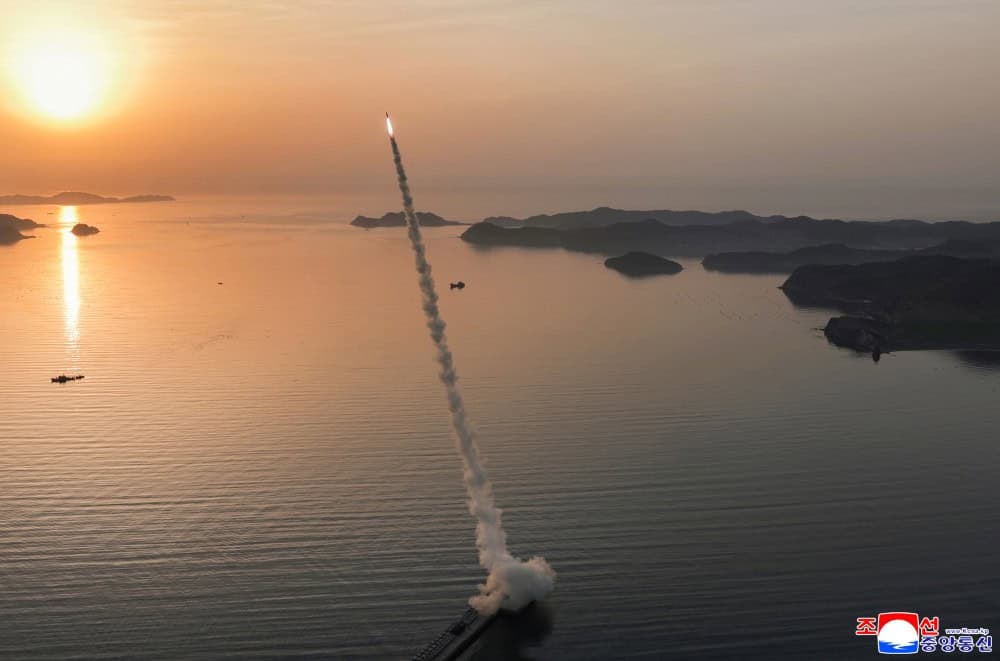
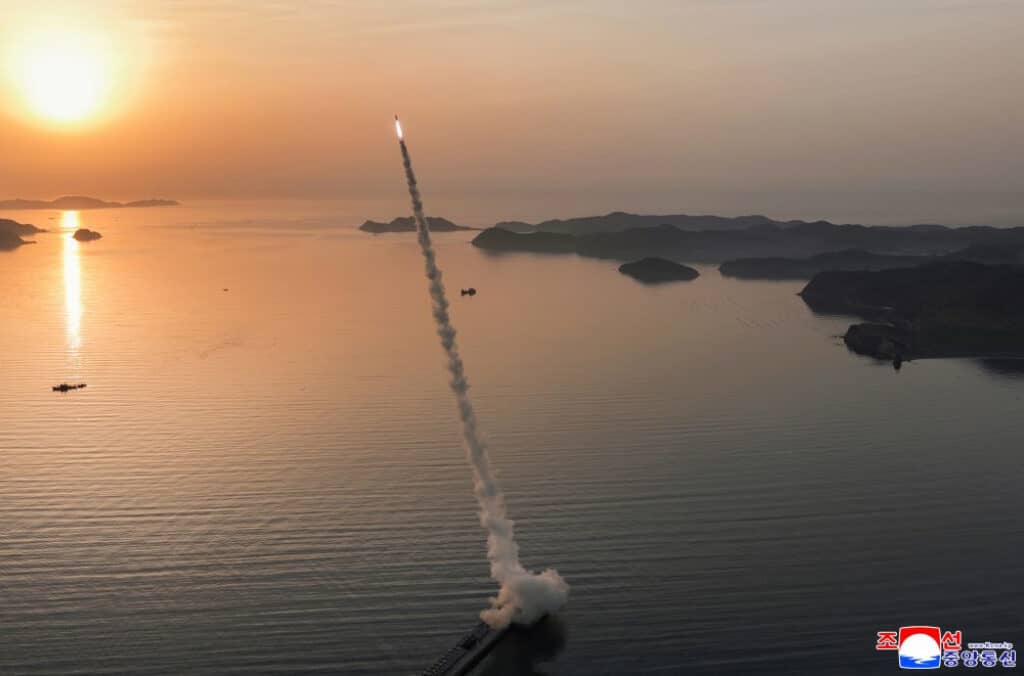
In a unique episode of father-daughter bonding, Kim Jong Un and his teenage daughter, Kim Ju Ae, observed a ballistic missile test on April 19 in which North Korea launched five missiles with cluster munition payloads at an island target in the Sea of Japan.
This was not an isolated incident, as Pyongyang has already tested more ballistic missiles in 2026 than it tested in all of 2025. At least one type of recently tested missile was previously transferred to Russia and improved in multiple ways before the knowledge of how to produce the upgraded missiles was reportedly sent back to North Korea. That security cooperation and other support from Russia are putting American and allied service members’ lives at greater risk.
A friend of the North
When Kim Jong Un inherited power in 2011, the stability of his rule was not guaranteed. However, in 2025, the US Defense Intelligence Agency assessed that Kim was “increasingly confident in his international political legitimacy and regime security.”
This is, in part, because Kim has rapidly built a security relationship with Vladimir Putin and bolstered relations with Xi Jinping. Prior to 2022, relations with Russia were tepid, despite a shared border. However, these dynamics have shifted in recent years. Since Russia’s 2022 invasion of Ukraine, security cooperation between North Korea and Russia has grown exponentially. This is one of the most underappreciated elements of security cooperation among China, Russia, Iran, and North Korea, as documented in a forthcoming book this summer on this “Axis of Aggressors” by FDD’s Bradley Bowman, Elaine Dezenski, and Rear Adm. (ret) Mark Montgomery. Beijing has sought to bolster ties with North Korea as a counterweight. These changes appear to have increased North Korea’s capabilities and its belligerence towards South Korea, Japan, and the United States.
North Korea’s recent launches follow a trend of increased missile tests since 2022, when Russia invaded Ukraine, and Pyongyang leaped at an opportunity to advance its geopolitical position. Beginning in late 2022, North Korea began sending artillery and rocket ammunition to Russia. These transfers increased over the next several years to include KN-23 short-range ballistic missiles (SRBMs), anti-tank guided missiles, artillery pieces, multiple launch rocket systems (MLRS), and tank ammunition. On top of this, thousands of North Korean soldiers helped augment Russian forces in Kursk starting in the autumn of 2024.
North Korean assistance was motivated by a desire to extract benefits from Russia. Over the course of the past three years, Moscow has provided Pyongyang with significant security assistance, including electronic warfare systems, air defense systems that have both land and maritime applications, satellite launch support, and, perhaps most concerningly, help with its missile program.
Russia began using North Korean KN-23 SRBMs against Ukraine in late 2023. Russia has since helped improve the survivability and accuracy of the KN-23, which Pyongyang armed with cluster munitions in an early April 2026 test. The missiles’ terminal maneuverability reportedly improved due to Russian modifications, making them more difficult to intercept. Russia also reportedly improved the KN-23’s accuracy from a circular error probable (CEP)—a measure of ballistic projectile accuracy that combines horizontal and vertical dispersion error—of 500-1,500 meters to 50-100 meters. This was a significant increase in the accuracy of the weapon system and could allow North Korea to engage in counterforce targeting with its missiles (targeting military forces) rather than countervalue targeting (targeting large civilian sites such as cities).
The increased accuracy, when combined with cluster munitions, increases the overall lethality of the system against certain targets. These types of payloads release multiple smaller submunitions rather than utilizing a unitary warhead. This makes them more effective at destroying soft targets over a larger area, albeit with the tradeoff of being less effective against hardened targets. Notably, Iran utilized cluster munitions delivered by ballistic missiles to penetrate Israeli and American missile defenses during the 2025 12-Day War and the more recent Operation Epic Fury.
North Korea’s flurry of missile tests
Since the start of 2026, North Korea has tested various missiles besides the KN-23, including other ballistic missiles, land attack cruise missiles (LACMs), and anti-ship cruise missiles (ASCMs). In total, Pyongyang has launched over 20 ballistic missiles and at least 16 cruise missiles in the past four months.
In January, North Korea launched at least four ballistic missiles from its west coast toward the Sea of Japan. Two ballistic missiles were launched on January 4 and landed outside of Japan’s exclusive economic zone, according to the Japanese Ministry of Defense (MOD). North Korea’s state-run news agency, KNCA, claimed that these were hypersonic missiles, and Japan’s MOD confirmed that these projectiles, at least, had irregular trajectories. The irregular trajectories indicate that North Korea could be making progress on developing maneuvering hypersonic weapons. A little over three weeks later, Kim oversaw a test of a large-caliber “multiple launch rocket systems,” likely the KN-25 SRBM, where at least two ballistic missiles were launched into the Sea of Japan.
Then, in the span of 10 days in March, North Korea launched 11 LACMs and at least 10 SRBMs. The 11 LACMs were all launched from the Choe Hyon (51), a 5,000-ton destroyer, in two different sets of tests, the first on March 4 and the second on March 10. These were important tests of critical weapon systems on the Choe Hyon (51) as it prepares for entry into the North Korean Navy’s battle force, and as Kim stresses the importance of building a strong navy. Four days later, on March 14, possibly related to the ongoing combined US-South Korea exercise Freedom Shield 26, Pyongyang launched at least 10 KN-25 SRBMs eastward into the Sea of Japan.
The flurry of missile tests did not stop there. Between April 6 and 8, the North Korean military tested electromagnetic weapon systems, mobile short-range anti-aircraft missile systems, and KN-23 SRBMs tipped with cluster munitions. While the exact number of missiles launched during the testing period was not specified by KNCA or US Indo-Pacific Command statements, the projectiles originated near Wonsan on North Korea’s northeastern coast. KNCA stated that the cluster munition-armed SRBMs could “reduce to ashes any target covering an area of 6.5-7 hectares [roughly 16-17 acres] with high-density power.”
April testing continued with the weapon systems verification and launch of two LACMs and three ASCMs from the Choe Hyon (51) on April 12. Kim personally observed these tests and, according to state-run media, was focused on checking the weapon command system and “confirming the accuracy and the rate of hits of the improved active anti-jamming navigation system.”
Five Hwasong-11D SRBMs tipped with cluster munition warheads and with a saturation area of 12.5-13 hectares (about 31-32 acres), were launched on April 19. These launches are significant because they demonstrate that North Korea is openly working to increase the lethality of the conventional payloads carried by its tactical missiles and not solely relying on its growing nuclear arsenal for deterrence.
The bottom line
North Korea’s increased rate of missile testing does not appear likely to stop. These tests include launches of the KN-23 SRBM, whose accuracy and survivability were enhanced by Russia. The cluster munition payloads tested by North Korea enhance the missile’s lethality against certain targets. The increased number of tests and types of capabilities being tested indicate that North Korea continues working to improve its long-range fires. North Korea’s relationship with Russia is enabling it to build capabilities that it would have been hard-pressed to achieve on such a rapid timeline in the absence of that support. This is a reminder that the Axis of Aggressors’ security cooperation is undermining American interests in the Pacific, not just in Europe and the Middle East.