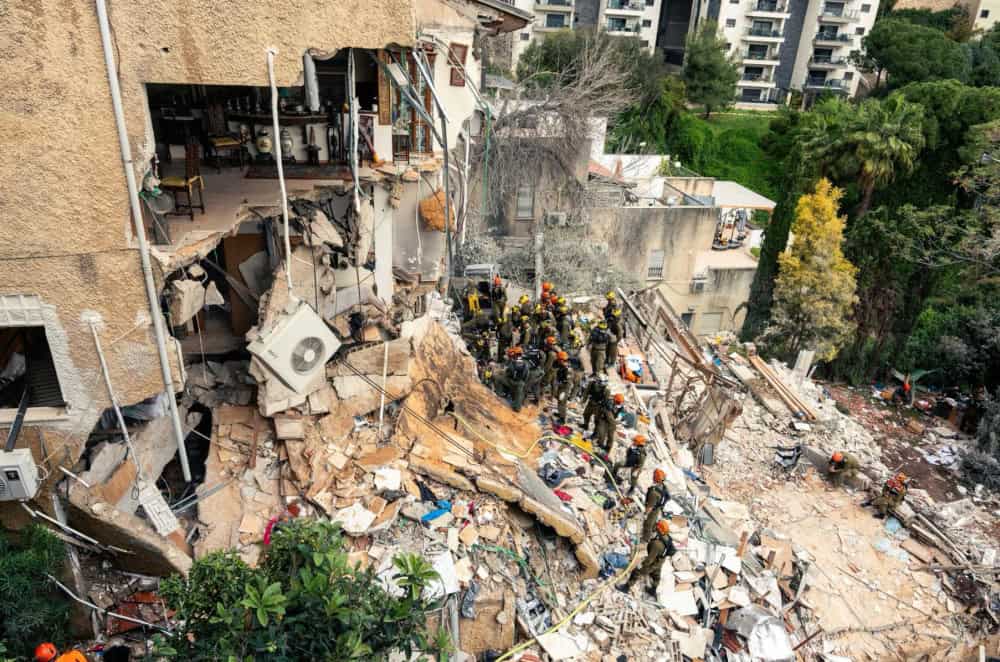
Iran’s increasing use of ballistic missiles containing cluster munitions has spread damage and harm across Israel. On April 6, as many as 50 sites were impacted by missiles and their cluster munitions.
“Iranian cluster munitions struck roughly 50 locations across central Israel, wounding at least six, including a seriously wounded woman in Petah Tikva and a moderately wounded man in Ramat Gan,” Haaretz reported. Iran has kept up its attacks on Israel every day since the US and Israel began airstrikes on Iran on February 28, 2026. Israel is also ramping up strikes on Iran, targeting infrastructure and other targets, and Israel is accelerating its production of Arrow missile interceptors to defend against attacks.
Iran has focused on using cluster munitions in its ballistic missile salvos since the first two weeks of the conflict. However, the proportion of these munitions has increased. By March 10, Israel’s Home Front Command said that 50 percent of the Iranian missiles contained cluster munitions. This has meant that although the number of missiles in each salvo may have decreased, the number of munitions falling on Israel has appeared to increase, according to reports of the number of impact sites in Israeli media. For security reasons, Israel does not release precise data on the quantity of missiles fired, how many of them are intercepted, or the number of impact sites.
On April 1, The Times of Israel reported that “12 missiles carrying conventional warheads with hundreds of kilograms of explosives […] struck populated areas in Israel, causing extensive damage. There have also been more than 30 incidents of missiles carrying cluster bomb warheads hitting populated areas, with over 200 separate impact sites.” A ballistic missile attack on April 4, which led to at least 10 impact sites, illustrated how large an area can be affected by one missile with cluster munitions. “Magen David Adom [Israel’s national emergency service] said teams were scanning multiple locations in Bnei Brak, Petah Tikva, Ramat Gan, Givatayim and Rosh HaAyin. Smoke was seen rising over parts of the Ramat Gan-Givatayim area, where at least one impact site was reported,” Ynet noted. This is an area of around 20 square miles.
Iran’s missile attacks have continued daily. On April 7, several areas in central Israel were affected by debris from an attack. On April 6, four members of one family were killed when a missile warhead struck their apartment building in Israel’s northern city of Haifa. “The warhead of the missile did not explode on impact, but the kinetic energy from the strike caused several floors of the building to collapse, burying the four victims under rubble. An Israeli Air Force probe found that the missile was not intercepted because the projectile broke up in the air,” The Times of Israel reported. On April 4, several cluster munitions struck Tel Aviv in an area near the IDF’s Kirya Headquarters. On April 1, 16 people were wounded in a cluster munition attack in Bnei Brak, near Tel Aviv.
Human Rights Watch has said that the cluster munition attacks are unlawful. “At least four civilians have been killed in the strikes, which violate the laws of war and may amount to war crimes,” the organization noted. Israel’s Foreign Ministry sent a letter to UNICEF on March 24, calling for the UN organization to condemn the missile attacks on Israel. “Iran is launching ballistic missiles armed with illegal cluster munitions, spreading indiscriminate harm—and children are among the victims,” the ministry said.
As the war continues, Israel’s Ministry of Defense says the country is accelerating the production of Arrow missile interceptors. Arrow is the top tier of Israel’s multi-layered air defense system, which includes David’s Sling, Iron Dome, and other systems. Arrow was jointly developed with the US Missile Defense Agency. The decision will enable “a significant increase in both the production rate and stockpile of Arrow interceptors,” the ministry said.
On April 3, the IDF said it had carried out 70 strikes on Iran over the last day. “Among the targeted infrastructure sites were launch sites storing ballistic missile launchers threatening the State of Israel, sites storing UAVs belonging to the Air Force of the IRGC [Islamic Revolutionary Guard Corps], and air defense system facilities,” the IDF said. The next day, the Israeli military said it had completed strikes aimed at damaging the Iranian regime’s “core systems and foundations.” Among the targets was an Iranian petrochemical complex near Mahshahr, Iran. This complex was involved in producing chemicals for weapons, the IDF said.
The IDF said that it had struck a mobile ballistic missile launcher on April 3. In addition, the IDF killed Mohammad Reza Ashrafi Kahi, who it said was a commander in the Islamic Revolutionary Guard Corps’ Oil Headquarters. In addition, the IRGC intelligence chief, Majid Khademi, was killed, according to an Israeli military statement on April 6.
On April 7, the IDF said that it was conducting a “wide-scale wave of strikes targeting dozens of infrastructure sites belonging to the Iranian terror regime in several areas across Iran,” according to a statement distributed by the Israeli military on WhatsApp. Among the targets of the campaign have been rail lines and bridges.