

-
Written by: Kelly Thompson
-
Art by: Hayden Sherman
-
Colors by: Jordie Bellaire
-
Letters by: Becca Carey
-
Cover art by: Hayden Sherman (cover A)
-
Cover price: $4.99
-
Release date: March 25, 2026
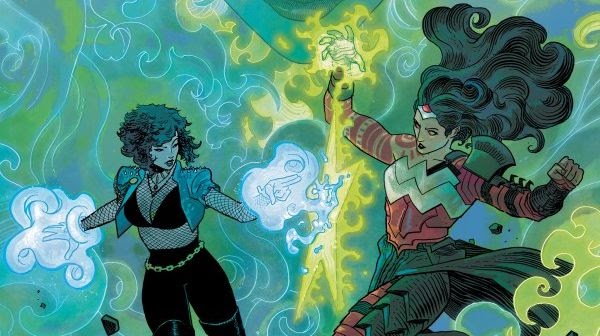
Absolute Wonder Woman #18 (DC Comics, 3/25/26): Writer Kelly Thompson and artist Hayden Sherman escalate Diana’s collison with Giovanni Zatara’s blood magic as she battles through reconciliation with Zatanna, frees enslaved beings, and invokes the Troika to meet a flame-wreathed demon witch determined to burn everything. The execution inspires with inventive ritual magic, raw emotional stakes, and Sherman’s kinetically precise inks that make every panel feel alive with consequence. Verdict: Worth reading.
First Impressions
The issue lands you in the smoking aftermath of Giovanni Zatara’s curse, Diana’s arm dissolved and her mind ablaze as the magical burn threatens to consume her entirely, and from that opening vulnerability you feel the weight of escalation that last issue only teased. Sherman’s jagged inks and Bellaire’s molten palette make the Hieron sanctuary feel less like refuge and more like a pressure chamber where Diana’s survival instinct wrestles with her conscience; every beat crackles with the tension of a warrior whose power draws her closer to the very magic that nearly consumed her. The moment Zatanna arrives to unbind Diana, Thompson pivots the tone sharply from physical survival into emotional negotiation, where a healer witch and a warrior princess have to find common ground despite past violence, and that shift from combat to conversation feels raw and necessary rather than a pause in momentum. Overall, the issue reads like a master class in escalation pacing, where action sequences, character reconciliation, and supernatural dread blend seamlessly into a package that leaves you desperate for the next chapter.
Recap
The previous issue threw Diana into a brutal museum ambush orchestrated by Area 41’s Sovereign and a mysterious witch using blood magic to burn Diana’s magical arm to ash. Zatanna, forced to attack but fighting her captors’ control, liberated herself through dark ritual and gave Diana her magic back, allowing Diana to battle Giganta, Cheetah, and Queen Ara’s minions across Gateway City while Sovereign deployed a more powerful weapon to the field. Giovanni Zatara, revealed as the skeletal witch fueling the chaos through blood sacrifice, killed the reverted Priscilla Rich and cursed Diana’s arm in a full-page finale that promised inferno in the next chapter.
Plot Analysis (SPOILERS)
Diana arrives at the Hieron sanctuary with Giovanni’s curse burning through her veins, and the Minotaur and Pegasus stand helpless as an unknown intruder enters the mystical refuge. That intruder is Zatanna, sent by the witch Cale to infiltrate and bind Diana, though Zatanna’s own conscience wars with the compulsion, forcing her to make a desperate gamble; she unbinds Diana’s voice rather than let Cale’s control force her to kill, choosing betrayal over murder. Diana’s reaction explodes into raw fury, the two witches clashing across the sanctuary with phasing magic and water prisons, Diana’s understanding of Zatanna’s sacrifice eventually cutting through her rage as she realizes the Raven-haired mage was fighting both her captor and the princess she was supposed to destroy. Thompson gives the reconciliation room to breathe through honest dialogue where Zatanna explains Cale’s dominion over her and the witches she commands, and Diana’s decision to trust Zatanna despite withheld aid becomes the emotional backbone that transforms a fight sequence into a relationship reset.
From the Hieron, Diana rides Pegasus into the city to confront Giovanni Zatara, but first she finds Queen Ara, a fish-like being enslaved by Cale’s magic, and frees her through ritual, learning that Giganta won’t abandon her master and that Zatara might be beyond salvation. Diana then discovers the flaming skeletal witch towering over the city, Giovanni’s grief and rage weaponized through blood sacrifice into a creature of pure destructive intent, and she meets his flame with invocation; calling upon the Troika, a trinity of mythic powers binding Scylla’s predatory hunger, Cerberus’s three-headed rage, and Styx’s sacred oath, Diana transforms herself into a magical vessel of ancient authority that promises to break Giovanni’s secrets and shatter his power. The issue closes on that moment of divine transformation, Diana standing before the demon-witch with her lasso blazing and the promise of real battle ahead.
Writing
Thompson crafts escalation through emotional logic rather than spectacle alone, moving Diana from physical crisis through character reckoning to mythic confrontation without sacrificing authenticity at any gear shift. The dialogue between Diana and Zatanna feels earned because it strips away performative heroics and settles into vulnerability; Zatanna’s profane exasperation about not finding a better solution lands harder than many scripted apologies because it captures the friction of two people trying to build trust after combat. The structure holds three distinct movements cleanly: reconciliation at the Hieron, mercy-based liberation in the city streets, and ritual preparation for battle, each beat serving both plot and character development simultaneously. Thompson’s pacing respects quiet moments, giving Diana space to grieve Priscilla Rich’s death and mourn the weight of choices no hero should have to make, which deepens the final summoning because it doesn’t feel like victory posturing but rather a warrior accepting transformation as the price of opposition. The dialogue authentically captures witch-speak through backward incantations and ritual language while keeping Diana’s internal voice grounded in tactical assessment and wry observation, creating a contrast that sells her as bridge between worlds.
Art
Sherman’s layouts perform the heavy lifting of tonal modulation through panel scaling and spatial relationships; the intimate conversation between Diana and Zatanna uses tight framing and profile shots that keep focus on faces and micro-expressions while the final summoning explodes across a full page to establish the Troika’s mythic scale. His inking style uses sharp, deliberate lines for magic effects (Zatanna’s phasing spell, the water prison, ritual circles) that contrast against softer, more organic line work for Diana’s armor and physical presence, ensuring magical threat reads as distinct from martial skill. The kinetic energy Sherman brings to Diana’s movement through city streets, vaulting between rooftops and Pegasus-back, makes geographic progression feel visceral rather than transitional; every jump or flight moment includes dynamic angles and follow-through that communicate speed and purpose.
Bellaire’s color palette does the emotional heavy lifting by shifting with Diana’s internal state; the Hieron sanctuary uses cool silvers and deep purples to establish sanctuary violated, while the city sequences layer in amber streetlights that warm Diana’s armor against the dying day, creating a sense of approaching nightfall and finality. Giovanni’s flaming form radiates molten orange and sickly yellow-green that Bellaire pulls back from to create jagged heat distortion, making the skeletal witch feel like a wound in reality rather than a contained figure. The final summoning panel bathes Diana in luminous greens and ethereal blues as the Troika channels through her, visually communicating her transformation from individual warrior into conduit for ancient power; Bellaire pulls the palette almost monochromatic in that moment, draining naturalism to emphasize the supernatural stakes at play. For now, at least, Bellaire’s unfortunate fascination with muddy browns and drab reds is on hiatus.
Character Development
Diana’s arc in this issue centers on learning to love complexity; she enters furious at Zatanna’s betrayal but recognizes quickly that coercion created the attack, and her decision to offer trust without demanding proof first demonstrates character growth from earlier encounters where suspicion dominated her judgment. Her willingness to free Ara and Giganta (or attempt to) despite their association with her enemies shows consistent heroic principle without naive optimism, and her grief over Priscilla Rich’s death grounds Diana as someone haunted by collateral damage in ways many superhero narratives gloss over. Zatanna develops from the previous issue’s desperation into someone burdened by impossible choices, her profane honesty about not finding better solutions making her more credible than manufactured redemption arcs; she owns her role in the attack while refusing to become Diana’s surrogate, asserting boundaries that feel psychologically authentic. Giovanni operates as grief-weaponized, his rage at his murdered daughter transforming him from person into instrument of vengeance, and while his motivations remain largely opaque, the willingness to kill his own people for power escalation marks him as someone whose pain has metastasized into pure destruction.
Originality and Concept Execution
The Troika invocation delivers on the “Season of the Witch” premise by showing Diana’s magical education as cumulative; she’s been gathering pieces of ancient power throughout this arc (names, rituals, relationships with goddesses), and the summoning feels earned through months of character work rather than sudden power revelation. Thompson avoids typical superhero power-up tropes by making the Troika a transformation rather than a temporary buff; Diana becomes something other than human in that moment, trading individuality for channeled authority, which raises stakes thematically because victory through the Troika might come at the cost of Diana’s selfhood. The concept of blood magic as ritual horror rather than flashy effect separates this witch war from standard magical superhero fare; Giovanni’s willingness to sacrifice people for power escalation creates a darker ethical landscape where Diana’s refusal to match that cruelty becomes the central conflict rather than simple good-versus-evil combat.
Pros and Cons
What We Loved
- Zatanna’s unbinding-through-self-naming ritual inverts captivity tropes with visceral, emotionally earned magic mechanics that feel foreign and dangerous even when beneficial.
- Diana’s mercy-based approach to liberation (freeing Ara, attempting Giganta’s salvation) demonstrates consistent protector ethics without sacrificing tactical awareness or emotional burden.
- Sherman’s kinetic layouts and Bellaire’s transformative color work make the Hieron-to-city-to-ritual progression feel like a visual escalation that heightens emotional weight alongside plot momentum.
Room for Improvement
- Giovanni’s motivations remain frustratingly opaque; the emotional through-line from grief to mass murder needs concrete anchoring beyond abstract rage and bloodlust.
- The transition from city sequences to the final summoning compresses Diana’s discovery of Giovanni into a few panels, undercutting the confrontation’s narrative weight.
- Zatanna’s promise to save her father creates emotional stakes that remain unresolved, leaving readers uncertain whether that parallel story will interfere with or complicate Diana’s battle focus going forward.
The Scorecard
Writing Quality (Clarity & Pacing): 3.5/4
Art Quality (Execution & Synergy): 3.5/4
Value (Originality & Entertainment): 1.5/2
Final Verdict
Absolute Wonder Woman #18 expands the witch war into genuinely mythic territory, balancing intimate character negotiation with apocalyptic ritual stakes in a way that respects both Diana’s growth and the legitimate cost of opposing entrenched magical corruption. The issue delivers exactly what Season of the Witch promises: witches burning brighter, rituals carrying weight, and Diana becoming something more dangerous and less certain of herself in the process. For readers tracking this arc, the emotional beats and magical escalation justify the investment fully; casual observers will find plenty to grab them, though the relationship work might require backtracking to earlier issues for full resonance.
8.5/10
We hope you found this article interesting. Come back for more reviews, previews, and opinions on comics, and don’t forget to follow us on social media:
Connect With Us Here: Weird Science DC Comics / Weird Science Marvel Comics
If you’re interested in this creator’s works, remember to let your Local Comic Shop know to find more of their work for you. They would appreciate the call, and so would we.
Click here to find your Local Comic Shop: www.ComicShopLocator.com
As an Amazon Associate, we earn revenue from qualifying purchases to help fund this site. Links to Blu-Rays, DVDs, Books, Movies, and more contained in this article are affiliate links. Please consider purchasing if you find something interesting, and thank you for your support.