
Brigadier General Kevin Lambert took over as the new commander of the anti-Islamic State coalition of Combined Joint Task Force-Operation Inherent Resolve (CJTF-OIR) in a ceremony in Iraq on July 21. Lambert assumes the role at a complex time and will likely oversee significant changes and challenges to the mission in Syria and Iraq over the next year.
US Central Command head General Michael Erik Kurilla attended the handover ceremony. The outgoing commander, Major General Kevin Leahy, had assumed command of the mission in August 2024. Commanders of CJTF-OIR serve for a year, so the transfer to Lambert was expected. “Maj. Gen. Leahy was the 11th commander of CJTF-OIR since the task force was formed in 2014 to reclaim land stolen by ISIS in Iraq and Syria, dismantle the group’s network, and protect the population from its violence and influence,” the US military noted.
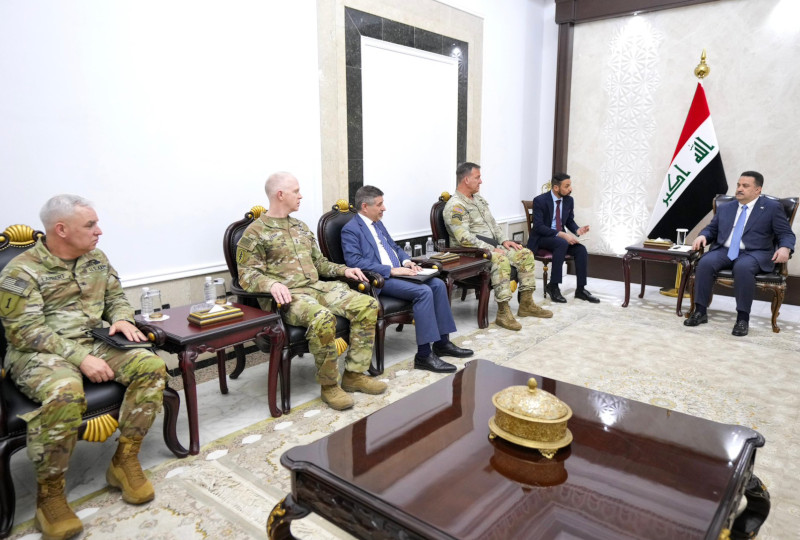
The office of Iraqi Prime Minister Shia al Sudani announced meeting with the new US commander on the same day of the handover, underscoring the importance that the US-led mission continues to hold for Iraq’s leadership. On July 21, Sudani received Kurilla, Leahy, and Lambert at his office, along with US Chargé d’Affaires Steven Fagin. “The meeting included a review of cooperation between Iraq and the International Coalition, its various phases of development, and preparations for transitioning to bilateral security relations with coalition member states,” the Iraqi Prime Minister Media Office stated. Sudani also discussed developments in Syria and their implications for regional security.
The US has forces in Syria and Iraq as part of the campaign against the Islamic State (IS). In Iraq, the US partners with the Iraqi Army as well as the Peshmerga security forces of the autonomous Kurdistan Regional Government. In Syria, the US partners with the Syrian Democratic Forces (SDF) in eastern Syria and also maintains a small garrison at Tanf in southern Syria.
Sudani “stressed the importance of maintaining stability, avoiding triggers that could escalate conflicts, and upholding the sovereignty of states.” He also emphasized the importance of diplomacy, a declaration that comes a month after the US supported a Qatar-backed ceasefire that suspended the 12-Day War between Israel and Iran, which included one round of US airstrikes on Iran. The conflict affected Iraqi airspace, forcing commercial flights to divert. In addition, drone attacks began in Iraq on June 24 in the wake of the war and have continued over the last month. The US and UK, as well as the Kurdistan Regional Government (KRG), have called for the drone attacks, which have targeted radar sites and energy facilities, to be investigated. Many analysts believe that Iraq’s Iran-backed militias are behind the attacks, and the KRG has explicitly placed the blame on them.
During the July 21 handover ceremony at Union III base in Baghdad’s Green Zone, Leahy noted that CJTF-OIR is “a coalition, which includes Iraq, that’s significantly diminished the ability of ISIS to conduct operations in Iraq and Syria, or export violence around the region and the world.” Leahy said that the enduring defeat of the Islamic State continues to require perseverance.
“I look forward to strengthening our partnerships as we maintain pressure on defeating Daesh in Iraq and Syria,” Lambert added. “The U.S.-led coalition continues its mission to build, maintain, and sustain counterterrorism partner capacity to repress ISIS remnants in Syria and Iraq,” a US military statement about the handover noted.
Lambert will oversee significant potential changes to the mission in Syria and Iraq. In Syria, the US has withdrawn from several posts in the last six months. It has been re-deploying and consolidating forces in the wake of the fall of the Bashar al Assad regime and a deal announced in March between the SDF and the new transitional government in Damascus.
Although CJTF-OIR does not specify the precise posts the US continues to use in Syria, Turkey’s Anadolu Agency reported in June that “the US is restructuring its military presence in northeastern Syria by reducing troop levels and shuttering multiple bases, scaling down from eight to three installations, with plans to consolidate operations at a single base in the future.” The report also claimed that the US continues to operate at Omar oil field near the Euphrates River, as well as near Shaddadi and Qasrek, which is northwest of Hasakah.
The US has backed and facilitated the SDF’s outreach to the Damascus government. However, recent clashes in Suwayda Governorate between pro-government forces and Syria’s Druze minority may delay the planned SDF integration into the new Syrian security forces.
In late 2024, an estimated 2,000 US personnel were present in Syria. There have also been limited numbers of French and British forces in the country operating with CJTF-OIR, but it is unclear how many remain. In April, French Army Brigadier General Olivier Celo, the director of civil affairs for CJTF-OIR, went to Tanf to meet with Syrian Free Army (SFA) commander Colonel Abu Turki. The SFA unit in Tanf, which was backed and trained by the US-led coalition for more than half a decade, recently became part of the new Syrian army’s 70th Division. The group’s last public operation as the SFA was in late April.
In Iraq, the US has maintained an estimated 2,500 troops over the last year. They are deployed at Union III, Al Assad Airbase, and several posts in the Kurdistan region. In 2024, the Pentagon announced that coalition forces were entering a new phase that would involve withdrawing from locations in Iraq and conclude by September 2025. In mid-July, Estonia became the latest country to withdraw its forces from a role in CJTF-OIR in Iraq.
It is unclear whether the September timeline will be met. The US-backed “train and equip” program for Iraq appears likely to continue. However, the final details on funding for that program and others in Iraq and Syria will need to wait until the 2026 National Defense Authorization Act is passed. In the Kurdistan region, the new CJTF-OIR commander will continue to work with the Kurdish Peshmerga as they work towards reform and unification of their units.
Lambert, a 1993 University of North Georgia graduate, previously served as the deputy commanding general of maneuver for the US Army’s 3rd Infantry Division based in Fort Stewart, Georgia, as well as the V Corps deputy commanding general of support from July 2023 to May 2024. He has been deployed to Haiti, Kosovo, Iraq, and Afghanistan and worked with the Saudi Arabian National Guard, according to a US military biography. Lambert recently served as the commanding general of the US Army Security Force Assistance Command, where he was involved in exercises with the 3rd Security Force Assistance Brigade, a unit that has played a key role in advising the Peshmerga in northern Iraq.